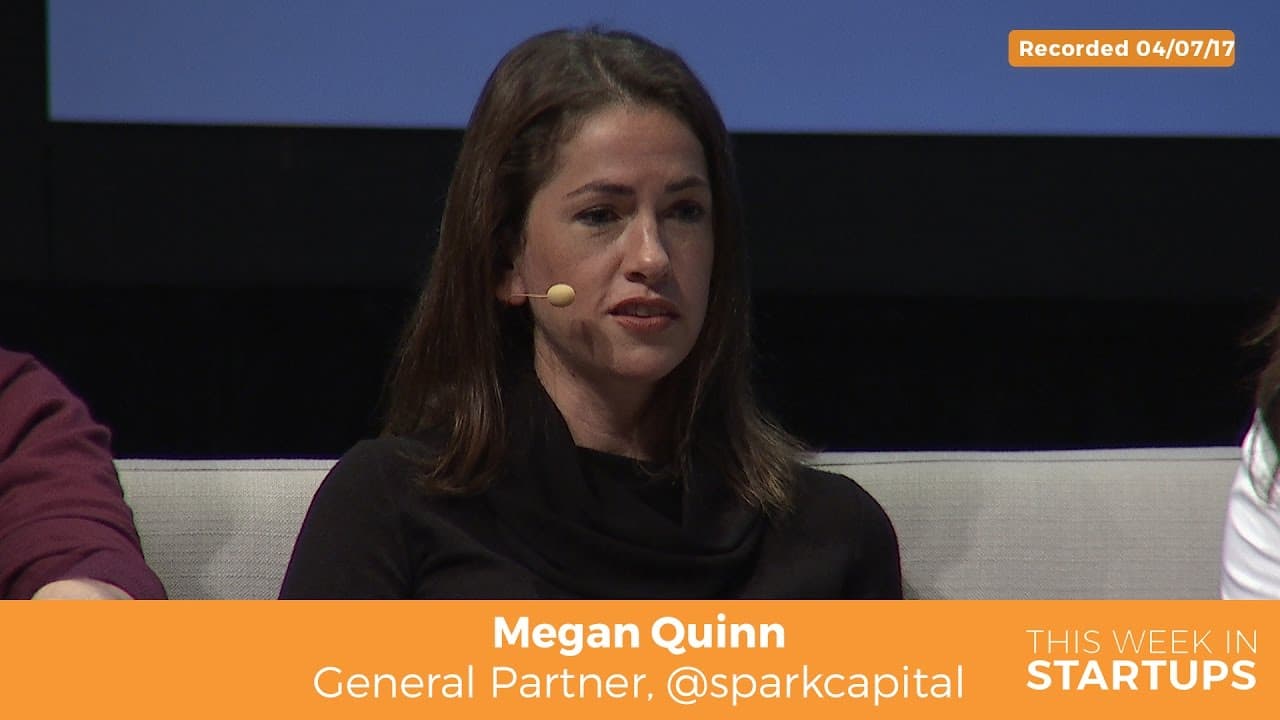
Megan Quinn of Spark Capital on VC funding myth & why equity crowdfunding is a great trend
TL;DR
Equity crowdfunding is a valuable trend because it gives companies that do not fit the traditional venture-capital model another way to raise money. Megan Quinn argues that venture capital, with its ownership and exit requirements, is unsuitable for the majority of companies, while distributed equity vehicles, small amounts of capital, and small-business loans offer alternatives. She also explains why investor time, advice, and mentorship matter, making the full discussion useful for founders evaluating funding options.
Transcript
I currently very supportive of it I think it's a great interesting trend mostly because I think that we've created this myth that venture capital is the right funding vehicle for all starts all sorts of companies that want to get going and I think that that's totally incorrect and I think if you can do small amounts of capital throughs distributed ... Read More
Key Insights
- 🗯️ Venture capital is not the right funding structure for all startups, and crowdfunding offers an alternative.
- 🚙 Distributed equity vehicles like crowdfunding provide smaller amounts of capital to startups.
- ❓ When assessing investors or syndicates, consider their contribution beyond monetary investments.
- 🔠 Startups that don't fit traditional venture capital requirements can benefit from alternative funding sources.
- ❓ Crowdfunding can provide mentorship and advice to early-stage startups.
- 🔇 The Casper mattress, a product unrelated to the content, is highly recommended by the speaker.
- 🎚️ Casper mattresses combine memory foam with an ideal level of support and bounce.
Install to Summarize YouTube Videos and Get Transcripts
Explore YouTube Video Summarizer or Get YouTube Transcript Extractor
Questions & Answers
Q: Why does Megan Quinn think equity crowdfunding is a great trend?
Quinn says equity crowdfunding opens another avenue of capital for people starting companies that do not fit the venture-capital model. It can provide small amounts of capital through distributed equity rather than imposing traditional venture-capital ownership and exit requirements.
Q: Is venture capital the right funding vehicle for every startup?
No. Quinn calls that belief a myth and says traditional venture capital is not the right funding structure for the majority of companies.
Q: Why might traditional venture capital be unsuitable for a company?
Traditional venture capital comes with traditional ownership and exit requirements. Companies that do not fit those requirements may be better served by another source of capital.
Q: What funding alternatives to traditional venture capital does Megan Quinn mention?
She mentions crowdfunding and other distributed equity vehicles that provide small amounts of capital. She also identifies small-business loans as another option.
Q: Do angel syndicates on venture deals concern Megan Quinn?
Their presence does not automatically make Quinn cringe. She instead wants to know which members contributed meaningful time and impact beyond the dollars invested.
Q: What should founders consider besides how much money an investor provides?
Founders should consider who invested time, acted as an advisor, and made a meaningful impact. Quinn treats those contributions as important signs that a company received useful support during its development.
Q: Why is mentorship especially important in a company's early stages?
Quinn says advice and mentorship can be instrumental during the early stages of company formation. If an entrepreneur cannot identify anyone in a syndicate who provided that support, she finds it concerning.
Q: What does it mean if no syndicate member provided meaningful advice or mentorship?
Quinn says it may mean the company effectively skipped a round of development as a company, though not necessarily as a business. The concern is that it missed guidance that could have been particularly valuable early in its formation.
Summary & Key Takeaways
-
Crowdfunding and other distributed equity vehicles offer small amounts of capital and are a great alternative to traditional venture capital for startups.
-
Traditional venture capital may not be the right funding structure for the majority of companies, and crowdfunding opens up another avenue of capital for startups.
-
When evaluating syndicates or investors, it is important to consider not only the monetary investment but also their time, advice, and mentorship.
Read in Other Languages (beta)
Share This Summary 📚
Summarize YouTube Videos and Get Video Transcripts with 1-Click
Try YouTube Summary with ChatGPT & Claude or YouTube Transcript Generator
Explore More Summaries from This Week in Startups 📚





Summarize YouTube Videos and Get Video Transcripts with 1-Click
Try YouTube Summary with ChatGPT & Claude or YouTube Transcript Generator