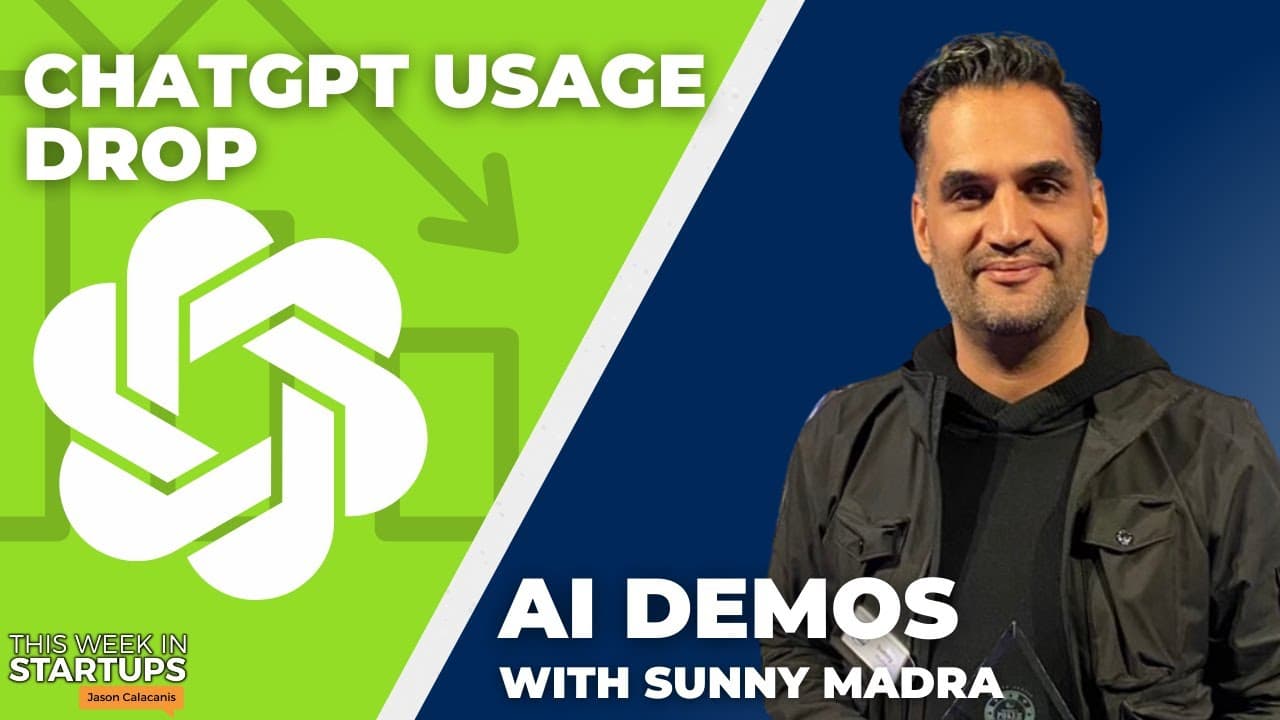
Threads, ChatGPT usage drops, and AI demos with Sunny Madra | E1774
TL;DR
OpenAI's shift from open to closed AI mirrors Facebook's approach with Threads, a copycat version of Twitter. Auto GPT shows promise in automating tasks and data analysis.
Transcript
the best way I heard it uh explained to me was when you're behind you open source when you're ahead you're closed and if you look at say um Windows they had a monopoly on the desktop closed they don't need to be open source um but then you look at Google very far behind they have a monopoly on search so when they talk about search their algorithm f... Read More
Key Insights
- 😚 OpenAI and Facebook follow different strategies based on their position in the market, with OpenAI becoming closed AI and Facebook creating a copycat product like Threads.
- 🚗 Auto GPT offers the potential to automate tasks and data analysis, improving efficiency and decision-making.
- 👤 The success of a clone product depends on offering unique features and addressing different user needs.
- ℹ️ The demand for open source and closed source AI depends on factors such as the stage of development and the need for protection or monetization.
Install to Summarize YouTube Videos and Get Transcripts
Explore YouTube Video Summarizer or Get YouTube Transcript Extractor
Questions & Answers
Q: Why did OpenAI become closed AI?
OpenAI adopted a closed AI strategy as it gained a lead in the industry. This allowed them to protect and monetize their technology.
Q: How does Facebook's Threads differ from Twitter?
Threads targets a different audience, with a focus on curated visual content rather than the fast-paced, text-centric nature of Twitter.
Q: What is Auto GPT's potential application?
Auto GPT can automate tasks such as finding new startups, analyzing data, and generating schedules. It has the potential to enhance productivity and decision-making processes.
Q: Can Auto GPT be used for personalized data analysis?
Yes, Auto GPT can be trained and customized to perform specific data analysis tasks based on user requirements. It can help in extracting valuable insights from large datasets.
Summary
In this video, the hosts discuss the concept of open source and closed source in relation to different companies and industries. They also explore the recent decline in AI usage, particularly in the education sector. Additionally, they showcase two AI tools: Venturus AI, which helps analyze business ideas, and Chat HN, which provides a chat interface for Hacker News.
Questions & Answers
Q: Can you explain the concept of open source and closed source in relation to different companies?
The concept of open source refers to making the source code of a software or product freely available to the public, allowing anyone to view, modify, and distribute it. Closed source, on the other hand, refers to keeping the source code proprietary, limiting access to it. Companies often choose between open source and closed source depending on their competitive position and market dominance. For example, Windows had a monopoly on the desktop and therefore remained closed source, while Google, far behind in the search market, initially kept its search algorithm closed but opted for open source with Android to increase its market presence.
Q: How does Facebook use closed source in relation to their graphs and other features?
Facebook started as an open platform, allowing companies like Zynga to build on its graph. However, as Facebook became a dominant player in the social media industry, it closed its graph, restricting access and making it difficult for competitors to compete. This move to closed source allowed Facebook to maintain its lead and control over the market.
Q: How did OpenAI become closed AI?
OpenAI, initially committed to openness and sharing research, evolved into closed AI over time. As they developed advanced AI capabilities, they realized the need to protect proprietary technology and transitioned towards closed source to maintain their competitive advantage. This shift mirrors the actions of other companies that have achieved market dominance and closed off their technologies from competition.
Q: What is the recent decline in AI usage attributed to?
The decline in AI usage, particularly in education, can be attributed to various factors. One significant factor is the impact of COVID-19, which caused disruptions in education systems worldwide, leading to reduced access to resources and changes in learning environments. Additionally, the absence of in-person teaching and collaborative learning could have hindered the integration of AI technologies in classrooms.
Q: Can you explain the concept of Venturus AI and how it analyzes business ideas?
Venturus AI is a platform that offers comprehensive training programs for individuals aspiring to become venture capitalists. By providing participants with the necessary knowledge, skills, and practical experience, the school aims to bridge the gap in skilled venture capitalists. The platform offers various training programs tailored to specific industry gaps and features strong industry partnerships for internships and job placements. Through extensive analysis and feedback, Venturus AI assists users in creating a solid business framework for their ideas.
Q: How does Chat HN use AI to provide a chat interface for Hacker News?
Chat HN leverages AI technology, specifically language models, to interact with users and generate responses based on prompts. The platform retrieves information from Hacker News and presents it in a chat format, making it easier for users to access and engage with the content. By providing a conversational interface, Chat HN enhances the user experience and allows for more efficient browsing and information retrieval.
Q: How can AI tools like Venturus AI and Chat HN enhance business processes?
AI tools like Venturus AI can enhance business processes by providing comprehensive analysis and feedback on business ideas. They offer valuable insights into market demand, competition, and potential strategies, helping entrepreneurs make informed decisions and refine their business plans. Similarly, tools like Chat HN simplify information retrieval and browsing, making it more efficient for users to access relevant content and stay up-to-date with industry trends, ultimately improving productivity and knowledge acquisition.
Q: What potential job roles can be replaced or enhanced by AI tools like Chat HN and Venturus AI?
AI tools like Chat HN and Venturus AI can replace or enhance job roles that involve data analysis, research, and processing. Specifically, analysts and researchers who spend significant time searching for and summarizing information could be augmented or replaced by AI tools that can perform these tasks efficiently. Similarly, data formatting and structuring tasks can be automated, reducing the need for manual data processing. However, these tools are more likely to enhance existing job roles rather than completely replace them, allowing professionals to focus on higher-level decision-making and strategy.
Q: How can AI tools improve the efficiency of data analysis and research?
AI tools like Chat HN and Venturus AI can improve the efficiency of data analysis and research by automating time-consuming tasks. They can gather relevant information, perform analysis, and generate insights at a faster pace than human analysts, allowing businesses to make more informed decisions in a timely manner. Additionally, these tools can assist in data structuring and formatting, making it easier to organize and access information, which further streamlines the research process.
Q: What are some potential limitations or challenges of using AI tools in business applications?
Despite their benefits, AI tools in business applications can face limitations and challenges. One limitation is the reliance on accurate and reliable data. If the underlying data is flawed or incomplete, the insights generated by AI tools may be inaccurate or misleading. Additionally, AI tools may struggle with interpreting complex or ambiguous information, leading to potential mistakes in analysis or recommendations. Lastly, the ethical considerations surrounding the use of AI, such as data privacy and algorithmic biases, require careful attention to ensure responsible and fair usage.
Q: How can businesses leverage AI tools to gain a competitive advantage?
Businesses can leverage AI tools to gain a competitive advantage by utilizing the efficiency and accuracy these tools offer. By automating repetitive tasks, businesses can free up time for employees to focus on higher-value activities, such as strategic planning and innovation. Furthermore, the insights generated by AI tools can provide a deeper understanding of the market, customer behavior, and industry trends, enabling businesses to make data-driven decisions and stay ahead of the competition.
Takeaways
The video discusses the concept of open source and closed source in relation to different companies and industries. It highlights how companies decide between open source and closed source based on their competitive position and market dominance. The decline in AI usage, particularly in the education sector, is attributed to various factors such as the COVID-19 pandemic. The AI tools, Venturus AI and Chat HN, are showcased as valuable tools that can enhance business processes by providing analysis, feedback, and a chat interface for information retrieval. These tools have the potential to augment job roles and improve efficiency in data analysis and research. However, limitations such as data quality, interpretation challenges, and ethical considerations should be carefully addressed. Overall, leveraging AI tools can enable businesses to gain a competitive advantage by automating tasks and making data-driven decisions.
Summary & Key Takeaways
-
OpenAI was open source when it was catching up, but became closed AI once it gained an advantage. Facebook's Threads is a copycat version of Twitter, targeting a different audience.
-
Auto GPT, using language models and APIs, shows potential in automating tasks such as gathering information on startups or creating schedules.
Read in Other Languages (beta)
Share This Summary 📚
Summarize YouTube Videos and Get Video Transcripts with 1-Click
Try YouTube Summary with ChatGPT & Claude or YouTube Transcript Generator
Explore More Summaries from This Week in Startups 📚






Summarize YouTube Videos and Get Video Transcripts with 1-Click
Try YouTube Summary with ChatGPT & Claude or YouTube Transcript Generator