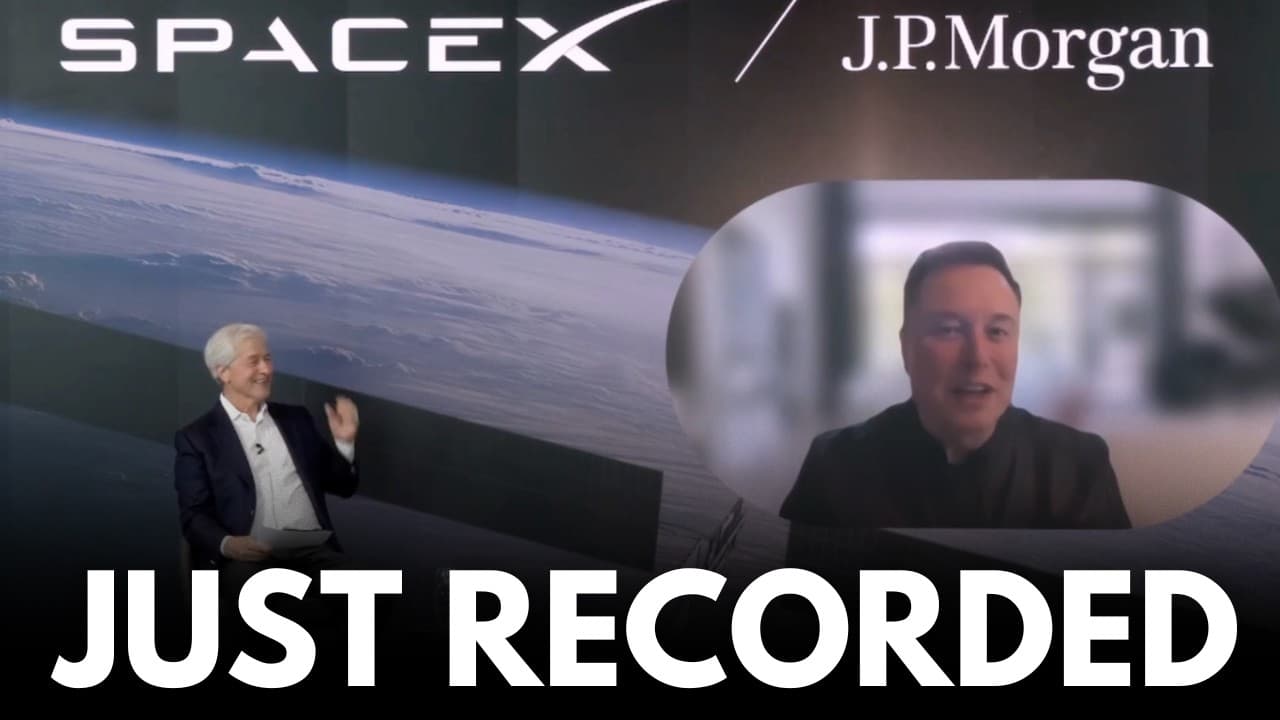
Why Is SpaceX Going Public Now?
TL;DR
SpaceX is going public to fund a significant growth phase, including the launch of over 100,000 satellites for communication and the development of AI data centers in space. This move is driven by the need for increased bandwidth to support AI and robotics, as well as the potential to harness solar energy on a massive scale.
Transcript
Elon, welcome to JP Morgan's headquarters. You're on the 51st floor, which is about the equivalent of the nowhere near where you go generally in space, but as high as we can get in New York City. But before we get started with you and Jamie, we had a very special guest that wanted to welcome you here this afternoon. And and so your mother, May Musk... Read More
Key Insights
- SpaceX is embarking on a significant growth phase requiring substantial capital, including launching over 100,000 satellites.
- Version 3 Starlink satellites are 10 to 20 times more capable than previous versions, offering 100 times more bandwidth.
- AI and robotics will demand vastly more bandwidth, with human peak bandwidth being only a few hundred bits per second.
- SpaceX plans to build AI data centers in space, which could become the primary means of AI expansion.
- Harnessing solar power in space could increase energy generation far beyond Earth's current capacity.
- Elon Musk envisions a future where humanity becomes a multi-planetary species, starting with moon bases and Mars colonization.
- Starship is the first fully reusable orbital rocket, significantly reducing the cost of access to space.
- SpaceX's AI strategy includes offering flexible hardware and software options for AI satellites, allowing various GPUs and TPUs.
Install to Summarize YouTube Videos and Get Transcripts
Explore YouTube Video Summarizer or Get YouTube Transcript Extractor
Questions & Answers
Q: Why is SpaceX going public now?
SpaceX is going public to fund a significant growth phase, including the deployment of over 100,000 satellites and the development of AI data centers in space. This expansion aims to increase bandwidth capacity to meet the demands of AI and robotics, and to harness solar energy on a massive scale.
Q: What advancements do Version 3 Starlink satellites offer?
Version 3 Starlink satellites are 10 to 20 times more capable than previous versions, offering 100 times more bandwidth. They are equipped with advanced phase array antennas, more ground links, and enhanced laser communication capabilities, making them a key component in SpaceX's strategy to provide high-bandwidth, low-latency communication.
Q: How does SpaceX plan to harness solar energy in space?
SpaceX plans to harness solar energy in space by deploying AI data centers and other infrastructure that can generate power far beyond Earth's current capacity. This approach takes advantage of the sun's vast energy output, which is largely untapped by human civilization, and could potentially scale Earth's economy significantly.
Q: What is the significance of Starship's full reusability?
Starship's full reusability is significant because it drastically reduces the cost of access to space. Unlike traditional rockets, which are discarded after use, Starship can be reused multiple times, lowering the cost to just the propellant. This makes space travel more economical and accessible for various missions.
Q: What is SpaceX's long-term vision for humanity in space?
SpaceX's long-term vision is to make humanity a multi-planetary species. This includes establishing moon bases and eventually colonizing Mars. Elon Musk envisions creating self-sustaining cities on the moon and Mars, enabling humans to live and work in space, and making science fiction concepts a reality.
Q: How does SpaceX's AI strategy integrate with its satellite plans?
SpaceX's AI strategy involves offering flexible hardware and software options for its AI satellites, allowing the use of various GPUs and TPUs. This flexibility enables different AI applications to run on SpaceX's infrastructure, supporting the growing demand for AI processing power and facilitating advancements in AI technology.
Q: What are the potential benefits of AI data centers in space?
AI data centers in space offer several benefits, including the ability to harness abundant solar energy and operate in a cooler, low-vibration environment. These centers can support the growing computational needs of AI and robotics, providing a scalable solution for data processing and storage beyond Earth's limitations.
Q: How does SpaceX's approach to space energy differ from traditional methods?
SpaceX's approach to space energy focuses on harnessing solar power directly in space, allowing for energy generation on a scale far beyond Earth's current capabilities. This method leverages the sun's immense energy output, reducing reliance on Earth-based power plants and enabling the expansion of energy-intensive technologies like AI and robotics.
Summary & Key Takeaways
-
SpaceX is going public to support a major growth phase, including launching over 100,000 satellites and developing AI data centers in space. This expansion aims to meet the growing bandwidth demands of AI and robotics, with Starlink Version 3 satellites being significantly more capable than their predecessors.
-
Elon Musk highlights the potential for harnessing solar power in space, which could vastly exceed current Earth-based energy generation. SpaceX's long-term vision includes making humanity a multi-planetary species, with plans for moon bases and Mars colonization.
-
Starship's full reusability marks a breakthrough in reducing space travel costs, making it more economical to send cargo to space. SpaceX's AI strategy involves offering flexible hardware and software options for AI satellites, accommodating various GPUs and TPUs.
Read in Other Languages (beta)
Share This Summary 📚
Summarize YouTube Videos and Get Video Transcripts with 1-Click
Try YouTube Summary with ChatGPT & Claude or YouTube Transcript Generator
Explore More Summaries from Brighter with Herbert 📚




Summarize YouTube Videos and Get Video Transcripts with 1-Click
Try YouTube Summary with ChatGPT & Claude or YouTube Transcript Generator