Why Is Tesla’s Execution Advantage Growing?
TL;DR
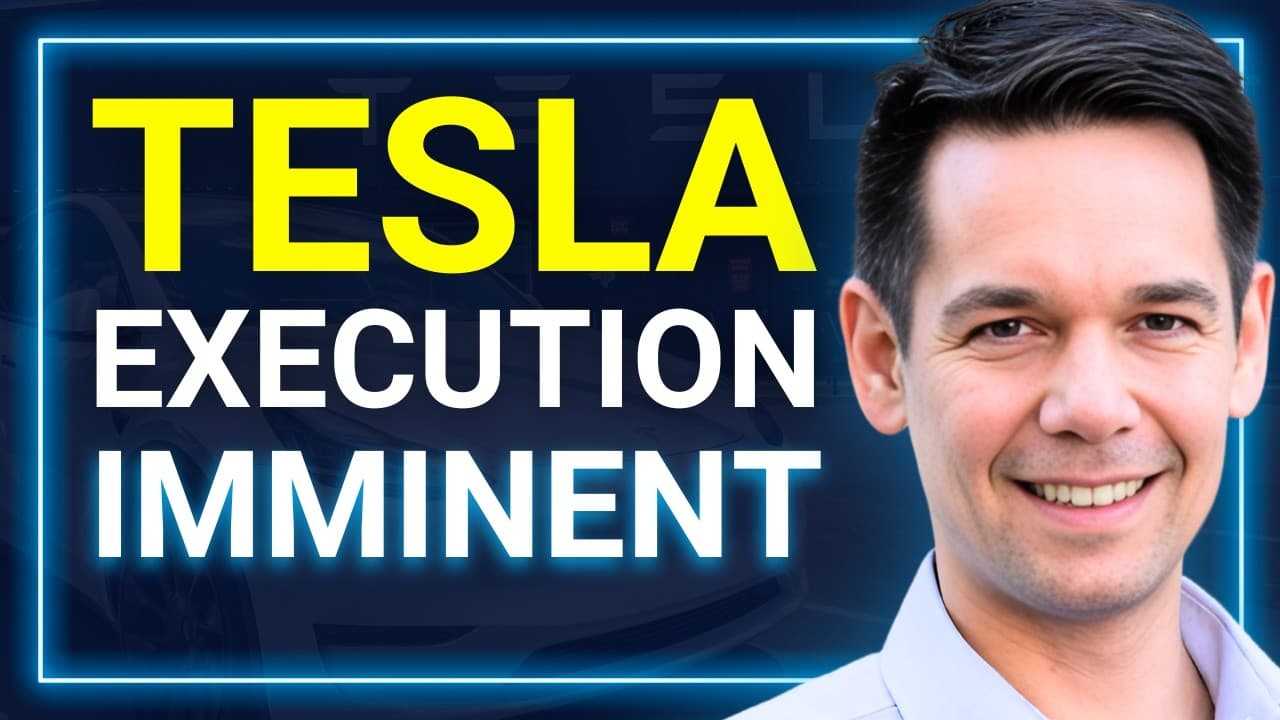
Tesla’s advantage is presented as execution capacity across manufacturing, autonomy, energy, and leadership. Tom Zhu’s five-year retention package supports operational continuity, while repeated Cybercab testing, an FSD software update, and a reported 12,000-mile drive without intervention are offered as evidence that Tesla is moving from plans toward deployment. The discussion also identifies Google’s AI distribution power as a potential strategic threat.
Transcript
Several important developments dropped over the last 24 hours for Tesla. First, [music] Tesla locked in Tom Drew for another 5 years. A form four confirms a long-term extension with roughly 520,000 Tesla shares that only vests if he stays. This is continuity at the top of Tesla's global operations and leadership stability. Second, Apple announced i... Read More
Key Insights
- Tom Zhu’s retention package is designed to reward long-term operational continuity. Roughly 520,000 Tesla shares vest only if he remains for another five years, linking a potentially valuable award to continued service and execution across Tesla’s manufacturing organization.
- Tesla China is presented as a manufacturing benchmark created under Tom Zhu’s operational leadership. His ability to improve production metrics is cited as evidence that he can help Tesla scale Cybercab, Optimus, energy products, factories, and other manufacturing-intensive programs.
- Execution is described as Tesla’s most important requirement after strategic direction becomes clear. The discussion argues that research, engineering, and first-principles thinking must be paired with an operator who can convert product plans into efficient, repeatable, large-scale manufacturing systems.
- Apple selected Google’s Gemini technology as the foundation for its next Siri upgrade. The discussion portrays this choice as strategically significant because Google already controls Android and Chrome, while Apple provides another large global distribution channel for Google-powered artificial intelligence.
- Google is characterized by the participants as a major artificial intelligence competitor because it combines algorithms, computing infrastructure, and distribution. Elon Musk’s stated concern focuses on concentration of power rather than only model quality, particularly when one company participates across mobile software, browsers, and AI.
- SpaceX is described as core infrastructure for NASA and United States national security through Starlink and Starshield. Elon Musk’s appearance greeting senior government officials at Starbase is presented as a visible reminder of his companies’ growing involvement with government and military-related infrastructure.
- A Tesla owner’s 12,000 consecutive FSD miles are reported as having zero disengagements, zero takeovers, and no hands-on alerts. The reported route also included charging and parking stops, making the account a notable real-world autonomy claim within the discussion.
- Tesla’s Austin Cybercab activity is described as repeated fleet testing rather than isolated sightings. Fleet tracking reportedly showed six active vehicles testing simultaneously, while FSD version 14.2.2.3 targeted parking, emergency vehicle handling, blocked-road routing, system recovery, and perception reliability.
Install to Summarize YouTube Videos and Get Transcripts
Explore YouTube Video Summarizer or Get YouTube Transcript Extractor
Questions & Answers
Q: Why did Tesla give Tom Zhu a five-year retention package?
Tesla’s arrangement is intended to retain a senior leader responsible for important manufacturing and operational work. Roughly 520,000 shares vest only if Tom Zhu stays for another five years, creating a direct incentive for continuity. The participants argue that his manufacturing record in China makes him especially valuable as Tesla attempts to scale Cybercab, Optimus, energy products, and additional factories.
Q: Could Tom Zhu eventually replace Elon Musk at Tesla?
The discussion does not establish Tom Zhu as Elon Musk’s designated successor. Instead, it presents him as the executive operator who complements Musk’s strategic, product, and first-principles strengths. One participant believes Musk is focused on winning in robotaxis, Optimus, and energy for at least another decade, making Zhu’s immediate role in execution more relevant than a formal succession plan.
Q: Why is manufacturing execution important to Tesla’s strategy?
Manufacturing execution matters because Tesla’s major ambitions require physical products to be produced efficiently and at large scale. The discussion names Cybercab, Optimus, energy systems, vehicle factories, and possible chip manufacturing as examples. Strong ideas and engineering are treated as necessary, but operational leadership determines whether those ideas become reliable production systems and commercially useful output.
Q: Why did Apple choose Google’s Gemini technology for Siri?
Apple stated that, after careful evaluation, Google’s AI technology provided the most capable foundation for Apple Foundation Models and the next Siri upgrade. The transcript does not provide more detail about Apple’s technical evaluation. The participants infer that the agreement could involve more than Siri, potentially including Google’s data centers and TPUs, but they present those broader elements as interpretation rather than confirmed terms.
Q: Why did Elon Musk criticize the Apple and Google AI partnership?
Elon Musk said the partnership appeared to create an unreasonable concentration of power because Google already controls Android and Chrome. The concern presented in the discussion is that Gemini could gain access to Apple’s large global device distribution in addition to Google’s existing mobile and browser reach. This would strengthen Google’s position across AI algorithms, computing resources, data, and distribution.
Q: What does the reported 12,000-mile FSD drive demonstrate?
The reported drive provides an owner’s real-world account of 12,000 consecutive miles using FSD with zero disengagements, zero takeovers, and no hands-on alerts. It also reportedly included charging and parking stops. The hosts treat the result as strong evidence of autonomy progress, although the supplied transcript describes the owner’s report and does not provide an independent validation process.
Q: What improvements were included in Tesla’s FSD update?
FSD version 14.2.2.3 is described as focusing on improvements to parking, handling emergency vehicles, routing around blocked roads, recovering from system issues, and perception reliability. Together, these areas address several practical situations an autonomous vehicle may encounter. The transcript announces the improvement categories but does not provide technical measurements or comparative performance results for the release.
Q: What do the Austin Cybercab sightings indicate about testing?
The Austin sightings suggest that Cybercab testing was occurring repeatedly and with multiple vehicles rather than as a single isolated appearance. Fleet tracking reportedly showed six active Cybercabs testing at the same time. The hosts interpret that activity as evidence of expanding deployment work, although the transcript does not specify test routes, operating hours, passenger access, or formal performance results.
Summary & Key Takeaways
-
Tesla retained senior operations leader Tom Zhu through a five-year arrangement involving roughly 520,000 shares that vest only if he remains. The discussion frames Zhu as a crucial manufacturing operator whose experience with Tesla China could support Cybercab, Optimus, energy products, factories, and other production programs requiring efficient large-scale execution.
-
Apple selected Google’s Gemini technology as the foundation for its next Siri upgrade after evaluating available options. Elon Musk criticized the agreement as an unhealthy concentration of power because Google already controls Android and Chrome. The participants interpret the partnership as strengthening Google across algorithms, compute, data, and global device distribution.
-
Tesla’s autonomy progress is illustrated through several developments: a Tesla owner reported 12,000 consecutive FSD miles without disengagements, takeovers, or hands-on alerts; six Cybercabs were reportedly testing simultaneously in Austin; and FSD version 14.2.2.3 introduced improvements involving parking, emergency vehicles, blocked roads, system recovery, and perception reliability.
Read in Other Languages (beta)
Share This Summary 📚
Summarize YouTube Videos and Get Video Transcripts with 1-Click
Try YouTube Summary with ChatGPT & Claude or YouTube Transcript Generator
Explore More Summaries from Brighter with Herbert 📚
Summarize YouTube Videos and Get Video Transcripts with 1-Click
Try YouTube Summary with ChatGPT & Claude or YouTube Transcript Generator