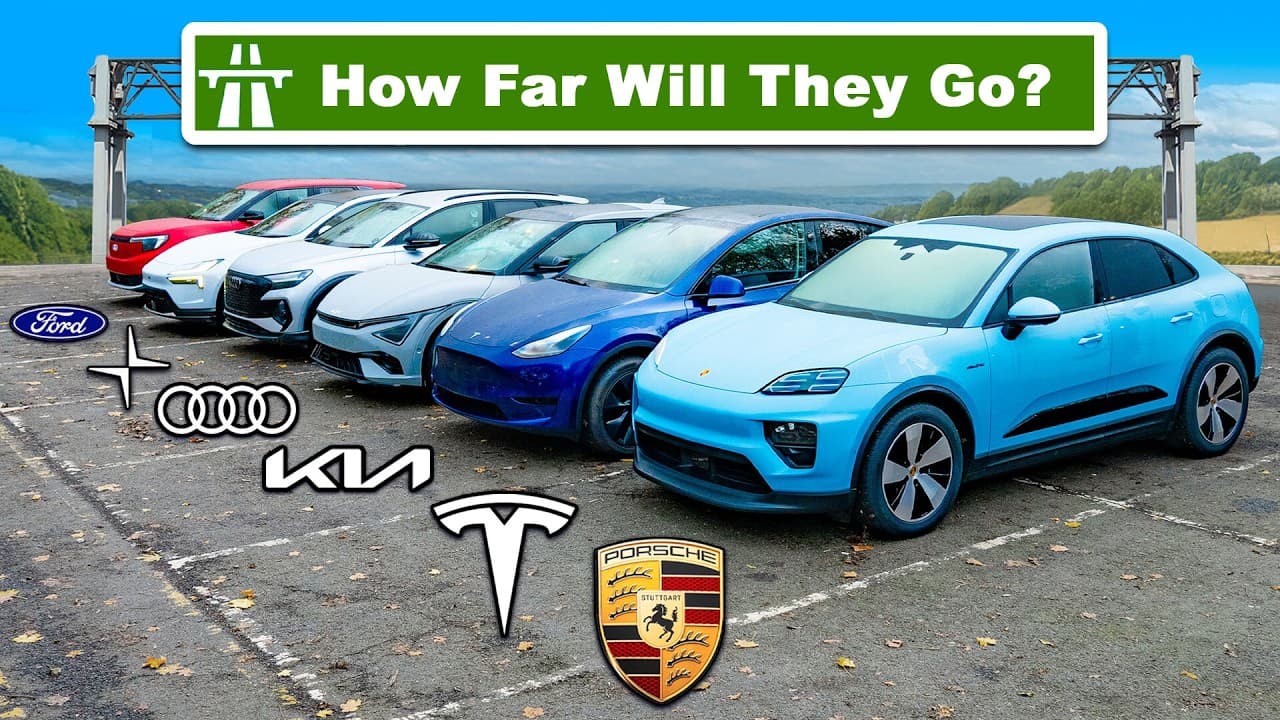
How Far Can the Polestar 4, Porsche Macan, Tesla Model Y, Ford Explorer, Kia EV6, and Audi Q4 e-tron Go on One Charge?
TL;DR
The tested electric SUVs traveled between 268 and 333 miles on a single charge, with the Polestar 4 finishing first at 333 miles, or 90% of its claimed 372-mile range. The Porsche Macan followed at 318 miles, while the Audi Q4 e-tron recorded the shortest distance at 268 miles. Read on for each model’s result and the test’s charging-cost comparison.
Transcript
I've got the very latest electric SUVs and they're the longest range versions of each model and I'm going to be driving them up north to see how far they can go on a single charge and see how close they get to the manufacturer's claimed range I'll also be seeing what exactly happens when they run out of electricity do they suddenly just like con ou... Read More
Key Insights
- The Polestar 4 achieved 333 miles, 90% of its claimed range, the highest among the tested cars.
- The Porsche Macan, with a 95 kWh battery, managed 318 miles, 82% of its claimed range.
- Tesla Model Y reached 294 miles, achieving 79% of its claimed range, with good energy efficiency.
- Ford Explorer covered 291 miles, 78% of its claimed range, showing similar efficiency to Tesla.
- Kia EV6 traveled 280 miles, 81% of its claimed range, with decent energy efficiency.
- Audi Q4 e-tron reached 268 miles, 79% of its claimed range, the lowest among the vehicles.
- The Skoda Kodiak, a diesel camera car, cost the same as the Polestar for a round trip but needed fewer refuels.
- Using public fast chargers for the Polestar would have increased the cost to £140, 50% more than the Skoda.
Install to Summarize YouTube Videos and Get Transcripts
Explore YouTube Video Summarizer or Get YouTube Transcript Extractor
Questions & Answers
Q: How far can these electric SUVs go on a single charge?
The six tested electric SUVs traveled between 268 and 333 miles on a full charge. The Polestar 4 went farthest at 333 miles, followed by the Porsche Macan at 318 miles, while the Audi Q4 e-tron recorded 268 miles.
Q: How far did the Polestar 4 go on a single charge?
The Polestar 4 traveled 333 miles, the longest distance among the tested vehicles. That was 90% of its claimed 372-mile range.
Q: What was the Porsche Macan’s real-world electric range?
The Porsche Macan covered 318 miles on a single charge. This equaled 82% of its claimed 386-mile range.
Q: How did the Tesla Model Y perform in the range test?
The Tesla Model Y traveled 294 miles, reaching 79% of its claimed 373-mile range. Its recorded efficiency averaged 3.8 miles per kilowatt-hour.
Q: What was the Ford Explorer’s real-world range?
The Ford Explorer covered 291 miles on a single charge. That represented 78% of its claimed 374-mile range.
Q: How far did the Kia EV6 travel in the test?
The Kia EV6 traveled 280 miles, or 81% of its claimed 347-mile range. Its average efficiency was 3.4 miles per kilowatt-hour.
Q: What range did the Audi Q4 e-tron achieve?
The Audi Q4 e-tron reached 268 miles, the shortest distance among the six tested SUVs. That was 79% of its claimed 336-mile range.
Q: How did public fast-charging costs compare with the diesel Skoda Kodiak?
The diesel Skoda Kodiak cost £92 in fuel for the round trip, matching the Polestar when its initial charge came from a home charger. Using public fast chargers for both legs would have raised the Polestar’s total to £140, which was 50% more than the Skoda.
Summary & Key Takeaways
-
The Polestar 4 led the test, achieving 90% of its 372-mile claimed range, covering 333 miles. Its efficiency and value for money were highlighted, making it a top choice among electric SUVs.
-
The Porsche Macan followed closely with 318 miles, achieving 82% of its claimed range. Despite its higher cost, it demonstrated excellent driving dynamics and comfort.
-
Tesla Model Y, Ford Explorer, and Kia EV6 showed competitive performance, with the Audi Q4 e-tron trailing. The test underscored the importance of real-world range over manufacturer claims.
Read in Other Languages (beta)
Share This Summary 📚
Summarize YouTube Videos and Get Video Transcripts with 1-Click
Try YouTube Summary with ChatGPT & Claude or YouTube Transcript Generator
Explore More Summaries from carwow 📚



Summarize YouTube Videos and Get Video Transcripts with 1-Click
Try YouTube Summary with ChatGPT & Claude or YouTube Transcript Generator