Cavalieri's principle in 3D | Solid geometry | High school geometry | Khan Academy
TL;DR
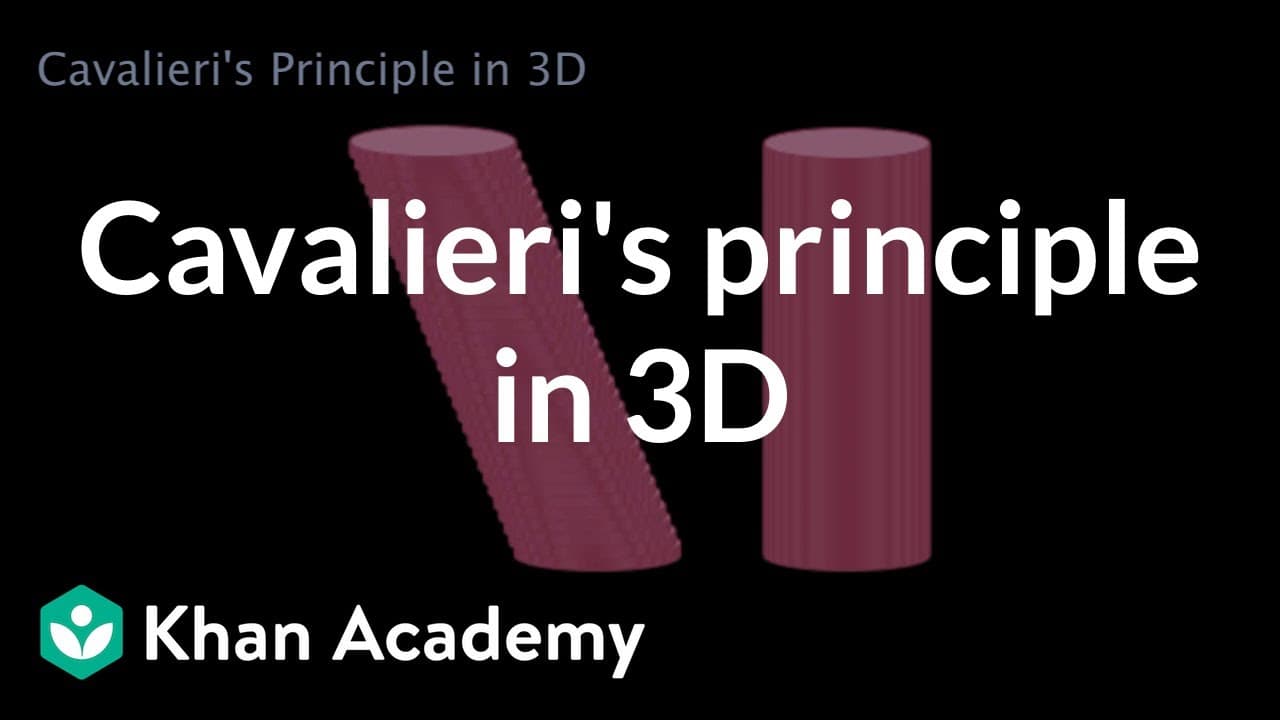
Cavalieri's principle says that two three-dimensional figures have the same volume when they have the same height and equal cross-sectional areas at every point along that height. Cutting a cylinder horizontally into halves, thirds, or many sections and shifting those pieces preserves its combined volume. The same reasoning applies to prisms, pyramids, and spheres, so read on to see why even skewed-looking solids can retain their volume.
Transcript
- [Instructor] So we have two cylinders here. Let's say we know that they have the exact same volume and that makes sense because it looks like they have the same area of their base and they have the same height. Now what I'm going to do is start cutting up this left cylinder here and shifting things around. So if I just cut it in two and take that... Read More
Key Insights
- 😵 Cavalieri's principle states that two figures with the same height and cross-sectional area have the same volume.
- 😵 Cutting and shifting shapes while maintaining the same height and cross-sectional area does not alter their volumes.
- 💠 This principle applies to various shapes such as cylinders, prisms, pyramids, and spheres.
Install to Summarize YouTube Videos and Get Transcripts
Explore YouTube Video Summarizer or Get YouTube Transcript Extractor
Questions & Answers
Q: What is Cavalieri's principle in 3D?
Cavalieri's principle states that two figures have the same volume if they have the same height and the same cross-sectional area at every point along that height. The figures can look different while still satisfying these conditions.
Q: Why does cutting and shifting a cylinder not change its volume?
Horizontal cuts divide the cylinder into sections whose combined volume equals the original cylinder's volume. Shifting those sections changes their arrangement, but it does not change their combined volume.
Q: How does the cylinder example demonstrate Cavalieri's principle?
The original cylinder and the rearranged figure have the same height. At every corresponding point along that height, their cross-sectional areas are also the same, so Cavalieri's principle says their volumes are equal.
Q: Does a skewed cylinder have the same volume as the original cylinder?
Yes, the continuously skewed cylinder shown has the same volume as the original cylinder. It retains the same height and the same cross-sectional area at every point along the height.
Q: Can Cavalieri's principle be applied to prisms?
Yes. A prism can be cut into horizontal sections and those sections can be shifted without changing their combined volume, provided the height and corresponding cross-sectional areas remain the same.
Q: Why do a pyramid and its skewed version have the same volume?
Skewing the pyramid by shifting horizontal sections does not change the area of those sections. Because the original and skewed pyramids have the same height and equal cross-sectional areas at every point along it, they have the same volume.
Q: Does Cavalieri's principle also apply to spheres?
Yes. The sphere example is cut horizontally and its sections are shifted, producing an object with a different appearance. Its height and cross-sectional areas remain the same as those of the original sphere, so its volume is unchanged.
Q: Why is Cavalieri's principle intuitive?
The examples show that cutting a solid horizontally and merely shifting its pieces neither adds nor removes volume. Making more cuts creates an increasingly continuous-looking skewed figure while preserving the height and cross-sectional areas.
Summary & Key Takeaways
-
The video demonstrates Cavalieri's principle, which states that if two figures have the same height and cross-sectional area at any point, they have the same volume.
-
Cutting and shifting shapes like cylinders, prisms, pyramids, and spheres, while maintaining the same height and cross-sectional area, does not change their original volume.
-
This principle applies to various shapes and helps to develop an intuitive understanding of why equal volumes can have different shapes.
Read in Other Languages (beta)
Share This Summary 📚
Summarize YouTube Videos and Get Video Transcripts with 1-Click
Try YouTube Summary with ChatGPT & Claude or YouTube Transcript Generator
Explore More Summaries from Khan Academy 📚


Summarize YouTube Videos and Get Video Transcripts with 1-Click
Try YouTube Summary with ChatGPT & Claude or YouTube Transcript Generator