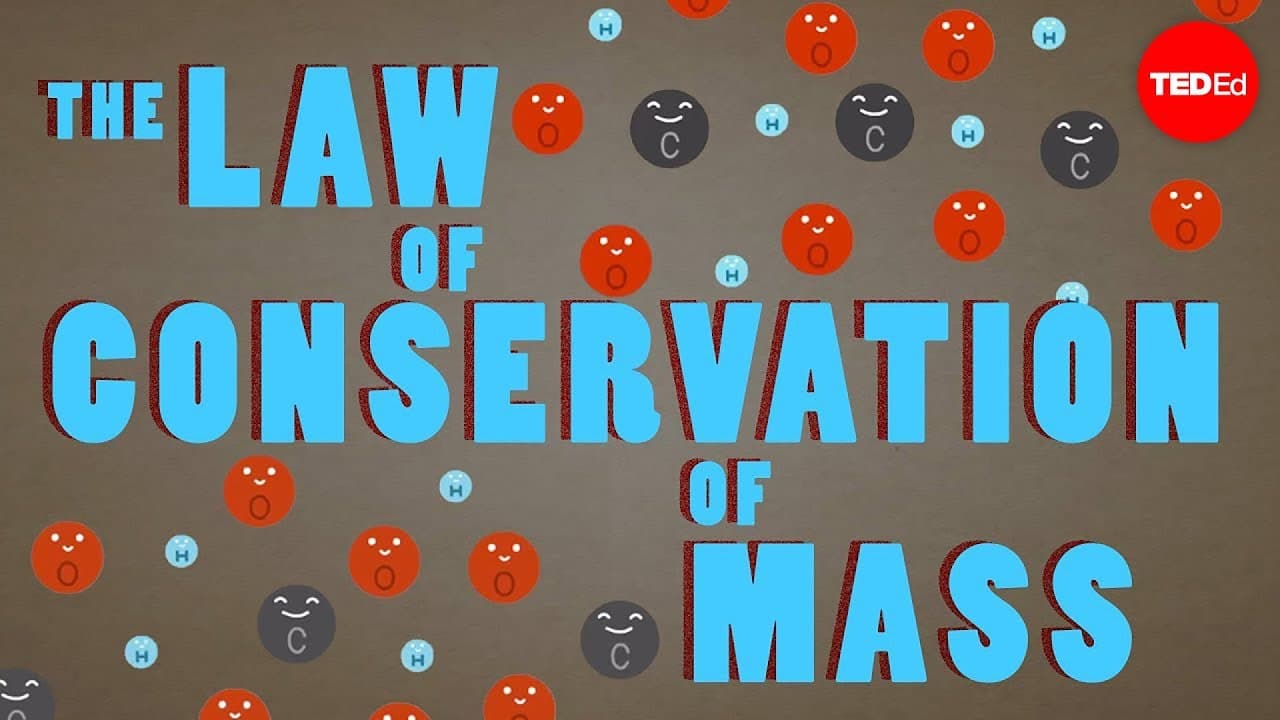
What Is the Law of Conservation of Mass? - Todd Ramsey
TL;DR
Conservation of mass means that within an isolated system, mass, or matter and energy, can neither be created nor destroyed. Chemical reactions only rearrange atoms, as shown when methane combusts into carbon dioxide, water, and energy while retaining all four hydrogen atoms. Read on for examples involving sugar, methane, propane, stars, and the origins of Earth’s atoms.
Transcript
Where does all this stuff come from? This rock? That cow? Your heart? Not the things themselves, mind you, but what they're made of: the atoms that are the fabric of all things. To answer that question, we look to the law of conservation of mass. This law says take an isolated system defined by a boundary that matter and energy cannot cross. Insid... Read More
Key Insights
- 👮 The law of conservation of mass governs the behavior of matter and energy in isolated systems, such as the universe.
- 🫀 Atoms, which make up all matter, cannot be created or destroyed but can combine and rearrange during chemical reactions.
- 🤩 Atoms originated from the high-energy conditions of the early universe and were further formed through nuclear reactions in stars.
- 🤩 Stars play a crucial role in the formation of heavy elements, which are essential building blocks for planets and life.
- 🤩 The atoms that make up our bodies and everything around us are ultimately derived from the remnants of ancient stars.
- 👻 Chemical reactions allow the rearrangement of atoms and the release or absorption of energy stored in their bonds.
- 💆 The law of conservation of mass ensures that the total mass of a system remains constant during chemical reactions.
Install to Summarize YouTube Videos and Get Transcripts
Explore YouTube Video Summarizer or Get YouTube Transcript Extractor
Questions & Answers
Q: What is conservation of mass?
Conservation of mass means that mass, or matter and energy, can neither be created nor destroyed inside an isolated system. Whatever matter and energy enter a chemical reaction are still present and accounted for when it is complete.
Q: What is the law of conservation of mass?
The law applies to an isolated system with a boundary that matter and energy cannot cross. Within that boundary, mass cannot be created or destroyed, although atoms can rearrange and energy can change form.
Q: What is an example of the law of conservation of mass?
When methane combusts with oxygen, it produces carbon dioxide, water, and energy. The methane begins with four hydrogen atoms, and all four remain at the end in two water molecules.
Q: How does the law of conservation of mass apply to propane combustion?
When propane burns with oxygen, it produces water and carbon dioxide. Three carbon dioxide molecules form because the propane molecule began with three carbon atoms, and those atoms cannot disappear.
Q: How can atoms form different substances without creating or destroying mass?
Atoms can bond and reshuffle into different molecules while their total numbers remain unchanged. Six carbon atoms, 12 hydrogen atoms, and 18 oxygen atoms can form carbon dioxide and water, then rearrange into a simple sugar and oxygen gas.
Q: Where does energy go during the formation of sugar?
The applied energy becomes stored in the bonds between atoms when they rearrange into sugar. Breaking the sugar back into water and carbon dioxide rereleases that energy while preserving the same atoms.
Q: Do nuclear reactions in stars violate the law of conservation of mass?
No. The starting atoms have slightly more mass than the products, and that loss of mass corresponds to the energy released as light, heat, and energetic particles.
Q: Where did the atoms on Earth come from?
Hydrogen formed from a high-energy soup of particles during the three minutes after the universe began. Stars later fused light elements into heavier elements such as carbon and oxygen, then supernovas scattered those elements across space, where they eventually helped form Earth.
Summary & Key Takeaways
-
The law of conservation of mass states that in an isolated system, matter and energy cannot be created or destroyed but can only change form.
-
Atoms, which make up all matter, can bond together to form molecules and undergo chemical reactions, but the total number of atoms remains constant.
-
Atoms originated from the high-energy soup of particles during the Big Bang and were further formed through nuclear reactions in stars, eventually leading to the formation of the Earth and all living things.
Read in Other Languages (beta)
Share This Summary 📚
Summarize YouTube Videos and Get Video Transcripts with 1-Click
Try YouTube Summary with ChatGPT & Claude or YouTube Transcript Generator
Explore More Summaries from TED-Ed 📚



Summarize YouTube Videos and Get Video Transcripts with 1-Click
Try YouTube Summary with ChatGPT & Claude or YouTube Transcript Generator