[Eng Sub] Marking Process: Laser marking, Ink marking, Nd-YAG laser, Green laser
TL;DR
Exploration of ink and laser marking techniques for semiconductor packaging.
Transcript
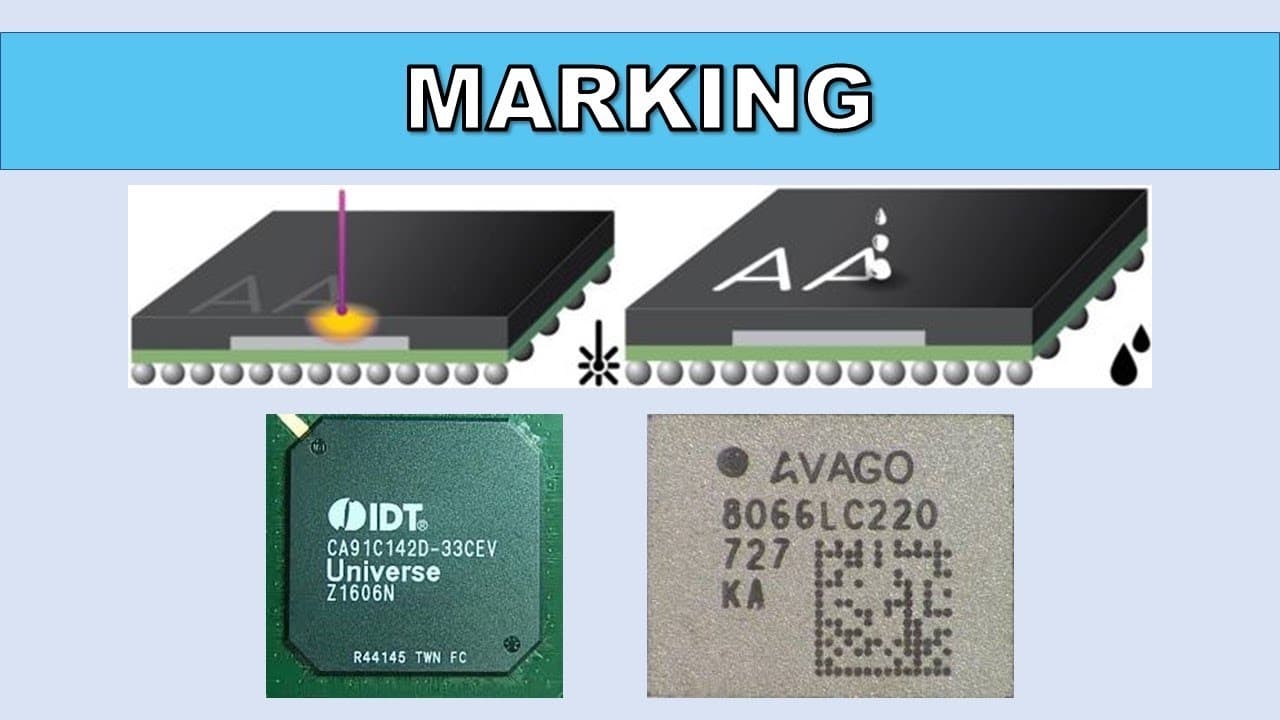
Today, let’s talk about marking process. Marking process is to write some information on package surface. There are 2 major methods of marking, one is ink marking and the other is laser marking. Ink marking has been common for a long time, but now laser marking is the most popular choice. Ink marking uses rubber stamp and ink. It engraves charact... Read More
Key Insights
- Marking processes are essential for writing information on package surfaces, with ink and laser marking being the two primary methods.
- Ink marking involves using a rubber stamp and ink, typically white for contrast on black mold compounds, requiring surface preparation to ensure adhesion.
- Laser marking uses lasers like Nd:YAG and green lasers to engrave information directly onto the package surface, offering flexibility and efficiency.
- Inkjet marking, similar to an inkjet printer, is an alternative to rubber stamps, applying ink directly to the package surface.
- Laser marking is advantageous as it doesn't require changing stamps for new information, simply adjusting the drawing in the machine.
- Nd:YAG lasers are popular for marking on mold compounds, while green lasers are used for die surfaces like WLCSP or exposed die packages.
- 2D barcodes, or QR codes, are increasingly used for unit-level traceability in automotive applications due to their capacity to store extensive information.
- Automotive and smartphone industries use 2D barcodes for traceability, containing critical data like lot numbers, manufacturing details, and more.
Install to Summarize YouTube Videos and Get Transcripts
Explore YouTube Video Summarizer or Get YouTube Transcript Extractor
Questions & Answers
Q: What are the two primary methods of marking in semiconductor packaging?
The two primary methods of marking in semiconductor packaging are ink marking and laser marking. Ink marking uses rubber stamps and ink to inscribe information, while laser marking employs lasers to engrave the necessary details directly onto the package surface. Each method has its own set of processes and advantages.
Q: How does ink marking work, and what are its steps?
Ink marking involves several steps: removing oily material from the package surface to ensure ink adhesion, applying ink to a rubber stamp, stamping the package surface, and curing the ink to dry it. This method has been traditionally used but requires careful preparation for effective results.
Q: What advantages does laser marking offer over ink marking?
Laser marking offers significant advantages over ink marking, such as eliminating the need for rubber stamps and allowing easy modifications to the marking information by simply adjusting the drawing in the machine. It is more efficient, flexible, and capable of engraving directly onto package surfaces without additional preparation.
Q: What types of lasers are used in laser marking, and for what purposes?
Nd:YAG lasers with a 1064nm wavelength are commonly used for marking on mold compounds, while green lasers with a 532nm wavelength are used for marking on die surfaces like WLCSP or exposed die packages. These lasers allow precise and efficient engraving on different types of surfaces.
Q: Why are 2D barcodes important in the automotive industry?
2D barcodes, or QR codes, are crucial in the automotive industry for unit-level traceability. They can store extensive information, such as lot numbers and manufacturing details, which is essential for quality control. This traceability is vital for analyzing and addressing failures, ensuring safety and compliance in automotive applications.
Q: How does inkjet marking differ from traditional ink marking?
Inkjet marking differs from traditional ink marking by applying ink directly onto the package surface, similar to an inkjet printer, rather than using a rubber stamp. This method allows for more flexibility and precision, especially for complex designs or when frequent changes in marking information are required.
Q: What role do 2D barcodes play in smartphone manufacturing?
In smartphone manufacturing, 2D barcodes are used for unit-level traceability, similar to the automotive industry. They store detailed information about the package, including manufacturing and component details, ensuring quality control and facilitating tracking and analysis in case of any issues or failures.
Q: How do laser marking machines adjust to new marking information?
Laser marking machines adjust to new marking information by modifying the drawing in the machine's software. This capability eliminates the need to create new rubber stamps for each change, making the process more efficient and adaptable to frequent updates or different marking requirements.
Summary & Key Takeaways
-
The marking process is crucial in semiconductor packaging, involving ink and laser methods to inscribe information on package surfaces. Ink marking uses rubber stamps, requiring surface preparation to ensure ink adhesion, while laser marking engraves directly onto surfaces, offering flexibility and efficiency.
-
Ink marking involves applying ink to a rubber stamp, stamping the package surface, and curing the ink. Laser marking, on the other hand, uses lasers to engrave information without the need for stamps, allowing for quick changes by adjusting machine drawings.
-
2D barcodes, or QR codes, are becoming essential for unit-level traceability, especially in automotive industries, due to their ability to store extensive information. Both automotive and smartphone industries utilize these codes to ensure quality control and traceability.
Read in Other Languages (beta)
Share This Summary 📚
Summarize YouTube Videos and Get Video Transcripts with 1-Click
Try YouTube Summary with ChatGPT & Claude or YouTube Transcript Generator
Explore More Summaries from Semicon Talk 📚
![[Eng Sub] 2.5D Package Technology: GPU+HBM, AMD, nVIDIA, TSMC thumbnail](/_next/image?url=https%3A%2F%2Fi.ytimg.com%2Fvi%2FEuBRa3NWMPs%2Fhqdefault.jpg&w=750&q=75)
![[Eng Sub] TSMC SOIC thumbnail](/_next/image?url=https%3A%2F%2Fi.ytimg.com%2Fvi%2F3pXrcWs8BqQ%2Fhqdefault.jpg&w=750&q=75)
![[Eng Sub] Wafer Sawing Process: Blade saw, Laser saw, Plasma saw thumbnail](/_next/image?url=https%3A%2F%2Fi.ytimg.com%2Fvi%2FJh4uJZR_OYs%2Fhqdefault.jpg&w=750&q=75)
![[Eng Sub] Cu Wire Bonding thumbnail](/_next/image?url=https%3A%2F%2Fi.ytimg.com%2Fvi%2F8XaobXIQueM%2Fhqdefault.jpg&w=750&q=75)
![[Eng Sub] Wafer Level Chip Scale Package (WLCSP) thumbnail](/_next/image?url=https%3A%2F%2Fi.ytimg.com%2Fvi%2FF0WLyZZDyeo%2Fhqdefault.jpg&w=750&q=75)
Summarize YouTube Videos and Get Video Transcripts with 1-Click
Try YouTube Summary with ChatGPT & Claude or YouTube Transcript Generator