What Will Be Vulnerable in an Autonomous Future?
TL;DR
Future cybersecurity must protect entire autonomous ecosystems, not merely networks or individual devices. As AI, IoT, enhanced connectivity, cloud services, sensors, robotics, and operational technology converge across healthcare, transportation, cities, energy, education, and public safety, vulnerabilities can arise in algorithms, models, data, software, systems, and the connections among them.
Transcript
My name is Bobbie Stempler. I am the director of the CERT Division at the Software Engineering Institute. Just give you a, a thirty-second, less than thirty-second, uh, backdrop on, on that organization. Um, some thirty years ago, a bunch of really smart engineers and researchers decided to build an intergalactic network we now know as the Internet... Read More
Key Insights
- Future cybersecurity is an ecosystem problem because people, devices, services, and data move across healthcare, transportation, cities, energy, education, entertainment, industry, and public safety. Protecting one operating vertical cannot address vulnerabilities created when these connected domains depend on one another.
- Assured autonomy is concerned with securing combinations of emerging technologies, including AI, IoT, quantum computing, additive manufacturing, and connected infrastructure. The central question is who will protect the conglomerate when cybersecurity must extend beyond familiar networks to services and autonomous ecosystems.
- AI adoption is being supported by available capabilities, computing power, and computer science that can implement increasingly advanced systems. Industry is also seeing returns on investment from AI, machine learning, and human language translation, encouraging faster integration into operations and services.
- Autonomous transportation is intended to improve efficiency and safety through vehicles, trains, and buses that operate with greater independence. Its success also depends on human adoption, showing that future security and assurance must consider social acceptance alongside technical performance.
- Smart cities are connected systems in which electric grids, service operations, sensors, and AI can coordinate to produce efficiencies unavailable through isolated infrastructure. Greater connectivity must be embraced to obtain these benefits, even though it also introduces security concerns and dependencies.
- Public safety systems can combine emergency call centers, sensing platforms, and infrastructure data to inform responses to events. Such integration could support first responders, but it also raises ethical questions because connected sensing technologies affect how information is collected and used.
- Personalized education can use AI to examine how individuals learn and enhance their learning experiences. This development may also change what students learn and which tasks lead to degrees or certifications, making education part of the broader autonomous and connected ecosystem.
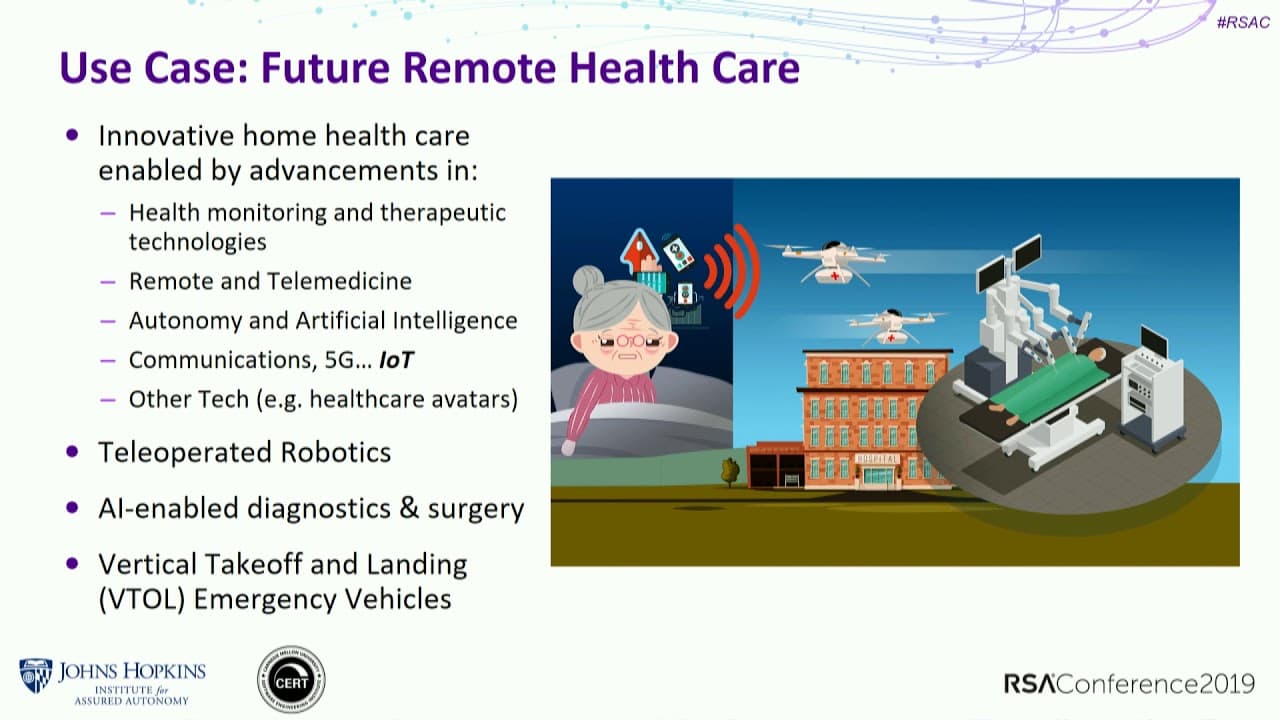
- Remote healthcare works through continuous coordination among wearable sensors, therapeutic devices, cloud services, analytics, alerts, clinicians, transportation, haptic sensing, and robotics. Its benefits depend on trusted data flows and reliable decisions across every component rather than any single medical device.
Install to Summarize YouTube Videos and Get Transcripts
Explore YouTube Video Summarizer or Get YouTube Transcript Extractor
Questions & Answers
Q: Why must future cybersecurity protect whole ecosystems?
Future cybersecurity must protect whole ecosystems because people and their connected technologies do not remain within a single operating vertical. Devices and data can move among healthcare, transportation, smart cities, power systems, education, entertainment, industry, and public safety. A failure in one service or connection can therefore affect other dependent components, making isolated network protection insufficient.
Q: What technologies create new cybersecurity attack surfaces?
The discussed attack surfaces arise from the convergence of artificial intelligence, IoT devices, enhanced connectivity, cloud services, sensors, robotics, quantum computing, additive manufacturing, and operational technology. Vulnerabilities may exist in algorithms, models, data, software, individual systems, or the connections that combine them into autonomous services. The challenge is securing the complete arrangement rather than treating each technology separately.
Q: How could autonomous technology improve remote healthcare?
Autonomous technology could let an older patient remain at home through wearable health monitors, computer-controlled dialysis equipment, telemedicine, cloud analytics, and automated alerts. In the example, sensors identify a biomarker indicating a possible blood clot, analytics determine that a response is needed, and vascular surgeons receive the information so they can initiate emergency transportation and prepare treatment.
Q: How would data move through a connected healthcare home?
Health data would flow from wearable sensors and therapeutic technologies in the home to a cloud service. Algorithms would analyze trends, determine what might be happening, and return alerts or guidance through health avatars or similar interfaces. When a serious condition is detected, relevant information could be sent to clinicians and continue updating them while the patient is transported.
Q: What security lesson comes from the remote healthcare scenario?
The remote healthcare scenario shows that successful care depends on many connected components working together. Wearables, home equipment, cloud analytics, communication links, clinicians, an emergency vehicle, haptic sensors, and robotics all contribute to one outcome. Cybersecurity must therefore consider the integrity and reliability of data, software, algorithms, devices, and handoffs throughout the complete care process.
Q: How could smart cities use AI and connected sensors?
Smart cities could use AI, connected sensors, and coordinated infrastructure to improve electric-grid efficiency and the delivery of city services. Public safety organizations could also combine information from emergency call centers with sensor and infrastructure data to understand events and assist first responders. These uses require broader connectivity while also creating security and ethical concerns that must be addressed.
Q: Why is human adoption important for autonomous transportation?
Human adoption is important because autonomous vehicles, trains, and buses are introduced to improve efficiency and safety, but those benefits depend on people accepting and using the technology. Technical capability alone does not determine deployment. The future transportation ecosystem must account for how humans interact with autonomous services as well as how the underlying systems are secured and assured.
Q: How could AI change education and individual learning?
AI could help educational institutions examine how different people learn and use that information to enhance individual learning experiences. Its adoption also prompts questions about what students should learn and which tasks should qualify them for degrees or certifications. Education therefore becomes another connected operating vertical shaped by AI capabilities, institutional decisions, and changing expectations about learning.
Summary & Key Takeaways
-
The CERT Division emerged after the Morris worm created a need to understand and respond to Internet security problems. Its work spans applied research in cybersecurity, software engineering, and artificial intelligence, with an emphasis on anticipating upcoming technologies and identifying what may become vulnerable as those technologies are deployed.
-
The Institute for Assured Autonomy examines cybersecurity beyond networks and infrastructure. Its central concern is who will secure ecosystems formed by AI, IoT, quantum computing, additive manufacturing, connected services, and increasingly autonomous capabilities. These technologies promise efficiencies, but their convergence also creates new dependencies and potential attack surfaces.
-
A remote healthcare scenario shows both the promise and risk of autonomous ecosystems. Wearable monitors, home dialysis equipment, cloud analytics, health alerts, surgeons, an emergency aircraft, haptic sensing, and robotics cooperate to detect a possible blood clot, transport the patient, stabilize her, and prepare clinicians with enriched health data.
Read in Other Languages (beta)
Share This Summary 📚
Summarize YouTube Videos and Get Video Transcripts with 1-Click
Try YouTube Summary with ChatGPT & Claude or YouTube Transcript Generator
Explore More Summaries from RSAC Cybersecurity 📚




Summarize YouTube Videos and Get Video Transcripts with 1-Click
Try YouTube Summary with ChatGPT & Claude or YouTube Transcript Generator