What Is Time Dilation and How Does It Work?
TL;DR
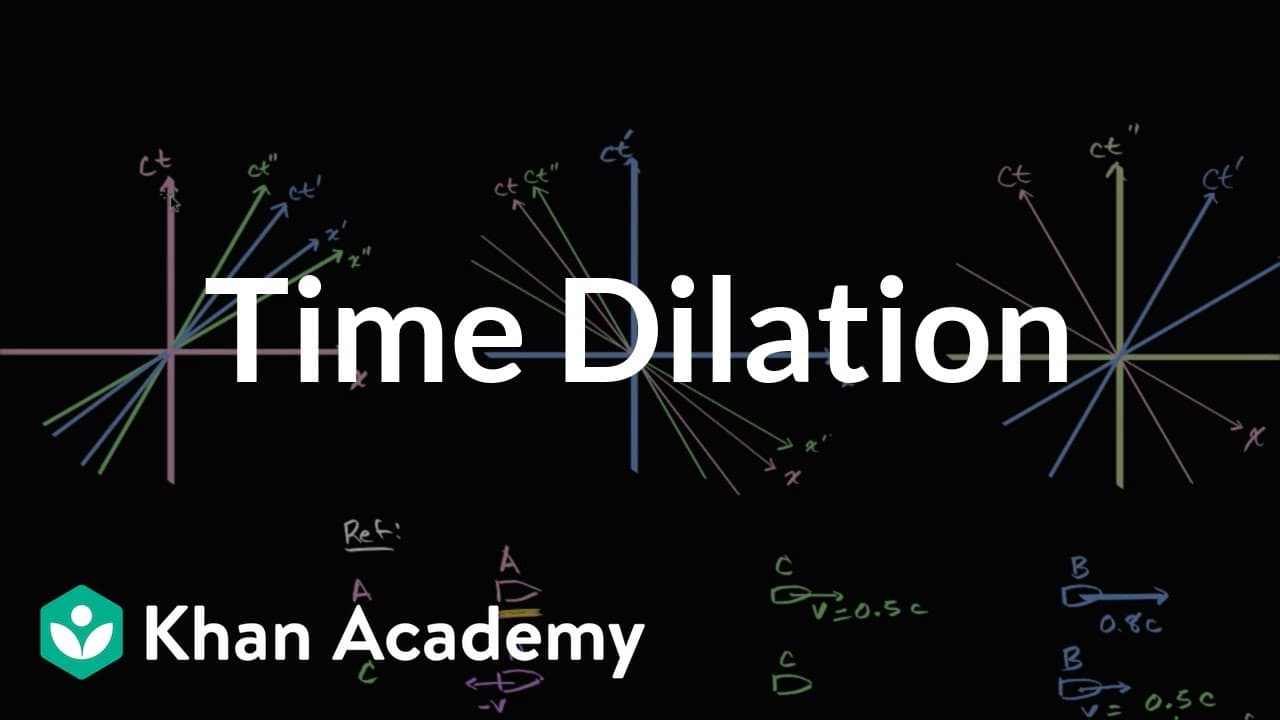
Time dilation occurs when two observers in different frames of reference perceive time differently due to relative velocities. For instance, events perceived as occurring sequentially in one frame may appear simultaneous or in a different order in another frame. The Lorentz factor quantifies this effect, indicating that moving observers can experience time differently depending on their speeds.
Transcript
- [Voiceover] So let's revisit a scenario that we have seen in several videos, especially the last video, where we tried to find this neutral frame of reference. Let's say we're in spaceship A. We are in an inertial frame of reference. And let's say right at time equal zero in our frame of reference, spaceship B is exactly where we are, but it's tr... Read More
Key Insights
- ⌛ Time dilation occurs when observing events from different frames of reference with varying velocities.
- 🖼️ In a moving frame of reference, the perception of time between events can be different than in a stationary frame.
- 🧑🏭 The Lorentz factor, determined by the relative velocity between observers, quantifies the extent of time dilation.
- 😐 A neutral frame of reference allows for a symmetrical representation of time dilation for both observers.
Install to Summarize YouTube Videos and Get Transcripts
Explore YouTube Video Summarizer or Get YouTube Transcript Extractor
Questions & Answers
Q: What is time dilation?
Time dilation is the phenomenon where time appears to move at different rates depending on the relative velocities of two observers. It is a key concept in the theory of relativity.
Q: How does time dilation occur in the example of spaceships A and B?
In the example, as observed from spaceship A's frame of reference, events appear to occur simultaneously. However, when observed from spaceship B's frame, these events are perceived as happening at different times due to the effects of velocity.
Q: What is a neutral frame of reference?
A neutral frame of reference is a frame where two observers, in this case, spaceships A and B, appear to be moving outward from a stationary observer at equal speeds. In this frame, the time dilation is symmetrical for both spaceships.
Q: How does the Lorentz factor relate to time dilation?
The Lorentz factor, denoted as gamma, is a mathematical term that represents the relationship between time dilation and relative velocities. It is responsible for the scaling and dilations observed in different frames of reference.
Summary & Key Takeaways
-
The video discusses the concept of time dilation in the context of two spaceships, A and B, traveling at different velocities.
-
The change in time between events in one frame of reference appears different in another frame of reference due to the effects of velocity.
-
By using Lorentz transformations and a neutral frame of reference, the video demonstrates how time appears to dilate in different frames.
Read in Other Languages (beta)
Share This Summary 📚
Summarize YouTube Videos and Get Video Transcripts with 1-Click
Try YouTube Summary with ChatGPT & Claude or YouTube Transcript Generator
Explore More Summaries from Khan Academy 📚



Summarize YouTube Videos and Get Video Transcripts with 1-Click
Try YouTube Summary with ChatGPT & Claude or YouTube Transcript Generator