Relative complement or difference between sets | Probability and Statistics | Khan Academy
TL;DR
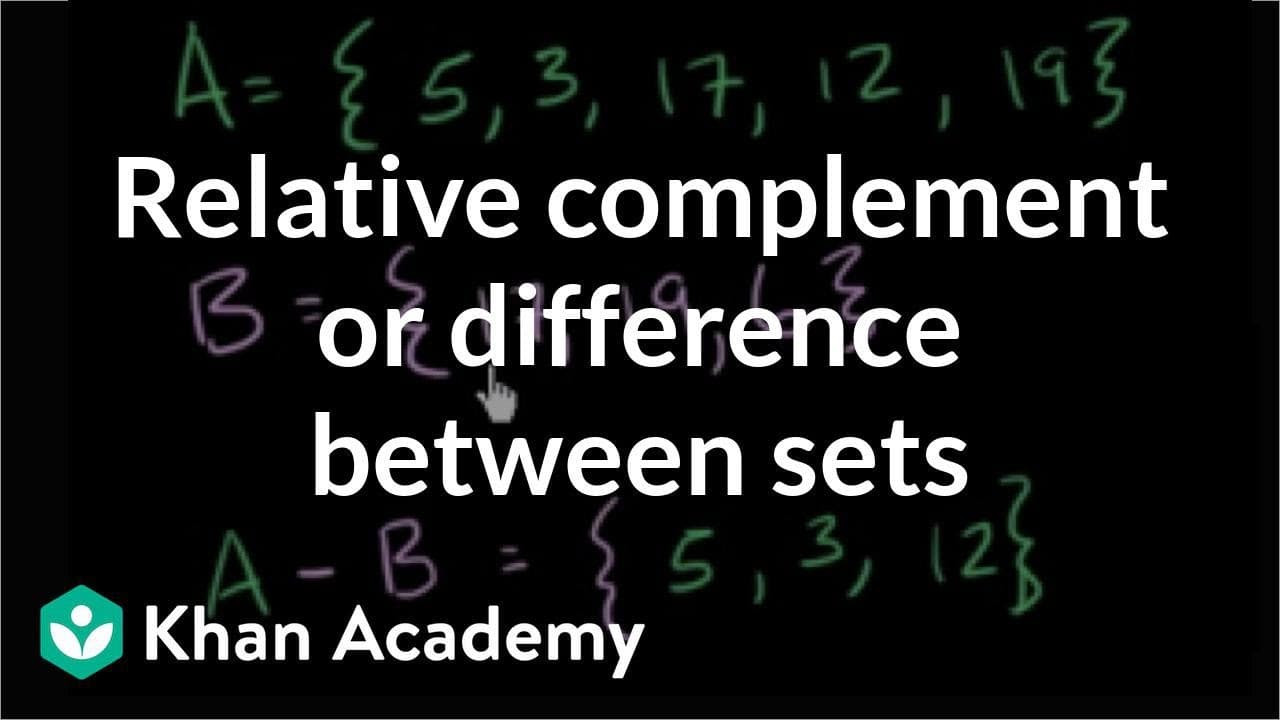
The difference A minus B is the set of elements that belong to A but not to B, also called the relative complement of B in A. In the example, A minus B is {5, 3, 12}, while B minus A is {6}. Subtracting a set from itself produces the empty or null set; read on to see why set subtraction depends on order and how each result is found.
Transcript
What we're now going to think about is finding the differences between sets. And the first way that we will denote this is we'll start with set A. I've already defined set A. Let me do it in that same shade of green. I've already defined set A here. And in both cases, I've defined these sets with numbers. Instead of having numbers as being the obje... Read More
Key Insights
- 😫 Sets can be subtracted from each other to find the unique elements.
- 😫 The difference between sets can be represented by subtracting one set from another.
- 😫 The relative complement of one set in another represents the elements that are not in the second set but are in the first set.
- 😫 Subtracting an element from a set that doesn't contain it doesn't change the set.
Install to Summarize YouTube Videos and Get Transcripts
Explore YouTube Video Summarizer or Get YouTube Transcript Extractor
Questions & Answers
Q: How do you find the difference between two sets?
To find A minus B, start with every element in A and remove each element that also appears in B. The result contains all elements that are in A but not in B.
Q: What is the relative complement of B in A?
The relative complement of B in A is the set of elements that are not in B but are in A. It is another way to describe B subtracted from A, or A minus B.
Q: What is A minus B in the example?
Set A contains 5, 3, 17, 12, and 19, while B contains 17, 19, and 6. Removing the elements shared with B leaves {5, 3, 12}.
Q: What is B minus A in the example?
Starting with B, the 17 and 19 are removed because they also occur in A. The 6 remains because it is not in A, so B minus A is {6}.
Q: Does the order of set subtraction matter?
Yes. In the example, A minus B is {5, 3, 12}, but B minus A is {6}. Reversing the sets changes which set supplies the starting elements and which elements are removed.
Q: What happens when the subtracted set contains an element absent from the starting set?
Nothing changes for that element because there is no matching element to remove. For example, removing 6 from A has no effect because A did not contain 6 to begin with.
Q: What is the difference between a relative complement and an absolute complement?
The relative complement restricts the result to elements within another set, such as elements not in B but still in A. The transcript contrasts this with considering everything outside B more broadly, including objects such as the color orange or a zebra.
Q: What is A minus A?
A minus A is the empty set, also called the null set. Every element is removed because each element of A is also in A, leaving a set with no objects.
Summary & Key Takeaways
-
Sets can be represented by numbers or other objects and can be subtracted from each other to find the elements unique to each set.
-
Subtracting set B from set A gives the elements that are in set A but not in set B.
-
The relative complement of set B in set A refers to the elements that are not in set B but are in set A.
Read in Other Languages (beta)
Share This Summary 📚
Summarize YouTube Videos and Get Video Transcripts with 1-Click
Try YouTube Summary with ChatGPT & Claude or YouTube Transcript Generator
Explore More Summaries from Khan Academy 📚



Summarize YouTube Videos and Get Video Transcripts with 1-Click
Try YouTube Summary with ChatGPT & Claude or YouTube Transcript Generator