How to Set Up a Primary-Secondary Deployment in Kubernetes
TL;DR
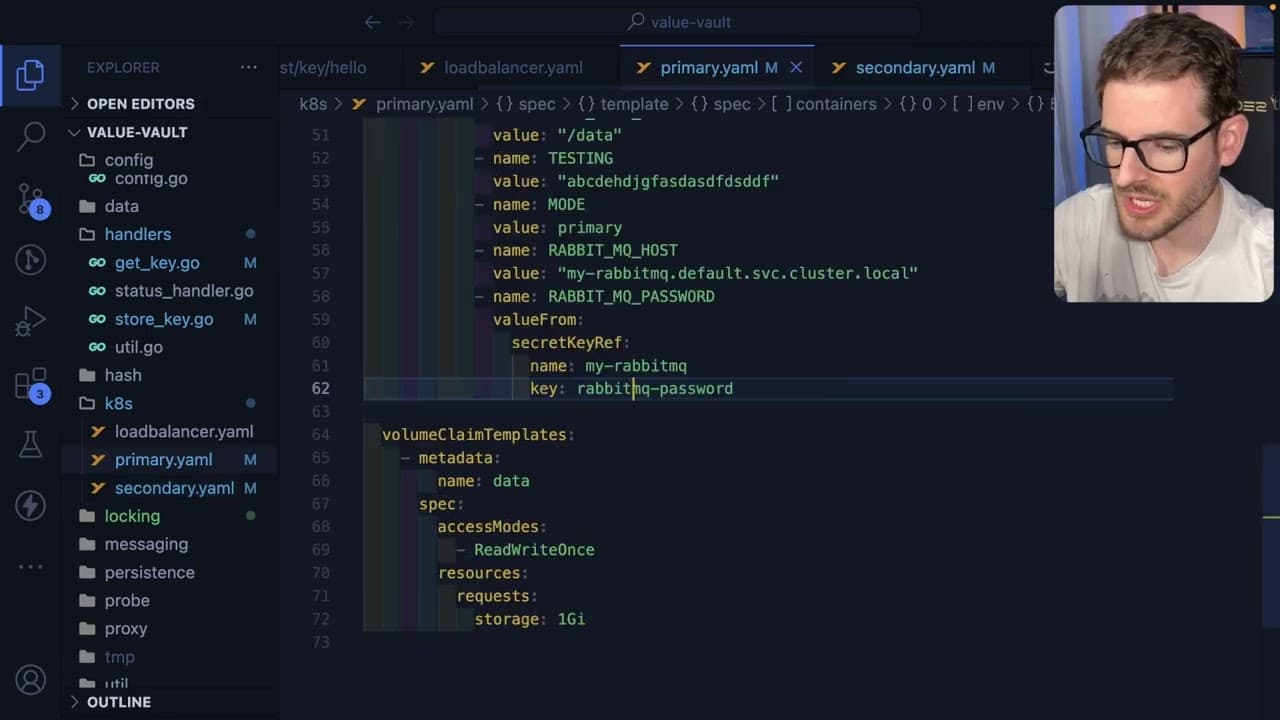
To set up a primary-secondary deployment in Kubernetes, configure a load balancer to route requests to a primary stateful set, with a secondary set acting as a failover. Use RabbitMQ for event-driven data replication to ensure data consistency, and implement a locking mechanism in Go to manage concurrent access effectively.
Transcript
so I've been trying to slowly add on to this distributed key value storage application I'm building using go and deploying with kubernetes and again this is just for me to learn more about kubernetes and go and again this is subject to change as I learn more and more and try to rethink what I'm doing so this is the current setup that I have uh with... Read More
Key Insights
- 🎓 The speaker's project emphasizes personal education in deployment principles, fault tolerance, and data consistency using distributed systems.
- 🤯 The architecture is designed with scalability in mind, using a load balancer to efficiently distribute requests across multiple replicas while maintaining a fallback mechanism for failover scenarios.
- 🚚 RabbitMQ serves as a critical component in the setup, enabling reliable message delivery for data synchronization across different nodes, thus ensuring all writes are captured and processed.
- 🤩 Implementing a locking mechanism in Go with mutexes helps to maintain data integrity during concurrent access, ensuring that only one write operation occurs per key at a time.
- 🪡 The speaker illustrates the need for careful event management and data migration strategies, particularly when changing configurations or scaling the application.
- 😫 Integrating both active and passive stateful sets allows for a robust deployment strategy, as new configurations can be tested without impacting user experience during transitions.
- 🍵 The learning curve involves exploring advanced topics like consistency models and messaging patterns, which are essential for architecting resilient systems capable of handling real-world applications.
Install to Summarize YouTube Videos and Get Transcripts
Explore YouTube Video Summarizer or Get YouTube Transcript Extractor
Questions & Answers
Q: What is the primary purpose of the distributed key-value storage application being built?
The distributed key-value storage application aims to facilitate learning about Go and Kubernetes while providing experience in developing scalable, fault-tolerant systems. The creator is focusing on practical implementation and iterating on the design as they learn more about the technologies involved.
Q: How does the load balancer function in this setup?
The load balancer routes user requests to the primary stateful set, managing traffic effectively to ensure users can store or retrieve values. The system is designed so that if the primary fails, the traffic can be re-routed to a secondary set, allowing for seamless operations, maximizing uptime, and minimizing errors.
Q: What strategies are used for data replication and consistency?
Data replication is managed through the use of RabbitMQ for event-driven messaging, where every write to the primary state is published to a queue, allowing secondary nodes to subscribe and replicate the data accordingly. To ensure consistency, the speaker employs a locking mechanism using mutexes to prevent race conditions during simultaneous reads and writes.
Q: What challenges does the creator face with scaling the application?
Scaling introduces challenges such as redistributing data between nodes and handling possible downtime during updates. As new nodes are added to the stateful set, the author must ensure data is updated and remains consistent across systems, which requires careful planning of deployment strategies and efficient data handling protocols to maintain service availability.
Summary & Key Takeaways
-
The speaker is developing a distributed key-value store application to enhance their skills in Go and Kubernetes, discussing their current setup for handling user requests for storing and retrieving values.
-
The architecture involves a load balancer routing requests to a primary stateful set, which maintains fault tolerance by allowing a secondary stateful set to take over during failures or upgrades without affecting user requests.
-
The author is exploring data redistribution strategies, including leveraging RabbitMQ for event-driven data replication, addressing challenges in statefulness, and ensuring consistency in data access across nodes.
Read in Other Languages (beta)
Share This Summary 📚
Summarize YouTube Videos and Get Video Transcripts with 1-Click
Try YouTube Summary with ChatGPT & Claude or YouTube Transcript Generator
Explore More Summaries from Web Dev Cody 📚

Summarize YouTube Videos and Get Video Transcripts with 1-Click
Try YouTube Summary with ChatGPT & Claude or YouTube Transcript Generator