How to Analyze Diode Circuits in Series and Parallel
TL;DR
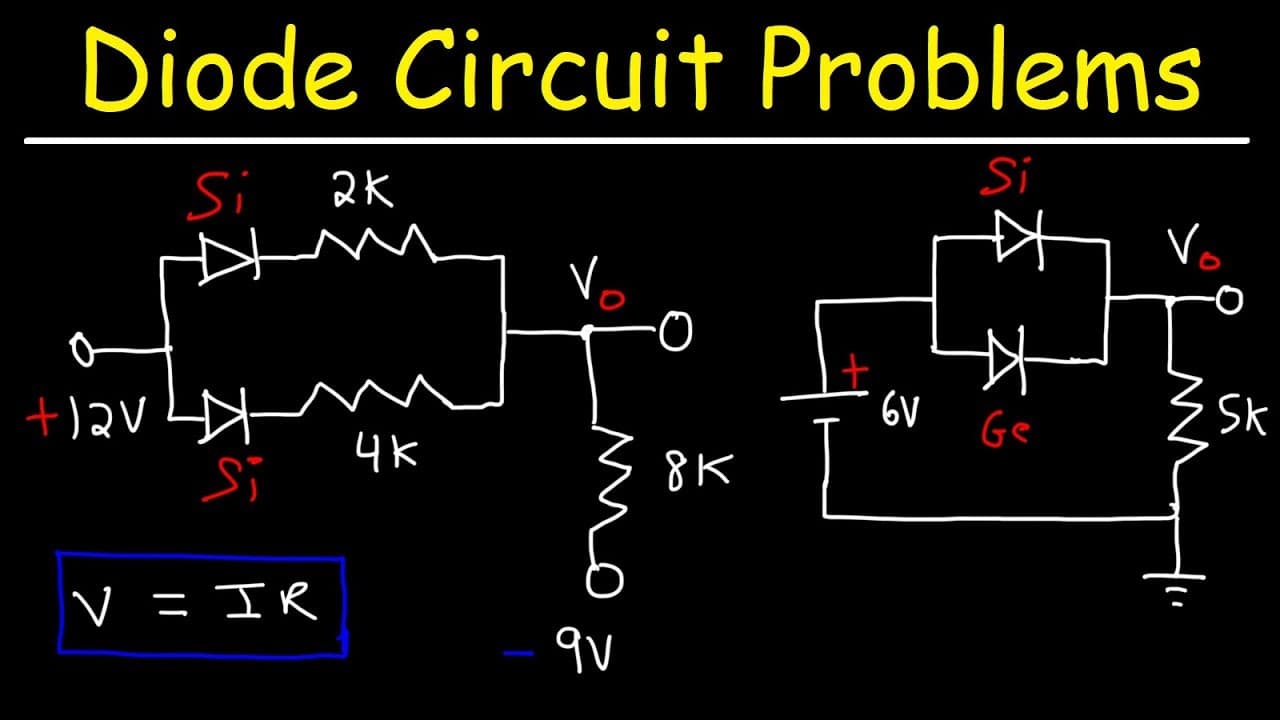
To analyze diode circuits, first determine if the diodes are on or off based on their voltage drops (0.7V for silicon, 0.3V for germanium). Use Ohm's Law (V=IR) to calculate output voltage and current flow through resistors, adjusting for configurations like series and parallel setups.
Transcript
in this video we're going to work on solving some diode circuit problems so for each of these circuits calculate the output voltage and the current flowing through the resistors now the first thing we need to determine is if the diode is on or in the off state the silicon diode requires a voltage of about 0.7 volts to activate it so there's enough ... Read More
Key Insights
- ⚡ Diodes require a certain voltage to be activated, usually around 0.7 volts for silicon diodes and 0.3 volts for germanium diodes.
- ♍ Understanding Ohm's Law (V = IR) is crucial for calculating current in resistors.
- ❓ Kirchhoff's Voltage Law can be used to analyze complex circuits and calculate potential differences.
- 😀 When resistors are in parallel, the equivalent resistance can be calculated using the formula 1/R = 1/R1 + 1/R2.
- 🎁 The path of least resistance determines which diode is on when multiple diodes are present.
- ⚡ Output voltage is determined by subtracting voltage drops from the input voltage.
- ⚾ Current is divided in parallel resistor circuits based on their respective resistances.
Install to Summarize YouTube Videos and Get Transcripts
Explore YouTube Video Summarizer or Get YouTube Transcript Extractor
Questions & Answers
Q: How do you determine if a diode is in the on or off state?
To determine the state of a diode, you need to consider the voltage required to activate it. For a silicon diode, it needs about 0.7 volts to turn on, while a germanium diode requires 0.3 volts. If the energy from the source is enough to meet these requirements, the diode will be on.
Q: What is the formula to calculate current in a resistor?
The formula to calculate current in a resistor is Ohm's Law, which states that current (I) is equal to voltage (V) divided by resistance (R). So, I = V / R.
Q: How do you calculate the output voltage in a diode circuit?
To calculate the output voltage, you need to determine the potential difference between two points in the circuit. Subtract the voltage drops across any diodes or resistors from the input voltage to obtain the output voltage.
Q: How do you calculate the total current in a diode circuit with parallel resistors?
To calculate the total current in a parallel resistor circuit, divide the total voltage across the resistors by the total resistance. This provides the sum of the currents flowing through each resistor.
Summary & Key Takeaways
-
This video provides step-by-step guidance on solving diode circuit problems, including determining if the diode is on or off and calculating output voltage and current flow.
-
The first circuit example demonstrates how to calculate the output voltage of 11.3 volts and a current of 2.26 milliamps.
-
The video also shows how to solve more complex diode circuit problems, including parallel resistors and multiple diodes.
Read in Other Languages (beta)
Share This Summary 📚
Summarize YouTube Videos and Get Video Transcripts with 1-Click
Try YouTube Summary with ChatGPT & Claude or YouTube Transcript Generator
Explore More Summaries from The Organic Chemistry Tutor 📚




Summarize YouTube Videos and Get Video Transcripts with 1-Click
Try YouTube Summary with ChatGPT & Claude or YouTube Transcript Generator