How Can Parents Keep Their Families Safe Online?
TL;DR
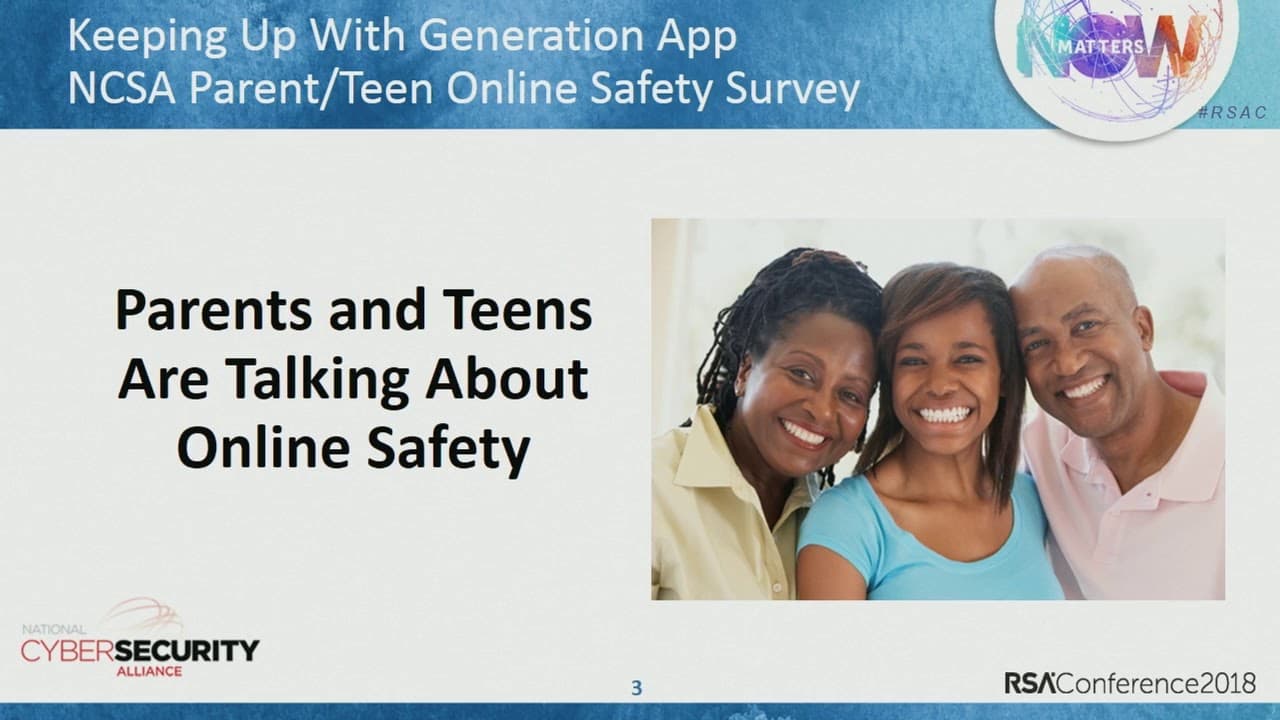
Parents can improve family safety online by discussing appropriate behavior, information sharing, account access, device security, identity theft, and deceptive messages with their children. Research involving more than 800 adults and more than 800 teens found that these conversations are happening, but parents consistently reported them more often than teens, suggesting that communication must be clear, memorable, and ongoing.
Transcript
Uh, good morning, everybody. Uh, welcome to San Francisco. Welcome to rainy San Francisco. It's so unusual that we get, um, a morning of rain like this, and so for all of us locals, we're pretty happy about it. Um, thank you for making the journey. Uh, my name is Jennifer Van Otta. Um, I'm an active communi- community member in San Francisco. I'm a... Read More
Key Insights
- Family online safety is presented as a communication challenge as well as a technical one. My Digital TAT2 promotes an optimistic approach in which parents communicate with children, remain curious rather than furious, and help families thrive in a highly connected environment.
- The National Cybersecurity Alliance is a neutral nonprofit that provides cybersecurity education and awareness for businesses and consumers. It works with technology companies, government agencies, schools, universities, and other groups to support a safer, more trusted, and more secure internet.
- The research is based on responses from more than 800 adults and more than 800 teens, with a stated margin of error of three and a half percentage points in either direction. Microsoft sponsored the research in part.
- Parent-teen conversations about internet and phone use are widely reported, but the groups remember them differently. Eighty percent of parents said these conversations occurred, compared with 68 percent of teens, revealing a notable gap in how family communication is perceived.
- Discussions about appropriate online behavior are less commonly reported by teens than by parents. Seventy-seven percent of parents said they had discussed what is appropriate and inappropriate, while only 64 percent of teens reported having such a discussion.
- Information sharing is the most frequently reported discussion topic in the presented results. Eighty-three percent of parents and 74 percent of teens said they had discussed what information should be shared through phones, screens, or applications.
- Parents and teens emphasize different privacy threats. Parents are particularly concerned that someone will share their children's private information, while 65 percent of teens are concerned that someone will access their accounts without permission, potentially including access by parents.
- Identity theft can include account access, account takeover, impersonating someone through posts, or creating an entirely new account in another person's name. Device security and identifying fake emails, social posts, and text messages also appear among the leading concerns.
Install to Summarize YouTube Videos and Get Transcripts
Explore YouTube Video Summarizer or Get YouTube Transcript Extractor
Questions & Answers
Q: How should parents discuss online safety with children?
Parents should treat online safety as an ongoing communication issue and talk with children about internet and phone use, appropriate behavior, private information, account access, and device security. The approach described by My Digital TAT2 is optimistic and encourages adults to be curious rather than furious. This creates space for families to discuss problems while adapting together to a highly connected environment.
Q: What did the research find about family internet discussions?
The research found that many parents and teens reported discussing internet and phone use, although their recollections differed. Eighty percent of parents said such conversations had occurred, compared with 68 percent of teens. The difference suggests that a parent may believe a subject has been addressed even when the child does not recognize or remember the exchange as a meaningful online-safety conversation.
Q: What online behavior topics do parents and teens discuss?
Families discuss which online behaviors are appropriate and which are not. Seventy-seven percent of parents reported having this discussion, while 64 percent of teens said it had happened. The research also covered internet use, phones, information sharing, account access, identity theft, device security, and the identification of fake emails, social media posts, and text messages.
Q: What should families discuss about sharing information online?
Families should discuss what information may be shared through a phone, screen, application, or social account, along with who may receive or redistribute it. Eighty-three percent of parents and 74 percent of teens reported discussing information sharing. The findings show that both the content being shared and access to the device or account are important parts of privacy conversations.
Q: Why do parents and teens have different online privacy concerns?
Parents tend to approach online privacy protectively, worrying that another person will take their child's private information and pass it to a third party. Teens express a related but distinct concern: 65 percent fear someone accessing their accounts without permission. The presentation notes that this concern may include parents going through a teen's phone, so privacy can involve both outsiders and family boundaries.
Q: What does identity theft mean in the online safety research?
Identity theft has several meanings in the presentation. It can involve unauthorized access to an account, takeover of an existing account, posting while pretending to be someone else, or creating a new account in another person's name. The presenter suggests adults may associate it more with account takeover, while teens may connect it with impersonation or redistribution of another person's information.
Q: How can teens think about keeping their devices secure?
Device security includes preventing someone from accessing a screen when the device is left unattended and recovering access when a password is forgotten or an account is compromised. The presentation identifies keeping devices secure as the second leading concern for teens. It also connects security with control over who can enter an account, view information, or use the device without permission.
Q: Why is identifying fake online messages becoming important?
Identifying fake emails, social media posts, and text messages is presented as a growing concern. The speaker connects it with deceptive identities affecting teens and with concerns about fake news and false social accounts. The presentation says this concern registered 30 percent in the prior year and predicts that it may grow if the research is repeated the following year.
Summary & Key Takeaways
-
Jennifer Van Natta describes becoming concerned about the intersection of children, families, education, and technology after seeing Facebook during its early development. She later found My Digital TAT2, whose optimistic approach encourages parents to communicate with children and to be curious rather than furious about their online lives.
-
Russell Schrader introduces the National Cybersecurity Alliance as a neutral nonprofit focused on business and consumer education. Its efforts include Data Privacy Day, National Cybersecurity Awareness Month, Lock Down Your Login, Cyber Secure My Business, and Stop Think Connect, with partnerships involving government agencies, technology companies, schools, universities, and businesses.
-
Research sponsored in part by Microsoft surveyed more than 800 adults and more than 800 teens about online attitudes, concerns, knowledge, and responsibility. Parents and teens reported discussions about internet use, appropriate behavior, and information sharing, while identifying identity theft, unauthorized account access, device security, and deceptive messages as important concerns.
Read in Other Languages (beta)
Share This Summary 📚
Summarize YouTube Videos and Get Video Transcripts with 1-Click
Try YouTube Summary with ChatGPT & Claude or YouTube Transcript Generator
Explore More Summaries from RSAC Cybersecurity 📚




Summarize YouTube Videos and Get Video Transcripts with 1-Click
Try YouTube Summary with ChatGPT & Claude or YouTube Transcript Generator