How Does Proxmark3 Test RFID Access Security?
TL;DR
Proxmark3 can sniff, read, write, clone, and emulate RFID cards, allowing researchers to evaluate whether badge-based access controls can be bypassed. RFID tags receive power through electromagnetic induction and return stored identity or authentication data, while security varies across more than twenty card standards and is weakened when older cards or unexamined proprietary cryptography remain in use.
Transcript
Good afternoon. Welcome everybody. Um, so my name's Dan Ayub. I, um, I do this kind of, uh, for fun, so this is a hobby. I full-time work as product manager and product marketing stuff, uh, for network security. But, um, brief overview of where I'm gonna be going today. I'm gonna give you a little bit of a primer on RFID just to kinda set the stage... Read More
Key Insights
- RFID tags are powered through electromagnetic induction: a reader produces a magnetic field, the tag antenna converts that field into current, and the resulting power activates a chip that communicates stored data back through the antenna.
- An RFID tag consists primarily of an antenna and a chip, with the chip storing information such as an identifier, authentication data, or a cryptographic mechanism. RFID devices can appear as cards, stickers, small pill-shaped units, or implantable tags about the size of a grain of rice.
- An RFID reader is connected to equipment that generates and modulates electromagnetic signals, while a computer processes and interprets the responses. Depending on the software and application, the system can authenticate users, log activity, or initiate other actions.
- A corporate RFID access system checks a presented badge against registered user information before unlocking a door. The computer logs the access event and sends a signal to an electromagnetic lock, while invalid or unusual attempts may be logged and reported.
- RFID security varies across more than twenty card standards, including newer options that support FIPS and AES. Card selection depends on the application and required security level, and cards may contain manufacturer-loaded public and private keys or accept keys supplied by the organization.
- Proprietary cryptographic algorithms are a security concern because many have not received broad examination. Research into breaking RFID cards and bypassing authentication systems had continued for more than five years, and several older card standards had already been broken.
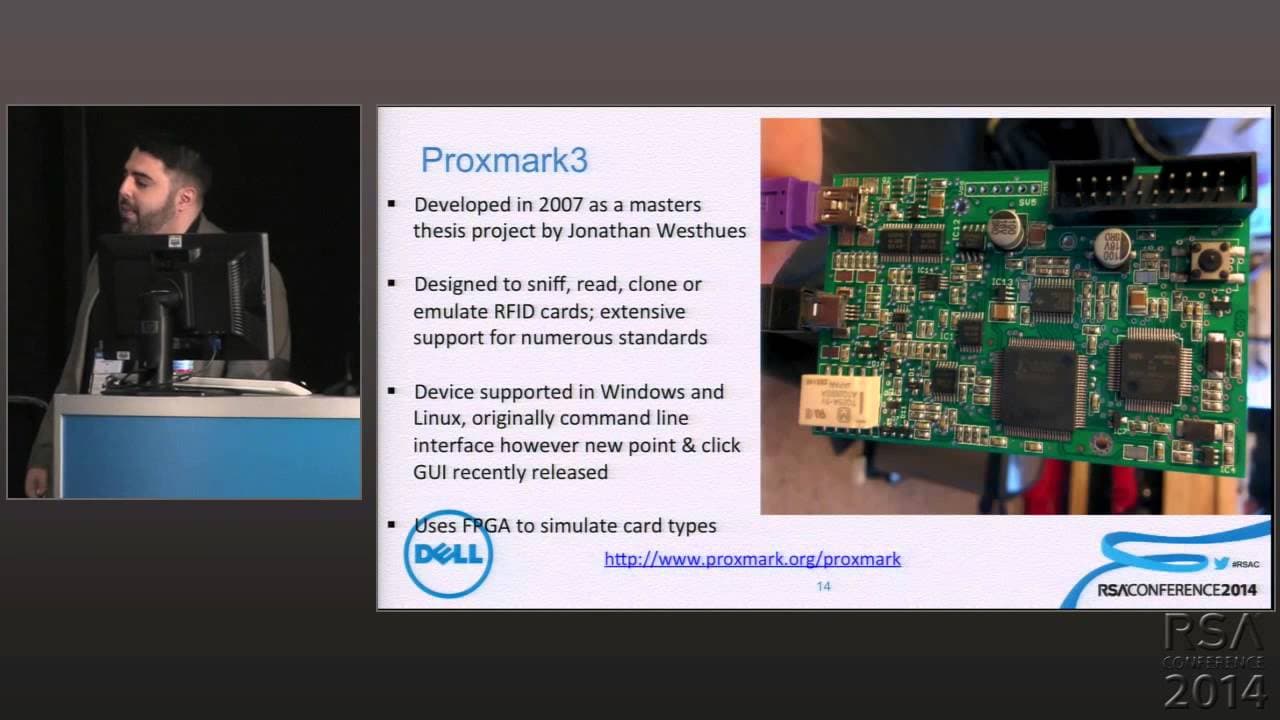
- Proxmark3 is designed to sniff, read, write, clone, and emulate RFID cards. The device uses an FPGA for much of its processing and card emulation, plus a microcontroller for board communication and additional components for signal processing.
- Proxmark3 development is supported by an active community that regularly updates its operating system and tracks fixes. The platform began as Linux-only software, later gained Windows support and a graphical interface, and newer boot ROMs allow firmware flashing over USB instead of requiring JTAG.
Install to Summarize YouTube Videos and Get Transcripts
Explore YouTube Video Summarizer or Get YouTube Transcript Extractor
Questions & Answers
Q: How does RFID work without a battery in the tag?
RFID can power a tag through electromagnetic induction. The reader produces a magnetic field, and the antenna inside the nearby tag picks up that field and generates an electrical current. That current powers the tag's chip. The chip then uses the antenna to respond to the reader with stored information, which may include an identifier, authentication data, or a cryptographic mechanism.
Q: How does an RFID badge unlock a corporate door?
An RFID reader detects the badge and sends the received information to a connected computer system. That system checks whether the card is registered and ties it to the appropriate user record. If authentication succeeds, the computer records the event and sends a signal to the electromagnetic lock so the door opens. Improper activity can also be logged and may trigger a notification.
Q: What can Proxmark3 do with RFID cards?
Proxmark3 is designed to sniff communications and to read, write, clone, and emulate RFID cards. These capabilities let a researcher inspect how badges and readers communicate, reproduce supported card data, and simulate a card during security testing. The presentation frames those capabilities as a way to explore weaknesses in RFID authentication systems, particularly physical access controls used by organizations.
Q: What hardware components make Proxmark3 work?
Proxmark3 includes a USB port, connections for antennas, a field-programmable gate array, a microcontroller, and signal-processing equipment. The FPGA performs much of the processing and card emulation. The microcontroller manages how the board interacts with the user and connected computer, while the antennas and signal-processing components support communication with different RFID cards and signals.
Q: Why can older RFID card standards create security risks?
Older RFID card standards can create risk because several had already been broken when the presentation was prepared. They may remain attractive because they are cheaper and are used in applications such as mass transit. If an organization relies on a broken standard, tools capable of reading, cloning, or emulating cards may help a researcher bypass the authentication mechanism protecting the system.
Q: Why is proprietary RFID cryptography a concern?
Proprietary cryptographic algorithms are concerning because many have not been examined as openly or thoroughly as more established alternatives. The presentation identifies attempts to crack these proprietary mechanisms as a source of discovered weaknesses and attacks. Although some advanced cards support technologies such as FIPS and AES, security still depends on the chosen standard, configuration, keys, and required authentication level.
Q: How is Proxmark3 firmware structured and updated?
The Proxmark3 firmware setup includes a boot ROM, FPGA code, and an operating system. The operating system was being updated regularly, while the boot ROM and FPGA code changed less frequently. Newer boot ROM versions support flashing updates through USB. Older versions required JTAG, so the newer process makes maintaining and updating the device easier for users.
Q: How did Proxmark3 become an accessible RFID research tool?
Proxmark3 began as a master's thesis project in 2007 and became commercially available a couple of years later. It was initially a Linux-only platform, but it was later ported to Windows and gained a graphical interface that sends commands to the underlying command line. Devices, antennas, and writable cards could be purchased online, and an active community continued improving the software.
Summary & Key Takeaways
-
RFID systems use electromagnetic induction to power a tag containing an antenna and chip. The tag returns stored identity, authentication, or cryptographic information to a reader, which forwards it to a computer. Software interprets the signal and may authenticate a person, record an event, or trigger another application-specific action.
-
Corporate access systems connect an RFID badge reader to a computer and an electromagnetic door lock. The computer checks whether the presented card is registered, associates it with a specific user, logs the event, and signals the lock. Improper authentication attempts can also be recorded and may generate a notification.
-
Proxmark3 is a deck-of-cards-sized research device designed to sniff, read, write, clone, and emulate RFID cards. Its hardware includes an FPGA, a microcontroller, signal-processing components, USB connectivity, and interchangeable antennas. Active community development has expanded it from Linux to Windows and made firmware updates easier through USB flashing.
Read in Other Languages (beta)
Share This Summary 📚
Summarize YouTube Videos and Get Video Transcripts with 1-Click
Try YouTube Summary with ChatGPT & Claude or YouTube Transcript Generator
Explore More Summaries from RSAC Cybersecurity 📚


Summarize YouTube Videos and Get Video Transcripts with 1-Click
Try YouTube Summary with ChatGPT & Claude or YouTube Transcript Generator