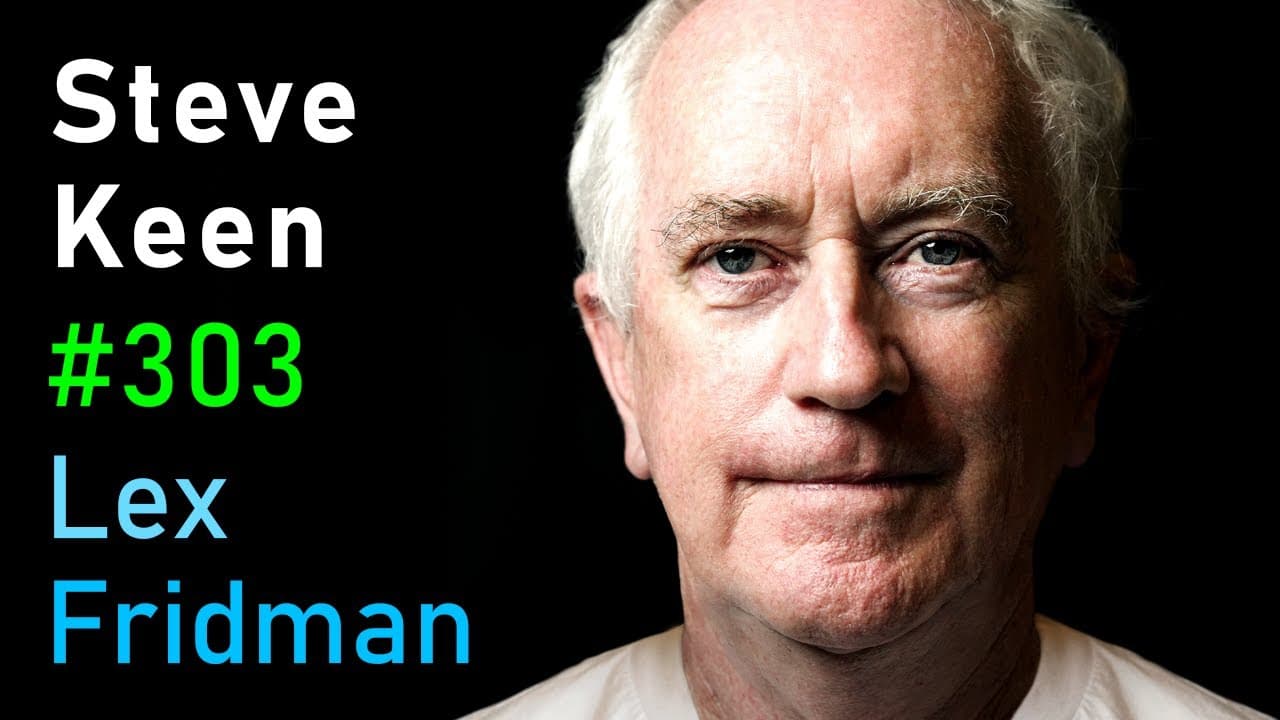
Steve Keen: Marxism, Capitalism, and Economics | Lex Fridman Podcast #303
TL;DR
Marxism posits that labor is the primary source of value in a capitalist economy, highlighting the inherent exploitation of workers for profit. The philosophy critiques traditional economic theories, emphasizing the tension between use value and exchange value, and suggests a transformative path towards socialism driven by these economic contradictions.
Transcript
the real foundation of marx's political philosophy was the economic argument that there would be a tendency for the rate of profit to fall and that tendency for the rate of profit of fall would lead to capitalists battening down on workers harder paying them less than their subsistence uh i would revolt by workers against this and then you would ge... Read More
Key Insights
- 📚 Marx's political philosophy centered around the economic argument of a falling rate of profit, leading to exploitation of workers and the need for socialism. (
- 🌍 Marx believed that the revolution would first happen in advanced economies like England, while primitive economies like Russia would have to go through a capitalist transition before reaching socialism. (
- 🎙 Steve Keen, an economist, criticizes modern economics and proposes new theories by integrating ideas from thinkers like Marx, Keynes, and Minsky. (
- 💭 Economics should aim to understand human civilization and how it can be sustained, but the discipline has failed to fulfill this purpose. (
- 💰 The soul of economics is to explain how humans elevate themselves above the natural environment, and this elevation is made possible by utilizing high-grade energy sources. (
- 🌍 Life is an incredible creation, and economists should focus on preserving and respecting it, rather than contributing to its potential demise. (
- 📈 Economics should use tools from systems engineering to better understand the complex and ever-changing nature of the economy. (
- 🔬 There are various economic schools of thought, including physiocrats, classical economists, neoclassical economists, Keynesians, and post-Keynesians, each offering different perspectives on value, equilibrium, and the role of money in the economy. (
Install to Summarize YouTube Videos and Get Transcripts
Explore YouTube Video Summarizer or Get YouTube Transcript Extractor
Questions & Answers
Q: What is Marx's dialectical approach to understanding value in a capitalist economy?
Marx's dialectics emphasizes the tensions between use value (the utility of a commodity) and exchange value (the price or worth of a commodity). He argues that the primary source of value in a capitalist economy is labor, and the exploitation of workers for profit is an inherent aspect of the system.
Q: How does Marx challenge traditional economic theories on value and capitalism?
Marx rejects the neoclassical theory that subjective utility determines the value of a commodity. Instead, he emphasizes the objective value of commodities based on the labor required to produce them. Marx also critiques the exploitation of workers in a capitalist system, arguing that their labor creates surplus value appropriated by capitalists.
Q: What role does labor play in Marx's explanation of value in a capitalist economy?
Labor is the core of Marx's theory of value. He argues that the labor of workers adds value to commodities and determines their worth. The capitalist system, according to Marx, exploits workers by paying them less than the value of their labor, leading to the creation of surplus value that is controlled by capitalists.
Q: How does Marx's analysis of value in a capitalist economy relate to his overall critique of capitalism?
Marx's critique of capitalism is based on the inherent contradictions and tensions within the system. His analysis of value highlights the exploitation of workers and the unequal distribution of wealth in a capitalist society. Marx argues that these contradictions will ultimately lead to the downfall of capitalism and the emergence of socialism.
Q: How does Marx's dialectical vision of value challenge the traditional understanding of economics?
Marx's dialectical approach challenges the neoclassical understanding of economics, which focuses on subjective utility and equilibrium. Marx's emphasis on labor as the primary source of value and his recognition of tensions between use value and exchange value provide an alternative perspective on the nature of capitalism and its impact on society.
Summary
This conversation is with Steve Keen, an economist who criticizes modern economics and proposes new theories and models that integrate ideas from Karl Marx, John Maynard Keynes, and Hyman Minsky. Keen discusses the soul of economics as understanding human civilization and how it can be maintained. He argues that economics should use the tools of engineering and systems analysis to study complex systems like the human mind, the economy, and the biosphere. Keen explores the different schools of economics, including the physiocrats, classical economics, neoclassical economics, Keynesian economics, and Austrian economics. He also delves into the concept of money and the role of money creation in the economy. Lastly, Keen praises Marx's critical examination of society and the dialectical philosophy of change.
Questions & Answers
Q: What should be the goal of economics?
Economics should aim to understand how human civilization comes about and how it can be maintained.
Q: How does Keen describe the soul of economics?
The soul of economics is to explain how human civilization elevates itself above the base level of the planet through the use of high-grade energy sources, like the sun, to create a complex society that surpasses the energy and consumption levels of the natural environment.
Q: What are the tools of economics that should be used?
Economics should use the tools of engineering, such as systems analysis and differential equations, to model and understand complex systems like the economy.
Q: How do potential economists usually view economics?
Without critical background knowledge, most new economists view economics as the neoclassical school, which is based on the subjective theory of value and equilibrium analysis.
Q: What did Marx argue about labor and value?
Marx believed that labor was the only source of value and that machinery did not add value.
Q: What is dialectics according to Marx?
Marx's dialectics is a philosophy of change that focuses on the tension between foreground and background elements in society. It explores the unity of an object, such as a human or commodity, and how different aspects are emphasized or de-emphasized.
Q: What did Keen say about money creation?
Money creation is a good thing and essential for commerce. It occurs through private banks creating money through loans and the government creating money through deficits and spending.
Q: How does Keen describe money?
Money is fundamentally a promise of a third party that is exchanged between buyer and seller, facilitated by the banking sector. It is a triangular transaction involving the buyer, seller, and the bank.
Q: What schools of economics did Keen mention?
Keen discussed the physiocrats, classical economics, neoclassical economics, Keynesian economics, and Austrian economics as different schools of economic thought.
Q: What sets Keynesian economics apart from other schools?
Keynesian economics recognizes the instability and volatility of a capitalist economy, emphasizing the role of uncertainty in investment decisions and the importance of government deficits in creating money.
Takeaways
Economics should aim to understand human civilization and how it can be maintained. It should use tools from engineering and systems analysis to study complex systems like the economy. The neoclassical school of economics, which is the dominant school, focuses on subjective utility and equilibrium analysis but neglects the dynamic nature of capitalism. Marx's dialectical philosophy provides a powerful framework for understanding change in society. Money creation, both by private banks and the government, is essential for commerce. Keynesian economics recognizes the inherent instability of a capitalist economy and emphasizes the importance of government deficits in creating money.
Summary & Key Takeaways
-
Marx's philosophy is based on dialectics, which explores the tensions and contradictions in a capitalist society.
-
He argues that labor is the primary source of value in a capitalist economy, and the exploitation of workers for profit is inherent in the system.
-
Marx also highlights the importance of understanding the tensions between use value and exchange value in determining the price and worth of commodities.
-
His analysis critiques the neoclassical school of thought and offers a different perspective on the nature of capitalism and its impact on society.
Read in Other Languages (beta)
Share This Summary 📚
Summarize YouTube Videos and Get Video Transcripts with 1-Click
Try YouTube Summary with ChatGPT & Claude or YouTube Transcript Generator
Explore More Summaries from Lex Fridman Podcast 📚

Summarize YouTube Videos and Get Video Transcripts with 1-Click
Try YouTube Summary with ChatGPT & Claude or YouTube Transcript Generator