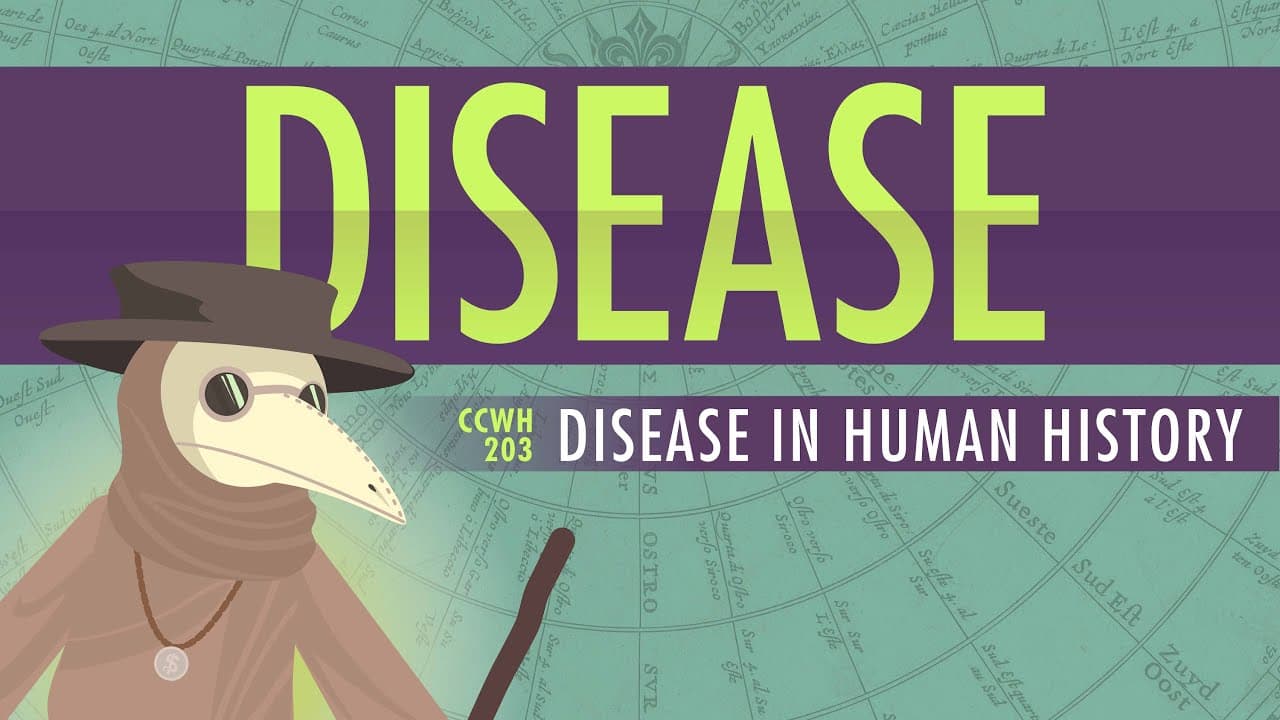
Disease! Crash Course World History 203
TL;DR
Disease has significantly influenced human history and civilization.
Transcript
Hi, I'm John Green, this is Crash Course World History, and today we're going to talk about a subject that makes me profoundly uncomfortable: disease. This is a tough subject for me personally because I'm a bit of a hypochondriac, but to be fair, my fears are kind of rational. I am afraid that my existence will be ended by a soulless, microscopic o... Read More
Key Insights
- Disease has played a crucial role in shaping human history, often acting as a limiting factor for population growth and civilization development.
- The Great Dying in the Americas exemplifies the massive impact of disease, wiping out large populations and reshaping cultures.
- Historically, diseases were often attributed to divine will, making them mysterious and terrifying, and thus less frequently documented in history.
- Migration and settlement in river valleys led to new disease problems due to increased population density and standing water, which facilitated the spread of epidemics.
- Trade and war have historically been major vectors for disease transmission, with armies and trade routes spreading diseases across regions.
- The Black Death serves as a prime example of a pandemic that had profound socio-economic impacts, including labor shortages and shifts in religious attitudes.
- The Columbian Exchange resulted in one of the most devastating pandemics, with diseases decimating indigenous populations in the Americas.
- Advancements in medicine, such as inoculation and antibiotics, have significantly reduced the impact of diseases, but challenges like antibiotic resistance and new epidemics persist.
Install to Summarize YouTube Videos and Get Transcripts
Explore YouTube Video Summarizer or Get YouTube Transcript Extractor
Questions & Answers
Q: How did disease influence early human populations?
Disease played a crucial role in keeping early human populations low, particularly in tropical regions where microparasites were abundant. As humans migrated out of Africa and settled in areas less conducive to disease, populations began to grow, eventually leading to the development of civilizations.
Q: What was the impact of the Black Death on Europe?
The Black Death had profound socio-economic impacts on Europe, killing a third of its population. It led to labor shortages, increased wages, and shifts in religious attitudes. The pandemic also prompted changes in construction techniques and living conditions to reduce the spread of disease.
Q: How did the Columbian Exchange affect indigenous populations in the Americas?
The Columbian Exchange introduced diseases like smallpox to the Americas, which decimated indigenous populations, potentially killing up to 90%. This massive loss of life disrupted communities and cultures, facilitating European colonization and dominance in the region.
Q: What role did trade play in the spread of disease?
Trade played a significant role in the spread of disease, as trade routes facilitated the movement of people and goods, along with pathogens. Historical pandemics, such as the Black Death, often followed trade routes, highlighting the dual nature of trade as economically beneficial but epidemiologically risky.
Q: What were some historical attitudes towards disease?
Historically, diseases were often attributed to divine will or wrath, making them mysterious and terrifying. This perception, along with a lack of understanding, led to diseases being less frequently documented in historical records, complicating modern efforts to study their impacts.
Q: How did the Great Dying differ from other pandemics?
The Great Dying was unique in its scale and impact, as it involved the introduction of Old World diseases to the Americas, where indigenous populations had no immunity. This led to catastrophic population declines, unlike other pandemics that primarily affected populations with some level of immunity.
Q: What advancements have been made in combating diseases?
Significant advancements in combating diseases include inoculation, which helped control viral diseases like smallpox, and the development of antibiotics, which have been effective against bacterial infections. These medical breakthroughs have drastically reduced the impact of diseases, although challenges like antibiotic resistance persist.
Q: What is the ongoing impact of disease on human history?
Disease continues to shape human history, as modern epidemics and antibiotic-resistant bacteria pose ongoing threats. Despite advancements in medicine, infectious diseases remain leading causes of death globally, reminding us of the complex relationship between humans and the biosphere.
Summary & Key Takeaways
-
Disease has been a significant force in human history, influencing population dynamics and cultural developments. Historically, diseases were often seen as acts of divine will, making them both mysterious and terrifying. Despite advancements in medicine, diseases continue to shape human history today.
-
The Black Death and the Great Dying are notable examples of pandemics that drastically altered societies. The Black Death led to economic changes in Europe, while the Great Dying decimated indigenous populations in the Americas, paving the way for European colonization.
-
Trade and war have historically facilitated the spread of diseases, with pandemics often following trade routes and military campaigns. Modern medicine has reduced the impact of diseases, but challenges like antibiotic resistance and new epidemics remain significant concerns.
Read in Other Languages (beta)
Share This Summary 📚
Summarize YouTube Videos and Get Video Transcripts with 1-Click
Try YouTube Summary with ChatGPT & Claude or YouTube Transcript Generator
Explore More Summaries from CrashCourse 📚




Summarize YouTube Videos and Get Video Transcripts with 1-Click
Try YouTube Summary with ChatGPT & Claude or YouTube Transcript Generator