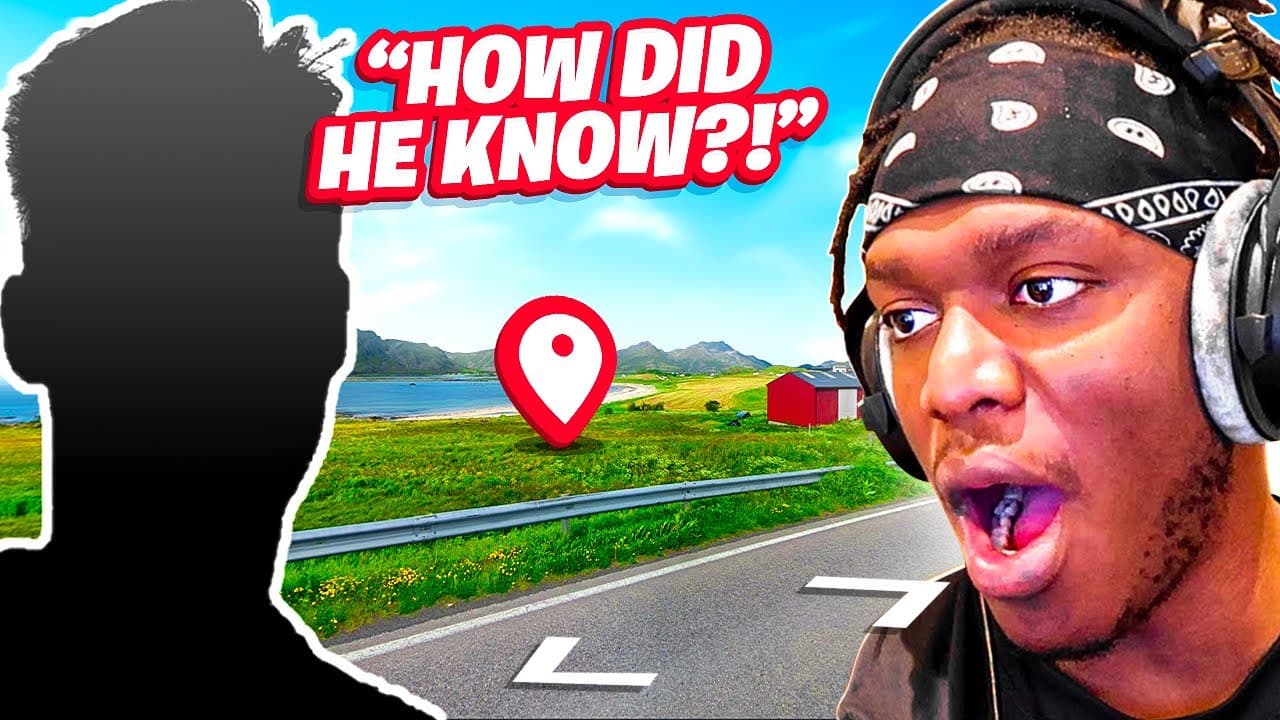
How Can Three Players Beat a GeoGuessr Expert?
TL;DR
Three players can challenge a stronger GeoGuessr opponent by searching in different directions, sharing clues, spreading their map guesses, and forcing quick decisions with early guesses. The match shows that road signs, scripts, driving sides, terrain, soil, and place names can guide identification, while rushed countdowns and unconfirmed assumptions often produce costly mistakes.
Transcript
how's it going guys welcome to uh one harry versus three sidemen geogebra edition it is myself uh versus jj toby and bez uh geo get a jewel the three brain cells this is gonna be interesting i think i think harry's got a task on his hand here yeah no it's three yeah because you can you can go in different directions so it's hard yeah but we're not ... Read More
Key Insights
- The contest is a one-versus-three GeoGuessr duel, with Harry playing alone against JJ, Tobi, and Behzinga. The team advantage comes from having several people who can inspect clues, discuss possibilities, and distribute guesses across different locations.
- Early guessing is a tactical weapon because it starts a countdown and forces the opponent to react before completing a search. JJ repeatedly guesses quickly, sometimes disrupting Harry, but his teammates also complain when the same tactic leaves them without enough time.
- Road signs are among the most decisive clues in the match. A sign mentioning Maidstone and the A274 allows the players to focus on southeastern England, producing close guesses and helping JJ finish closest during that specific location.
- Driving-side evidence can narrow the country when written clues are missing. During one rural round, the team connects left-side driving and yellow-and-black roadside markings with Australia, and Harry later acknowledges that the roadside observation was strong.
- Language and script clues are useful but easy to misinterpret under pressure. Dotted letters and unfamiliar words lead players toward Turkey, while the actual location is Albania, and Asian-looking writing later sends them toward Thailand before Israel is revealed.
- Terrain creates broad regional hypotheses rather than exact answers. Mountains suggest Andorra, Italy, or the Alps, red soil prompts guesses such as Botswana, Eswatini, and Lesotho, and flat land leads the group to consider Amsterdam and several Asian locations.
- Guess distribution improves the team's coverage when certainty is low. The three players deliberately spread their selections across countries or regions, including England, Scotland, Poland, Spain, and South Africa, instead of always stacking every guess in one place.
- Confidence does not reliably predict accuracy in these rounds. Players repeatedly call locations definite or obvious, then discover a different answer, while several admitted guesses, including Harry's Albania choice and JJ's close Polish placement, perform unexpectedly well.
Install to Summarize YouTube Videos and Get Transcripts
Explore YouTube Video Summarizer or Get YouTube Transcript Extractor
Questions & Answers
Q: How can three players challenge a GeoGuessr expert?
Three players can challenge a stronger individual by dividing the search, discussing separate interpretations, and spreading their guesses across plausible regions. In the match, JJ, Tobi, and Behzinga use their combined attention against Harry. Their best moments come when one player notices a concrete clue, another locates it on the map, and the group avoids placing every guess in the same uncertain area.
Q: Why do early guesses matter in a GeoGuessr duel?
An early guess matters because it starts the countdown and limits how long everyone else can continue investigating. JJ repeatedly uses quick guesses to pressure Harry into making rushed decisions. The tactic can work when Harry still lacks a country, but it also creates risk for JJ's teammates because they may not have selected or submitted their own locations before time expires.
Q: What geographic clues do the players use most often?
The players rely on road signs, town names, road numbers, alphabets, marked letters, driving sides, road colors, mountain scenery, soil color, and the overall flatness of the land. Their strongest clue is a sign naming Maidstone and the A274. Their weaker deductions often come from broad visual impressions, such as assuming mountains indicate Andorra or red soil indicates southern Africa.
Q: How do road signs help identify a location in GeoGuessr?
Road signs can provide place names, route numbers, language, and traffic conventions that sharply reduce the search area. In the England round, a sign mentioning Maidstone and the A274 directs the players toward southeastern England, near places they discuss such as Tonbridge and Rochester. That concrete information produces much closer guesses than rounds dominated by scenery and intuition alone.
Q: How does driving-side knowledge narrow a GeoGuessr guess?
Driving-side knowledge removes countries that use the opposite traffic direction and works best when combined with road markings or roadside signs. In one rural scene, the team believes traffic is using the same side as in England and connects yellow-and-black roadside signage with Australia. That combination supports Australia more convincingly than either observation would have done by itself.
Q: Why are language clues difficult to interpret under time pressure?
Language clues are difficult because short words, partial signs, and unfamiliar letter forms can resemble several languages. The players notice dotted letters and text that appears Turkish, leading them toward Turkey, but the revealed location is Albania. In another round, writing on a bus appears Asian, prompting Thailand and Indonesia discussions before the location is revealed as Israel.
Q: What mistakes repeatedly hurt the players' GeoGuessr guesses?
The recurring mistakes are overconfidence, relying on scenery without confirmation, moving in an unhelpful direction, and guessing before teammates are ready. Players call several countries definite and then receive a different result. They also complain about lag, dead-end routes, unreadable signs, and JJ's rapid countdowns, all of which reduce the time available to validate an initial theory.
Q: Does the transcript reveal who wins the GeoGuessr match?
The provided transcript does not establish a final winner. It includes an initial contest, a replay after the players discuss luck, and a final deciding sequence with several revealed locations. However, the text ends during another round after guesses involving Spain and South Africa. Any claim about the overall winner would therefore go beyond the supplied title, transcript, and description.
Summary & Key Takeaways
-
Harry competes alone against JJ, Tobi, and Behzinga in a GeoGuessr duel. The trio can investigate different routes, compare interpretations, and place guesses across multiple regions, while Harry relies on faster individual recognition. Their conversation mixes genuine geographic reasoning with deliberately rushed guesses intended to pressure their stronger opponent.
-
The players use visible evidence such as road numbers near Maidstone, unfamiliar scripts, marked letters, driving sides, mountain ranges, red soil, road colors, and business signs. Some clues produce strong results, including identifying southeastern England and recognizing Australia, while other scenes trigger conflicting guesses involving Albania, Turkey, Andorra, Italy, Israel, Belgium, and Thailand.
-
Speed becomes as important as geographic accuracy because an early guess starts the countdown for everyone else. JJ repeatedly uses fast guesses to restrict Harry's search time, although the tactic sometimes harms his own team. The transcript ends during another round after the trio divides guesses between Spain and South Africa, so no final winner is established.
Read in Other Languages (beta)
Share This Summary 📚
Summarize YouTube Videos and Get Video Transcripts with 1-Click
Try YouTube Summary with ChatGPT & Claude or YouTube Transcript Generator
Explore More Summaries from MoreSidemen 📚




Summarize YouTube Videos and Get Video Transcripts with 1-Click
Try YouTube Summary with ChatGPT & Claude or YouTube Transcript Generator