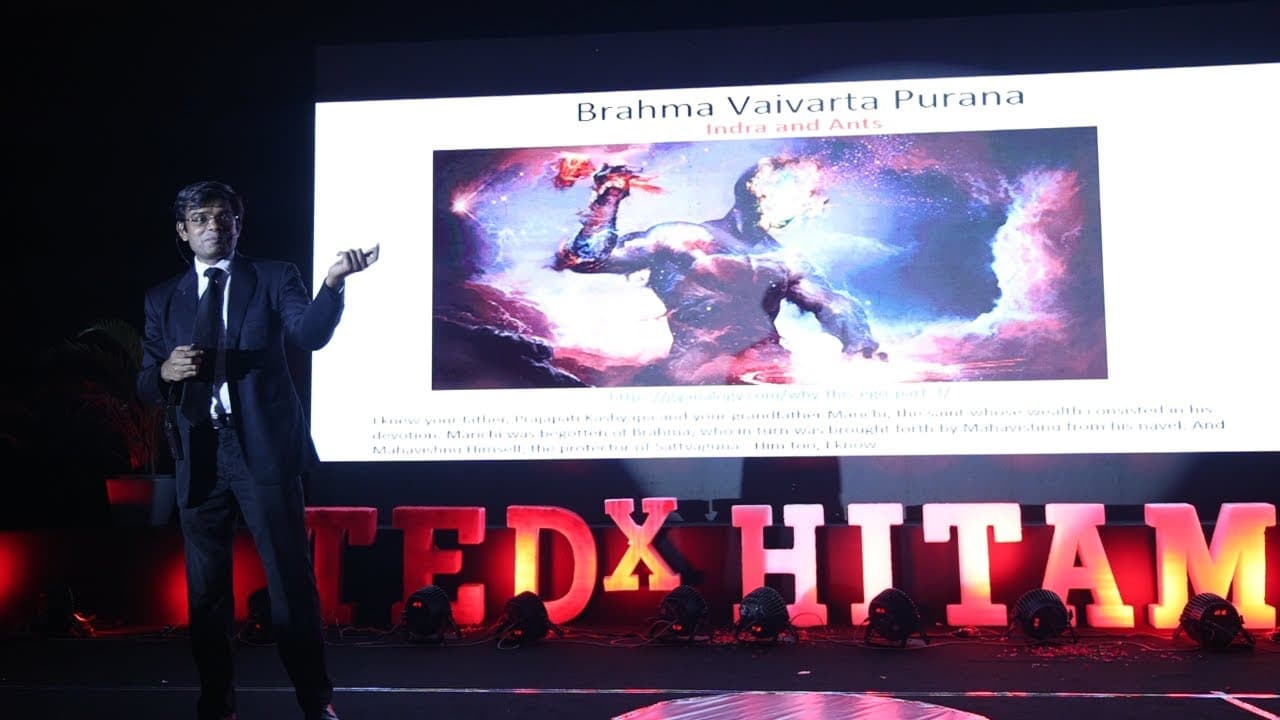
Bhagavad Gita and Infinity | Rahul Singh | TEDxHITAM
TL;DR
Rahul Singh presents the Bhagavad Gita as an instruction manual for life that explains how the living entity, or Jiva, interacts with Prakriti through time under karma and Ishwara. He connects its ancient wisdom to infinity, cyclical time, ethical action, desire, and happiness, including a cosmic cycle lasting 8.64 billion years. Read on to see how these concepts form a practical framework for modern life.
Transcript
expect you to remain silent when the speaker is on the stage and please do not be silent when there is nobody on stage please make use of this time to interact and talk to people connect to people and when the speaker is on the stage we will observe utmost silence are everybody with me a chair a little louder please thank you we will now move on ok... Read More
Key Insights
- 🛟 The Bhagavad Gita serves as an instruction manual for life, guiding individuals on how to interact with the material world and understand the laws of karma.
- 🏍️ Time in Indian scripture is considered cyclical, with cycles of creation and destruction lasting for billions of years.
- 🖐️ Karma plays a central role in determining the consequences of actions and moving towards spiritual growth.
- ❓ Detachment from desires and focusing on the process rather than the outcome is essential for attaining true happiness.
- 🥳 Ancient wisdom offers valuable insights and can bridge the gap between spirituality and modern-day applications.
- 🛟 The accumulation of actions and their consequences can shape future lives, emphasizing the importance of ethical behavior.
- 🖤 Gen Z's detachment from spiritual and religious learning may stem from a lack of understanding the influence of ancient wisdom on modern life.
Install to Summarize YouTube Videos and Get Transcripts
Explore YouTube Video Summarizer or Get YouTube Transcript Extractor
Questions & Answers
Q: What does Rahul Singh say the Bhagavad Gita teaches about infinity and life?
Rahul Singh describes the Bhagavad Gita as an instruction manual for leading life. He says its five concepts, Ishwara, Kala, Jiva, Karma, and Prakriti, are each infinite and together explain existence and action.
Q: How does the Bhagavad Gita serve as an instruction manual for life?
It explains how a Jiva, or living entity, interacts with Prakriti, the material world, within Kala, or time. According to Singh, this interaction follows the laws of Karma designed by Ishwara, the Supreme Controller.
Q: What are the five concepts Rahul Singh identifies in the Bhagavad Gita?
The five concepts are Jiva, Prakriti, Kala, Karma, and Ishwara. Singh defines them as the living entity, material nature, time, the laws governing action, and the Supreme Controller.
Q: How does Rahul Singh describe time in Indian scripture?
He describes time as circular rather than linear: the universe is created, destroyed, and created again. The talk states that a day of the universe governed by Brahma lasts 8.64 billion years.
Q: What are the four Yugas and their relative lengths?
Singh names Satya Yuga, Treta Yuga, Dvapara Yuga, and Kali Yuga. He says their lengths follow a ratio of 4:3:2:1, making Kali Yuga the shortest.
Q: How long does Kali Yuga last according to the talk?
The talk describes Kali Yuga as 1,200 divine, or godly, years. The existing explanation on the page gives its span as approximately 432,000 human years.
Q: How does karma affect actions, consequences, and happiness?
Karma is presented as the accumulation of actions and their consequences. Singh connects happiness and ethical conduct to controlling desire, because desire-driven action can lead people toward unethical choices.
Q: What practical approach to happiness does Rahul Singh recommend?
He says happiness can come either from attaining more than one desires or from controlling desires themselves. His broader advice is to detach from desired outcomes and focus on the process rather than the result.
Summary & Key Takeaways
-
The speaker, Mr. Rahul Singh, discusses the detachment of Gen Z from spiritual and religious learning and emphasizes the importance of understanding the influence of ancient wisdom on modern-day applications.
-
He introduces the Bhagavad Gita as an instruction manual for life, detailing the interaction between the living entity (Jiva) and the material world (Prakriti) governed by the laws of karma.
-
The speaker explains the cyclical nature of time in Indian scripture, with each day of the universe being created and destroyed by Brahma, lasting for 8.64 billion years.
-
He elaborates on the concept of karma as the accumulation of actions and their consequences, emphasizing the need to dissociate oneself from desires and focus on the process rather than the outcome.
-
The speaker concludes by highlighting that happiness can be achieved by attaining more than desired or controlling desires altogether, and suggests his book as a source for further exploration.
Read in Other Languages (beta)
Share This Summary 📚
Summarize YouTube Videos and Get Video Transcripts with 1-Click
Try YouTube Summary with ChatGPT & Claude or YouTube Transcript Generator
Explore More Summaries from TEDx Talks 📚




Summarize YouTube Videos and Get Video Transcripts with 1-Click
Try YouTube Summary with ChatGPT & Claude or YouTube Transcript Generator