How Human Behavior Shapes Security and Privacy
TL;DR
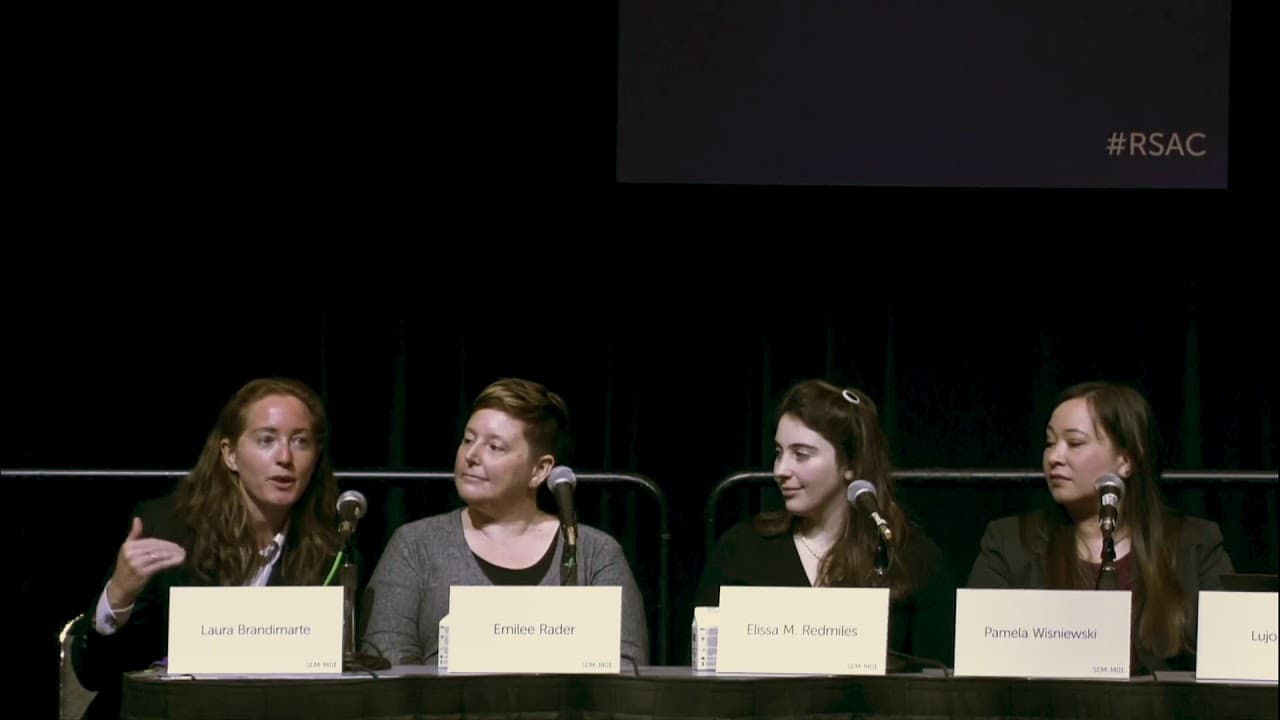
Effective security and privacy systems must account for stable human needs, changing technologies, diverse mental models, and unequal user costs. People manage privacy in different ways, make decisions through both reasoning and emotion, and face controls that can become exploitable when behavior is predictable, so practitioners must evaluate trade-offs on users’ behalf.
Transcript
So I will seed the discussion, uh, with, with a few questions. Um, but we have plenty of time, and we have microphones out in the audience. So if any of you in the audience have a topic that you'd like the panel to comment on or a question that you want to ask the panel, you're welcome to line up in front of the microphones and eventually say who y... Read More
Key Insights
- The human need to manage privacy is described as stable across history and locations, even though privacy does not necessarily mean complete secrecy. People simultaneously seek privacy and publicity, making control over disclosure more fundamental than simply refusing to share information.
- Generalizable privacy knowledge must be separated from technology-specific observations. Interface settings may change while research is underway, but the broader finding that people manage privacy through varied, holistic, and multidimensional processes can remain useful after a particular platform design becomes obsolete.
- Folk theories are shaped by users’ experiences and can change when institutions introduce new technology or messaging. Airport signs promoting facial recognition as a convenient boarding method illustrate how public communication may alter beliefs about whether a privacy-sensitive practice is acceptable.
- Core human factors can recur across different security behaviors and years. The panel reports similarities in models of software updates and two-factor behavior, while emphasizing that system designers continually change how those factors are manipulated, supported, or accommodated.
- Security and privacy concerns differ across populations and locations. Research involving users in the United States and European Union may reveal different concerns, theories, or models from research involving users in Brazil or Vietnam, so studies should extend beyond an envisioned end user.
- Predictable human behavior is useful to both defenders and attackers. Researchers can identify patterns to improve systems, but malicious actors can exploit the same regularities. Emotion-driven and spur-of-the-moment decisions also introduce unpredictability that may make some user actions harder for attackers to anticipate.
- Security practitioners also face limits on rational decision-making. They may lack strong measurements of a control’s effectiveness or accurate information about user preferences, so improving protection requires examining practitioners’ own assumptions and making better-supported trade-offs before attackers exploit user patterns.
- Security costs can fall unevenly across socioeconomic groups. Some users spend substantially more time and effort for a similar presumed benefit, while lower-status users may consult less authoritative advice associated with more negative incidents. Existing policy settings do not necessarily constrain variation in costs or protection.
Install to Summarize YouTube Videos and Get Transcripts
Explore YouTube Video Summarizer or Get YouTube Transcript Extractor
Questions & Answers
Q: Which privacy and security findings remain stable over time?
Findings about broad human needs and behavioral differences are presented as more durable than findings about particular interfaces. People consistently need to manage the boundary between privacy and publicity, and different people manage that boundary in different ways. Specific privacy settings, technological interactions, messages, and user beliefs can change quickly, requiring researchers to revisit context-dependent conclusions.
Q: How should researchers study privacy when technology changes rapidly?
Researchers should distinguish generalizable knowledge from observations tied to a particular platform, setting, or moment. A privacy interface can change while a study is being launched, making individual settings temporary objects of analysis. Broader conclusions, such as privacy management being holistic, multidimensional, and different across people, may remain useful even after the original technology changes.
Q: What are folk theories in security and why can they change?
Folk theories are users’ experience-based beliefs about security threats, attackers, motives, and acceptable practices. Some underlying concerns, such as caring about who might attack and why, may persist. However, experiences and institutional messages can revise these beliefs. Messaging that presents facial recognition as an easier way to board a flight may influence whether users consider it acceptable.
Q: Why does predictable behavior create cybersecurity risk?
Predictable behavior can be identified by researchers seeking to design stronger protections, but the same patterns are visible to people with malicious intentions. When users repeatedly respond in a known way, attackers may exploit that regularity. The panel also notes that emotion and immediate desires can make decisions less predictable, while attackers themselves are not always perfectly rational.
Q: How do emotions affect privacy decisions?
Privacy choices are not described as formal calculations in which users list and compute every cost and benefit before disclosing information. Decisions are often influenced by emotion, the immediate situation, and a desire to share something quickly. This mixture of rational and emotional behavior can create exploitable patterns, but it can also make individual actions harder to predict.
Q: Why should security research include users from different countries?
Users in different countries can have different concerns, folk theories, and models of security. The panel contrasts findings involving users in the United States and European Union with perspectives from Brazil and Vietnam. Studying only people who resemble a system’s envisioned end user can leave gaps, so research should consider broader populations as well as changes over time.
Q: How does socioeconomic status affect security and privacy?
Socioeconomic status can affect the time, effort, advice, and support involved in obtaining security benefits. Some users incur greater costs for presumably similar protection, while lower-status users tend to rely on less authoritative advice associated with more negative security incidents. Policy settings do not necessarily require firms to minimize differences in user costs or security outcomes.
Q: How can privacy inequality be passed from parents to children?
The panel reports that among parents describing the same privacy behaviors and interest, those with higher income or education were between sixty-six percent and three times more likely to help their children with privacy. Children might receive information from teachers or other sources, but no policies were identified as ensuring that support, creating the possibility of inherited inequality by adulthood.
Summary & Key Takeaways
-
The panel distinguishes persistent human tendencies from technology-specific findings. The need to manage privacy and publicity appears stable across history and locations, while particular settings, interfaces, messages, and folk theories can change rapidly. Researchers should separate generalizable knowledge about human behavior from conclusions tied to a specific system or moment.
-
Privacy and security decisions combine rational evaluation, emotions, immediate desires, prior experiences, and imperfect mental models. Predictable behavior can help researchers design better protections, but it can also help malicious actors exploit users. Human unpredictability may complicate attacks, while attackers themselves are not assumed to behave with perfect rationality.
-
Security burdens and benefits are distributed unequally. Users with lower socioeconomic status, skill, or literacy may spend more effort obtaining similar protection and may rely on less authoritative advice. Differences in parental income or education can also influence whether children receive privacy assistance, potentially carrying inequities into adulthood.
Read in Other Languages (beta)
Share This Summary 📚
Summarize YouTube Videos and Get Video Transcripts with 1-Click
Try YouTube Summary with ChatGPT & Claude or YouTube Transcript Generator
Explore More Summaries from RSAC Cybersecurity 📚



Summarize YouTube Videos and Get Video Transcripts with 1-Click
Try YouTube Summary with ChatGPT & Claude or YouTube Transcript Generator