How to Calculate the Surface Area of a Triangular Prism
TL;DR
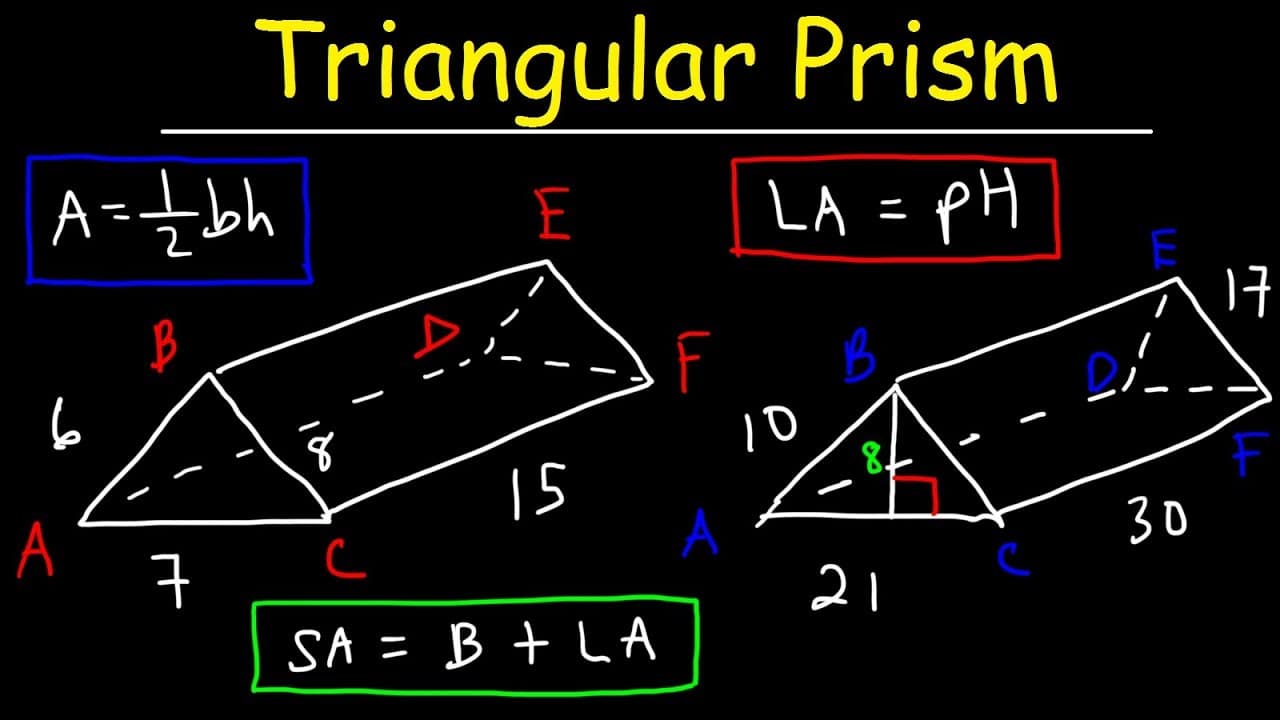
To calculate the surface area of a triangular prism, first determine the lateral area by multiplying the perimeter of the base triangle by the height of the prism. Then, add the area of the two triangular bases to the lateral area to get the total surface area, which combines both components.
Transcript
in this video we're going to focus on calculating the surface area of a triangular prism so let me draw a picture first so let's call this a b c d e and f so let's say that c f is 30 and let's say that a b is 10 ac is 21 and e f is 17. and let's say the height of the triangle is 8 units long calculate the lateral area of the prism and then the tota... Read More
Key Insights
- ⚾ The lateral area of a triangular prism is equal to the perimeter of the base multiplied by the height of the prism.
- ⌛ To calculate the total surface area, add the lateral area to two times the area of the triangular base.
- 🙃 Heron's formula can be used to find the area of a triangle when all three sides are known.
- 🙃 The perimeter of the base is calculated by adding the lengths of all the sides.
- ⚾ The area of a triangle can be found using the formula: (1/2) base * height.
- 🍹 The total surface area of a prism is the sum of the area of the base and the lateral area.
- ❓ Calculating the surface area of a prism requires understanding the formulas for area and perimeter.
Install to Summarize YouTube Videos and Get Transcripts
Explore YouTube Video Summarizer or Get YouTube Transcript Extractor
Questions & Answers
Q: How do you calculate the lateral area of a triangular prism?
To find the lateral area, multiply the perimeter of the base by the height of the prism. The perimeter is calculated by adding the lengths of all the sides of the base.
Q: How is the total surface area of a triangular prism calculated?
The total surface area is obtained by adding the lateral area to the area of the triangular base. The area of the base is found using the formula: (1/2) base * height of the triangle.
Q: Can you calculate the lateral area and total surface area of a triangular prism with specific measurements?
Yes, by knowing the lengths and heights of the prism's base and triangle, you can calculate both the lateral area and the total surface area using the formulas provided.
Q: What is Heron's formula used for in calculating surface area?
Heron's formula is used to find the area of a triangle when all three sides are known. It involves calculating the semi-perimeter (s) and then plugging the values into the formula: A = sqrt(s(s-a)(s-b)(s-c)).
Summary & Key Takeaways
-
Triangular prisms have two main components for calculating surface area: the lateral area and the total area.
-
The lateral area is found by multiplying the perimeter of the base by the height of the prism.
-
The total surface area is the sum of the lateral area and the area of the base, which is calculated using the formula for the area of a triangle.
Read in Other Languages (beta)
Share This Summary 📚
Summarize YouTube Videos and Get Video Transcripts with 1-Click
Try YouTube Summary with ChatGPT & Claude or YouTube Transcript Generator
Explore More Summaries from The Organic Chemistry Tutor 📚




Summarize YouTube Videos and Get Video Transcripts with 1-Click
Try YouTube Summary with ChatGPT & Claude or YouTube Transcript Generator