2015 AP Chemistry free response 2a (part 1 of 2) | Chemistry | Khan Academy
TL;DR
To solve 2015 AP Chemistry free response 2a, subtract water’s vapor pressure from the total pressure, then use the ethene partial pressure in the Ideal Gas Law. The experiment collects 0.0854 liters of gas at 0.822 atmospheres and 305 Kelvin, while water’s vapor pressure is 35.7 torr. Read on for the setup, unit conversion, and mole-calculation method.
Transcript
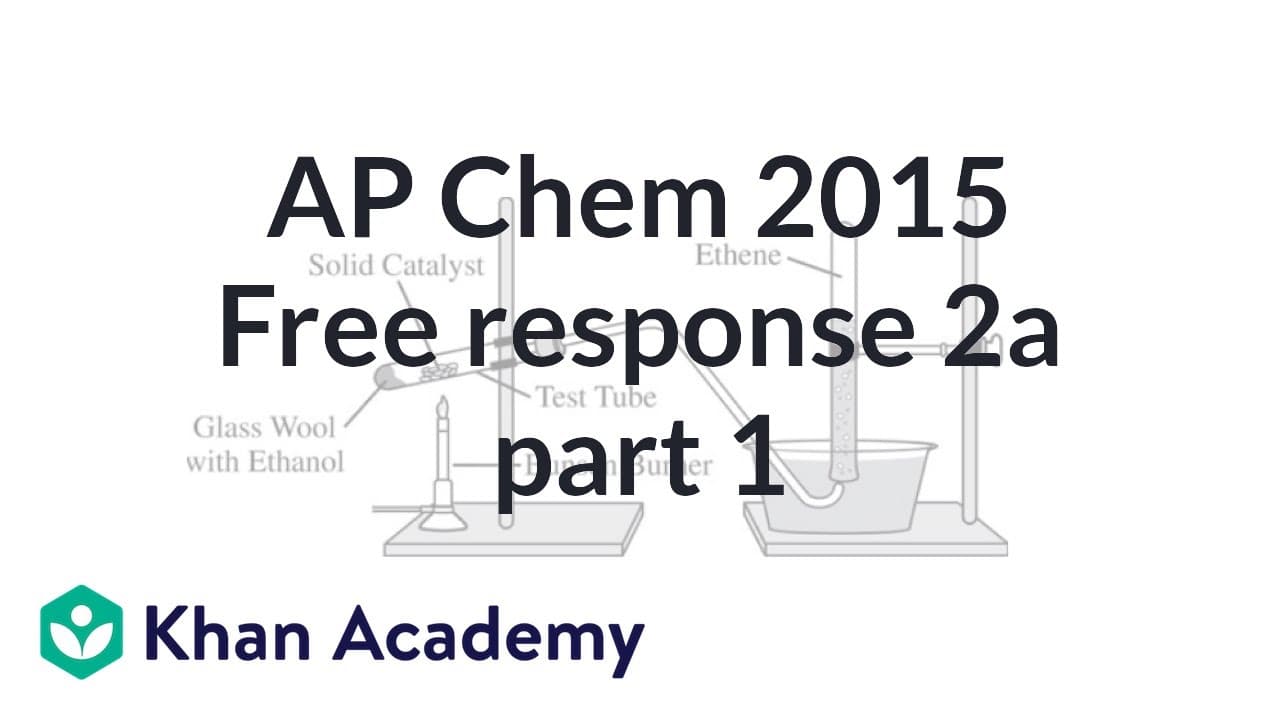
- [Voiceover] Ethene, C2H4, molar mass of 28.1 grams per mole, may be prepared by the dehydration of ethanol, C2H5OH, molar mass 46.1 grams per mole, using a solid catalyst. A setup for the lab synthesis is shown in the diagram above. The equation for the dehydration reaction is given below. So, we have the ethanol, and then in the presence of a ca... Read More
Key Insights
- ❓ Ethene can be produced by dehydrating ethanol using a solid catalyst.
- 🫢 The volume of gas collected during the experiment can be used to calculate the number of moles of ethene produced.
- 💦 The partial pressure of ethene can be determined by subtracting the vapor pressure of water from the total pressure.
Install to Summarize YouTube Videos and Get Transcripts
Explore YouTube Video Summarizer or Get YouTube Transcript Extractor
Questions & Answers
Q: How do you solve 2015 AP Chemistry free response 2a, part 1?
First, find the partial pressure of ethene by subtracting the vapor pressure of water from the total gas pressure. Then use that ethene pressure with the collected volume and temperature in the Ideal Gas Law, rearranged as n = PV/(RT).
Q: How is ethene produced by dehydrating ethanol?
Ethanol, C2H5OH, is heated in the presence of a solid catalyst. The dehydration reaction produces ethene, C2H4, and water.
Q: What experimental measurements are provided?
The student begins with 0.200 gram of ethanol and collects 0.0854 liters of gas. The collected gas is at a total pressure of 0.822 atmospheres and a temperature of 305 Kelvin.
Q: Why must the water vapor pressure be considered?
The collected gas contains ethene and water vapor. Their partial pressures add to the total pressure, so the water contribution must be removed before calculating the moles of ethene.
Q: How is the partial pressure of ethene determined?
Subtract the partial pressure of water from the total pressure of 0.822 atmospheres. Because the water vapor pressure is given as 35.7 torr, it must first be converted to atmospheres.
Q: How is 35.7 torr converted to atmospheres?
Use the relationship that one atmosphere equals 760 torr. Dividing 35.7 by 760 gives a water partial pressure of 0.0470 atmospheres.
Q: How does the Ideal Gas Law give the actual moles of ethene?
Apply the Ideal Gas Law to ethene using its partial pressure rather than the total gas pressure. With volume 0.0854 liters and temperature 305 Kelvin, rearrange the equation to n = PV/(RT).
Q: What does the problem ask students to calculate?
It asks for the moles of ethene actually produced and measured in the gas collection tube. It also asks for the moles that would form if the dehydration went to completion, followed by the percent yield of ethene.
Summary & Key Takeaways
-
Ethanol can be dehydrated using a solid catalyst to produce ethene and water.
-
A student conducted an experiment where they added a sample of ethanol to a test tube and heated it until all the ethanol evaporated and gas generation stopped.
-
The volume of gas collected was measured, along with the total pressure and temperature, to calculate the number of moles of ethene produced.
Read in Other Languages (beta)
Share This Summary 📚
Summarize YouTube Videos and Get Video Transcripts with 1-Click
Try YouTube Summary with ChatGPT & Claude or YouTube Transcript Generator
Explore More Summaries from Khan Academy 📚



Summarize YouTube Videos and Get Video Transcripts with 1-Click
Try YouTube Summary with ChatGPT & Claude or YouTube Transcript Generator