Snell's law example 2 | Geometric optics | Physics | Khan Academy
TL;DR
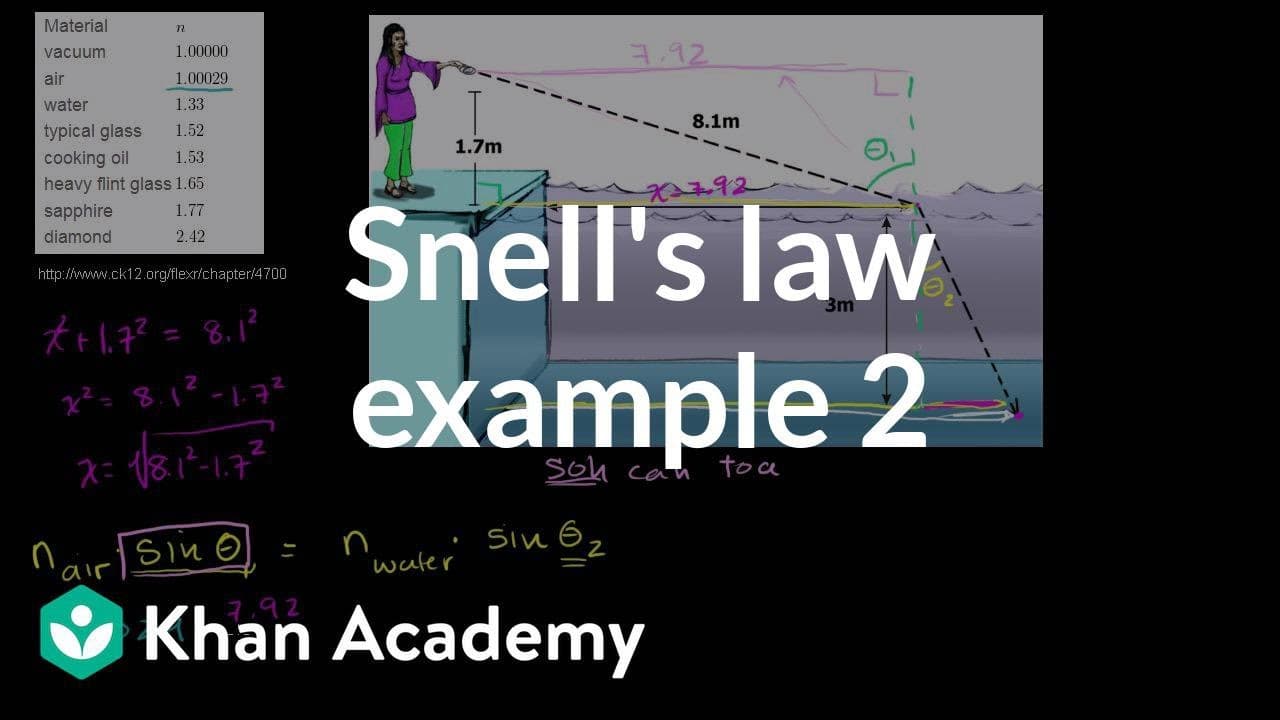
The laser reaches the bottom of the three-meter-deep pool approximately 11.18 meters away in this Snell’s law example. Khan Academy first uses the Pythagorean theorem to find the 7.92-meter horizontal distance to the water, then applies the refractive indices of air and water and trigonometry to determine the remaining distance. Read on for the equations and reasoning behind each step.
Transcript
Let's do a slightly more involved Snell's law example. So I have this person over here, sitting at the edge of this pool. And they have a little laser pointer in their hand and they shine their laser pointer. So in their hand, where they shine, it's 1.7 meters above the surface of the pool. And they shine it so it travels 8.1 meters to touch the su... Read More
Key Insights
- ✈️ Snell's law can be used to determine the angles involved in the refraction of light at the interface between two mediums, such as air and water.
- 🗯️ The Pythagorean theorem is useful for finding distances and lengths in right triangles, such as the horizontal distance traveled by the laser pointer.
- 👨💼 Trigonometry, including concepts like sine and tangent, can be applied to calculate angles and distances in complex scenarios like this one.
- 🫰 Understanding the relationship between the indices of refraction for different mediums is crucial in applying Snell's law accurately.
- 🛝 Precision and accuracy can be improved by using exact values and rounding only when necessary.
- ❓ Recognizing the relationships between different measurements and using appropriate formulas can simplify complex calculations.
- 🙂 Snell's law can be a useful tool for solving real-world problems involving light and refraction.
Install to Summarize YouTube Videos and Get Transcripts
Explore YouTube Video Summarizer or Get YouTube Transcript Extractor
Questions & Answers
Q: How far away does the laser hit the bottom of the pool in Khan Academy’s Snell’s law example 2?
The final calculated distance is approximately 11.18 meters. The solution combines the horizontal distance before the laser enters the water with the additional horizontal distance traveled after refraction.
Q: What information is given in the Snell’s law example?
The laser pointer is 1.7 meters above the pool’s surface, and its beam travels 8.1 meters before touching the water. The pool is three meters deep, while the refractive indices used are 1.00029 for air and 1.33 for water.
Q: How is the horizontal distance to the point where the laser enters the water calculated?
The setup forms a right triangle with a 1.7-meter vertical side and an 8.1-meter hypotenuse. Using the Pythagorean theorem, x² + 1.7² = 8.1², giving x ≈ 7.92 meters.
Q: Why is the positive square root used when solving for x?
The calculation gives x as the principal square root of 8.1² minus 1.7². The positive root is used because x represents a physical distance.
Q: What form of Snell’s law is used in this example?
The equation is n_air × sin(θ1) = n_water × sin(θ2). Here, θ1 is the incident angle and θ2 is the angle of refraction, both measured from the perpendicular to the water’s surface.
Q: How is the sine of the incident angle found without calculating the angle itself?
Using “soh cah toa,” sine equals the opposite side divided by the hypotenuse. Therefore, sin(θ1) is approximately 7.92 divided by 8.1.
Q: How is the refracted angle determined?
The example substitutes 1.00029 for air, 1.33 for water, and 7.92/8.1 for sin(θ1) into Snell’s law. Dividing by 1.33 isolates sin(θ2), which can then be used to determine the refracted direction.
Q: Why does the laser bend inward when it enters the water?
The transcript explains that the light enters a slower medium and is refracted inward. The car analogy describes the outside tires remaining in the faster medium longer, causing the path to turn.
Summary & Key Takeaways
-
The video demonstrates a more complex example of using Snell's law to calculate the distance a laser pointer travels in water.
-
The process involves determining the distance along the surface of the water and the incremental distance from the surface to the bottom of the pool.
-
Trigonometry is used to calculate the angles involved, allowing for the final distance to be calculated.
Read in Other Languages (beta)
Share This Summary 📚
Summarize YouTube Videos and Get Video Transcripts with 1-Click
Try YouTube Summary with ChatGPT & Claude or YouTube Transcript Generator
Explore More Summaries from Khan Academy 📚



Summarize YouTube Videos and Get Video Transcripts with 1-Click
Try YouTube Summary with ChatGPT & Claude or YouTube Transcript Generator