What Happens to Supply and Demand When a Tax Is Implemented?
TL;DR
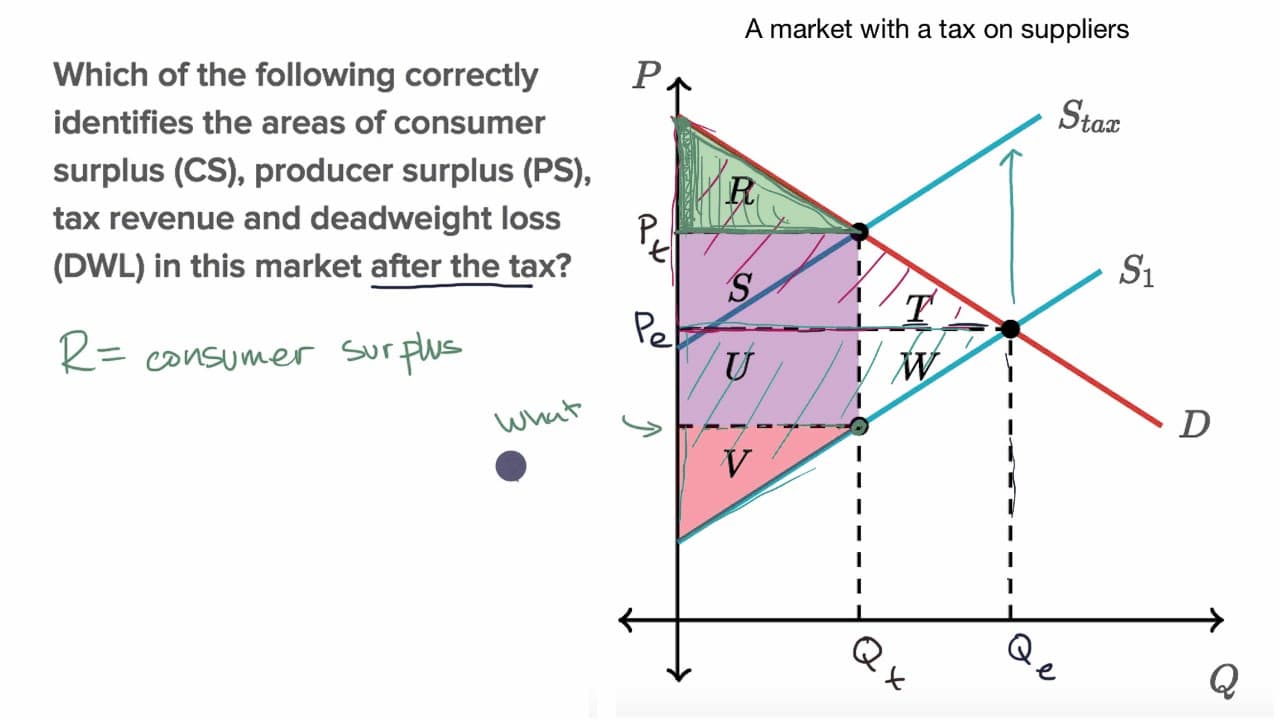
When a tax is imposed, the effective supply curve shifts, resulting in a new equilibrium price and quantity. This leads to a decrease in consumer and producer surplus, generates tax revenue for the government, and introduces deadweight loss, reflecting inefficiencies in the market. Understanding these changes is crucial for analyzing the overall impact of taxes on market dynamics.
Transcript
- [Instructor] We are asked, which of the following correctly identifies the areas of consumer surplus, producer surplus, tax revenue, and deadweight loss in this market after the tax? So pause this video, have a go at it. Even if you struggle with it it will make your brain more attuned to when we work through it together. All right, now let's wor... Read More
Key Insights
- 👶 The tax on a market shifts the effective supply curve, resulting in a new equilibrium price and quantity.
- 🚕 Consumer surplus is the benefit consumers receive from paying less than their maximum willingness to pay, even after the tax.
- 🚕 Producer surplus is reduced because producers do not get to keep the tax revenue, resulting in a price below the equilibrium price.
- 🚕 Tax revenue is the difference between consumer surplus and producer surplus after the tax.
- 🌸 Deadweight loss represents the inefficiency caused by the tax, resulting in a lower total surplus compared to the scenario without the tax.
- 🚕 Understanding the impact of a tax on consumer surplus, producer surplus, tax revenue, and deadweight loss is essential for analyzing market dynamics.
- 🚕 The size of the tax determines the extent of the changes in consumer surplus, producer surplus, tax revenue, and deadweight loss.
Install to Summarize YouTube Videos and Get Transcripts
Explore YouTube Video Summarizer or Get YouTube Transcript Extractor
Questions & Answers
Q: How was the consumer surplus affected after the tax?
After the tax, the consumer surplus was still present, but it was now the region above the new equilibrium price (including the tax) and below the demand curve. Consumers were still benefiting as they paid less than what they were willing to pay.
Q: How did the tax impact the producer surplus?
The producer surplus was affected because producers did not get to keep the tax revenue. The actual price the producers received, or the net of taxes, was below the equilibrium price. The producer surplus was the area above the net of taxes and below the price at which they were willing to produce.
Q: What constitutes the tax revenue?
The tax revenue is the difference between the consumer surplus after the tax and the producer surplus after the tax. It is essentially the portion of the total surplus that goes to the government. The government receives this revenue as a result of the tax imposed on every unit of the good.
Q: How is deadweight loss calculated in this scenario?
The deadweight loss is the difference between the original total surplus and the new total surplus after the tax. The original total surplus was represented by a triangle, while the new total surplus is a trapezoid. The area lost (T plus W) between these two represents the deadweight loss.
Summary & Key Takeaways
-
Before the tax, the market had an equilibrium price and quantity determined by the intersection of the supply and demand curves.
-
Consumer surplus was the area above the equilibrium price and below the demand curve, while producer surplus was the area above the supply curve and below the equilibrium price.
-
After the tax, the effective supply curve shifted, resulting in a new equilibrium price and quantity. The consumer surplus, producer surplus, tax revenue, and deadweight loss were all affected.
Read in Other Languages (beta)
Share This Summary 📚
Summarize YouTube Videos and Get Video Transcripts with 1-Click
Try YouTube Summary with ChatGPT & Claude or YouTube Transcript Generator
Explore More Summaries from Khan Academy 📚



Summarize YouTube Videos and Get Video Transcripts with 1-Click
Try YouTube Summary with ChatGPT & Claude or YouTube Transcript Generator