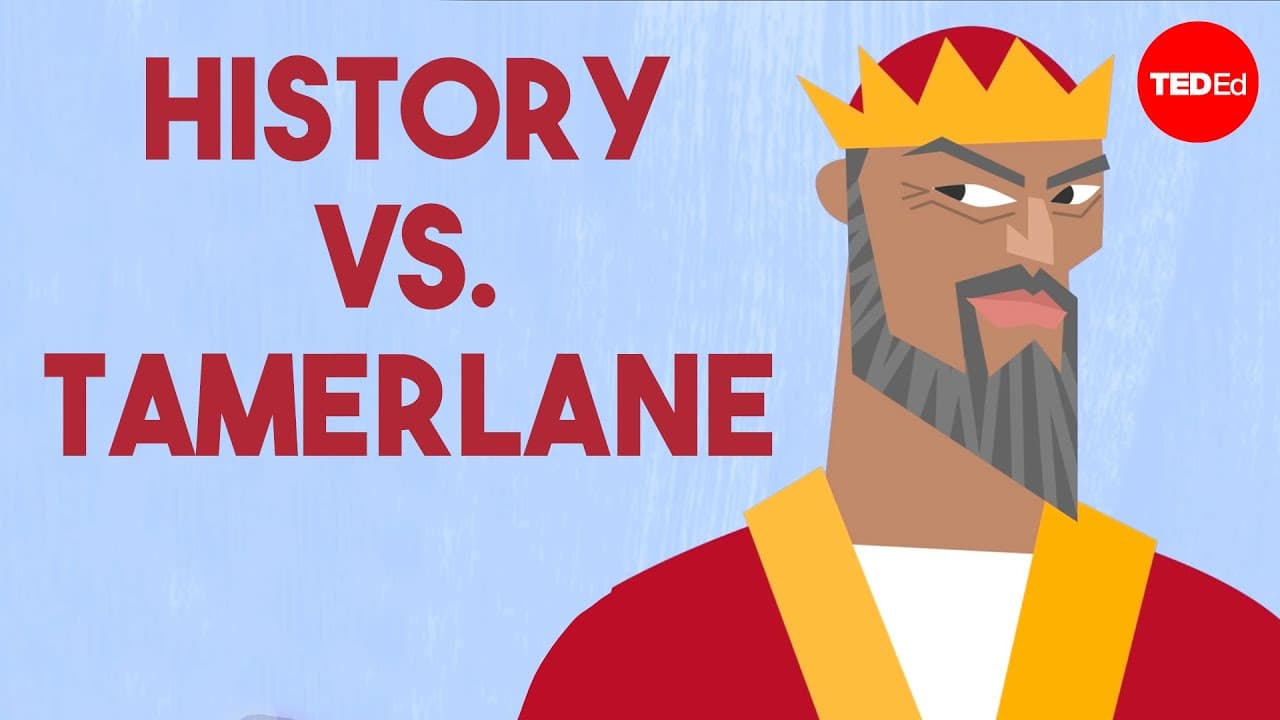
History vs. Tamerlane the Conqueror - Stephanie Honchell Smith
TL;DR
Timur the Lame, a lowly sheep thief who rose to power and became one of history's greatest conquerors, remains a controversial figure, hailed as a great state builder by some and a bloodthirsty tyrant by others.
Transcript
He was born in the 1330s in the Chaghatayid Khanate formerly the Mongol Empire in Central Asia. On the unforgiving steppe, he rose from a lowly sheep thief to become one of history’s greatest conquerors, uniting nearly all of Central Asia, Afghanistan, and Iran under his rule. But was he a great state builder or a bloodthirsty tyrant? Order! Or... Read More
Key Insights
- ✊ Timur's rise to power showcased strategic maneuvering, as he defected and reconciled with his uncle and brother-in-law, before seizing power after his brother-in-law's assassination.
- 🏙️ While Timur is often criticized for his brutal campaigns and destruction of cities, he also rebuilt infrastructure, distributed food to the poor, and made Central Asian cities thrive as commercial hubs.
- 🌏 Timur's empire lasted for a century after his death, fostering a renaissance in architecture, art, literature, and science in Central Asia, with his descendants establishing the Mughal Empire in India.
Install to Summarize YouTube Videos and Get Transcripts
Explore YouTube Video Summarizer or Get YouTube Transcript Extractor
Questions & Answers
Q: Was Timur a commoner or did he come from a ruling family?
Timur was born into minor nobility, with high-ranking officials in his family. However, he had to prove his worth through daring and horsemanship to gain power.
Q: How did Timur justify his actions of wars and killings?
Timur portrayed himself as a divinely ordained protector of the Mongol and Muslim worlds. He claimed to offer cities surrender opportunities and only resorted to massacres when faced with revolts.
Q: Did Timur contribute to the revival of the Silk Road?
Yes, by unifying Central Asia, Afghanistan, and Iran, Timur reinvigorated the Silk Road and benefited Eurasia through increased long-distance trade.
Q: What was Timur's impact on culture and the arts?
Despite being illiterate, Timur patronized the arts and spared artisans and scholars during his conquests. He even impressed famous historian Ibn Khaldun and had a variant of chess named after him.
Summary & Key Takeaways
-
Timur, born in Central Asia in the 1330s, went from a sheep thief to a powerful ruler, uniting Central Asia, Afghanistan, and Iran.
-
He faced criticism for raiding rival tribes and defying his own family, but he successfully consolidated his power and ended years of infighting.
-
Timur claimed to be a protector of the Mongol and Muslim worlds but waged relentless wars and caused millions of deaths, while also patronizing the arts and promoting trade.
Read in Other Languages (beta)
Share This Summary 📚
Summarize YouTube Videos and Get Video Transcripts with 1-Click
Try YouTube Summary with ChatGPT & Claude or YouTube Transcript Generator
Explore More Summaries from TED-Ed 📚




Summarize YouTube Videos and Get Video Transcripts with 1-Click
Try YouTube Summary with ChatGPT & Claude or YouTube Transcript Generator