What Were the Roles of Cathedrals and Universities in Medieval Knowledge?
TL;DR
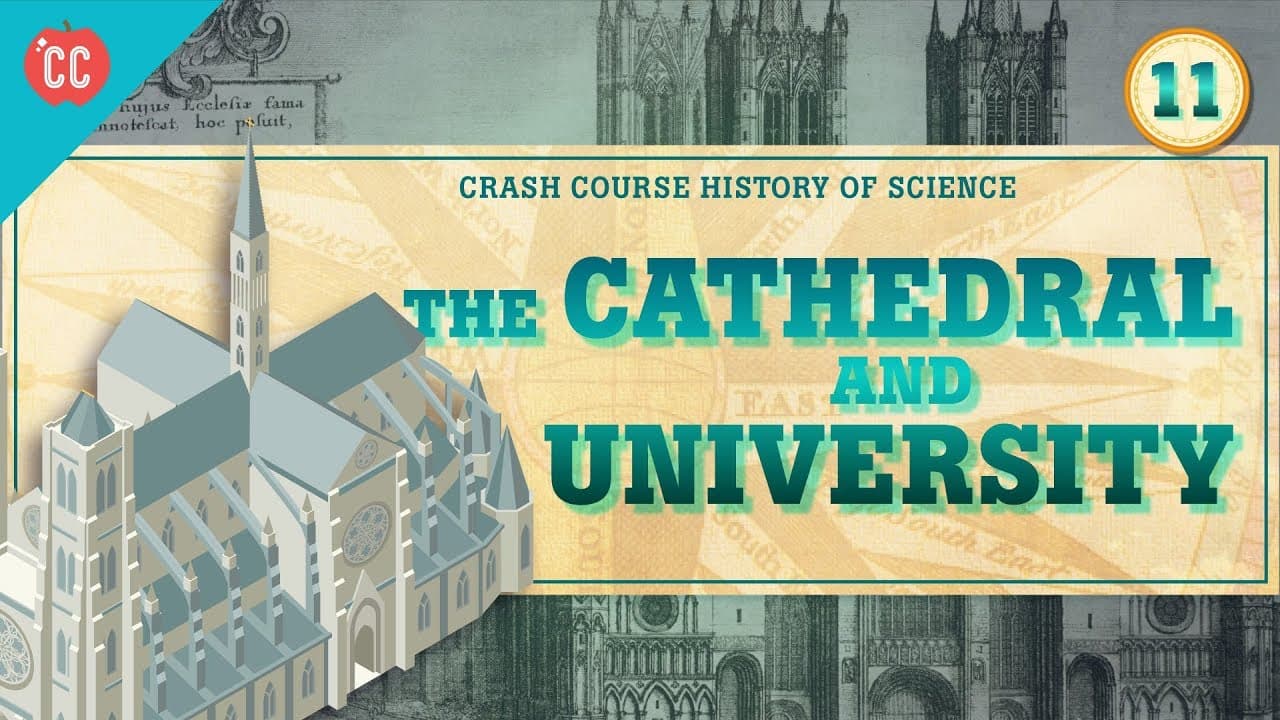
Cathedrals and universities served as key centers of knowledge production in medieval Europe. Cathedrals functioned as educational, administrative, and spiritual hubs, showcasing advanced architectural techniques like flying buttresses. Universities emerged due to population growth and evolving educational needs, operating as self-governing institutions that fostered a curriculum based on classical texts while navigating theological constraints.
Transcript
Hi, I’m Hank Green, this is Crash Course, and today I wanna explore two sites of knowledge production in Europe during the medieval period. This is the story of the cathedral and the university. [INTRO MUSIC PLAYS] First, let’s agree to call the general time period in Eurasia and North Africa after the birth of large states but before colonial empi... Read More
Key Insights
- Cathedrals were central to medieval knowledge production, serving as administrative, spiritual, and educational centers in Europe.
- The construction of cathedrals required advanced technical knowledge, with flying buttresses being a significant architectural innovation.
- Universities emerged in the medieval period, driven by population growth and the need for educated professionals like lawyers and physicians.
- The first universities functioned as self-governing corporations, requiring Christian oaths and Church-approved curricula.
- Medieval universities offered a curriculum based on classical texts, with disciplines divided into the trivium and quadrivium.
- The Church's control over universities paradoxically allowed for academic freedom, as long as teachings were aligned with Catholicism.
- The condemnation of Aristotelian ideas in 1277 led to new thought experiments and the separation of Nature from theological studies.
- Medieval universities laid the groundwork for secular scientific inquiry, setting the stage for future advancements in understanding the natural world.
Install to Summarize YouTube Videos and Get Transcripts
Explore YouTube Video Summarizer or Get YouTube Transcript Extractor
Questions & Answers
Q: What role did cathedrals play in medieval knowledge production?
Cathedrals were central to medieval knowledge production, serving as administrative, spiritual, and educational centers in Europe. They were not only places of worship but also hubs for learning and cultural development. The construction of cathedrals required significant technical expertise, making them architectural marvels of their time.
Q: How did the architectural design of cathedrals contribute to their function?
The architectural design of cathedrals, particularly the use of flying buttresses, allowed for the creation of tall, narrow structures with large stained glass windows. This design distributed the weight of the heavy stone structures, enabling more light to enter the cathedral and reducing the material and labor costs. The cathedrals were not only functional but also symbolized paradise on Earth.
Q: What factors led to the rise of universities in medieval Europe?
The rise of universities in medieval Europe was driven by population growth, urbanization, and the increasing need for educated professionals in fields such as law, theology, and medicine. The establishment of universities provided a structured environment for learning and knowledge production, contributing to the intellectual and cultural development of the period.
Q: How did universities function as self-governing entities?
Medieval universities functioned as self-governing entities, often referred to as corporations. They required members to swear a Christian oath and adhere to Church-approved curricula. Despite this, universities enjoyed a degree of academic freedom, as they were recognized by the Church as independent institutions, allowing them to teach and research within a Catholic framework.
Q: What was the impact of the 1277 condemnation of Aristotelian ideas?
The 1277 condemnation of Aristotelian ideas in Paris led to a shift in medieval scholarship, as it encouraged scholars to explore new thought experiments and consider Nature independently of theological constraints. This event helped to separate the study of Nature from religious doctrine, paving the way for a more secular approach to scientific inquiry.
Q: What subjects were included in the medieval university curriculum?
The medieval university curriculum was based on classical texts and divided into the trivium and quadrivium. The trivium included grammar, rhetoric, and logic, serving as tools for thinking. The quadrivium comprised arithmetic, geometry, astronomy, and music, focusing on specific subjects. This curriculum laid the foundation for a liberal arts education.
Q: How did the Church's involvement influence medieval universities?
The Church's involvement in medieval universities required that curricula be approved and aligned with Catholic teachings. This influence ensured that universities maintained a religious framework, but it also provided a level of protection from secular authorities. As a result, universities enjoyed academic freedom within the boundaries of Catholic doctrine.
Q: In what ways did medieval universities contribute to the development of scientific inquiry?
Medieval universities contributed to the development of scientific inquiry by promoting the study of classical texts and encouraging critical thinking. The separation of Nature from theological studies, as prompted by the 1277 condemnation, allowed scholars to explore scientific concepts independently. This laid the groundwork for future scientific advancements and a more secular approach to understanding the natural world.
Summary & Key Takeaways
-
The video explores the role of cathedrals and universities as centers of knowledge production during the medieval period. Cathedrals served as educational and administrative hubs, while universities emerged due to population growth and the need for educated professionals. This period laid the foundation for secular scientific inquiry.
-
Cathedrals were architectural marvels that required advanced technical knowledge, featuring innovations like flying buttresses. Universities, on the other hand, functioned as self-governing entities with Church-approved curricula, offering disciplines based on classical texts and promoting academic freedom within a Catholic framework.
-
The condemnation of Aristotelian ideas in 1277 led to a shift in thought, encouraging medieval scholars to explore Nature beyond theological constraints. This separation of Nature from religious studies paved the way for future scientific advancements and a more secular approach to understanding the world.
Read in Other Languages (beta)
Share This Summary 📚
Summarize YouTube Videos and Get Video Transcripts with 1-Click
Try YouTube Summary with ChatGPT & Claude or YouTube Transcript Generator
Explore More Summaries from CrashCourse 📚





Summarize YouTube Videos and Get Video Transcripts with 1-Click
Try YouTube Summary with ChatGPT & Claude or YouTube Transcript Generator