What Causes the Seasons on Earth?
TL;DR
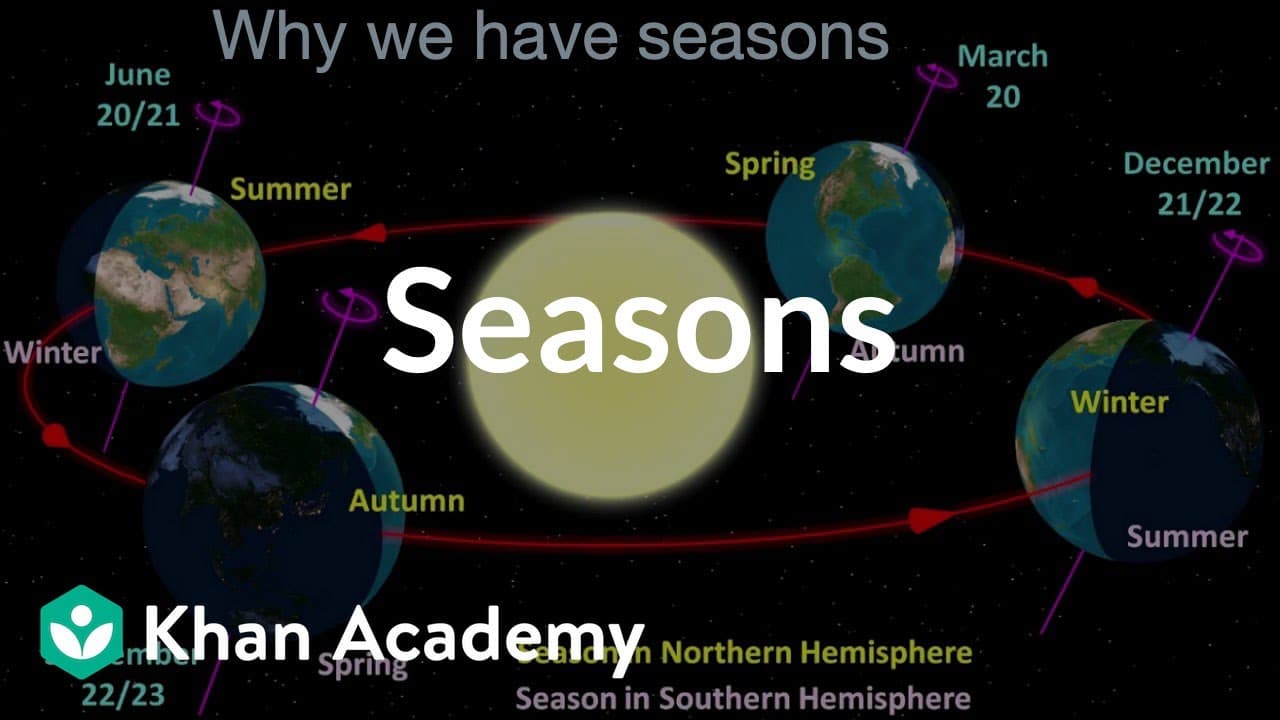
Seasons are primarily caused by Earth's axial tilt of about 23.5 degrees, not by its distance from the sun. When the Northern Hemisphere is tilted toward the sun, it experiences summer, while the Southern Hemisphere has winter, and vice versa. This axial tilt affects the angle of sunlight and results in varying temperatures throughout the year.
Transcript
- [Instructor] In this video, we're gonna think about why we have seasons on Earth, like summer and fall and winter and spring. Now, one theory that some folks might have is maybe it's due to the distance between the Earth and the sun. We know that the Earth orbits the sun, the sun is where the great majority of the heat and the energy on the surfa... Read More
Key Insights
- 😎 Earth's distance from the sun does not determine the seasons.
- 🔍 The axial tilt of Earth, which is about 23.5 degrees, is responsible for the seasons.
- 🌞 When the Northern Hemisphere is tilted towards the sun, it is summer, while when it is tilted away, it is winter.
- 📞 The angle of the sunlight affects the intensity of the energy received by the Earth's surface.
- 🔍 The Northern and Southern Hemispheres have opposite seasons because of Earth's axial tilt.
- 😎 Spring and autumn occur when neither hemisphere is pointed towards or away from the sun, resulting in milder temperatures.
- 🌞 Earth's distance from the sun is actually farthest in July, which is in the middle of summer in the Northern Hemisphere.
Install to Summarize YouTube Videos and Get Transcripts
Explore YouTube Video Summarizer or Get YouTube Transcript Extractor
Questions & Answers
Q: What is the main theory behind Earth's seasons?
The main theory is that Earth's axial tilt causes different parts of the planet to receive sunlight at different angles, resulting in the seasons.
Q: Does Earth's distance from the sun affect the seasons?
No, contrary to popular belief, Earth's distance from the sun does not determine the seasons. The Northern Hemisphere experiences summer when it is actually farthest from the sun.
Q: Why do the Northern and Southern Hemispheres have opposite seasons?
The seasons are opposite in the Northern and Southern Hemispheres because when one hemisphere is pointed towards the sun, the other hemisphere is pointed away from it.
Q: How does Earth's axial tilt impact the intensity of sunlight?
The tilt causes sunlight to hit the Earth's surface at different angles. When the sun is directly overhead, the sunlight is more intense, while when it is at an angle, the sunlight is spread out over a larger surface area, resulting in less intensity.
Summary & Key Takeaways
-
Earth's distance from the sun does not explain the seasons since the Northern and Southern Hemispheres experience opposite seasons.
-
The main reason for seasons is Earth's axial tilt, which causes sunlight to hit the Northern and Southern Hemispheres at different angles.
-
When the Northern Hemisphere is pointed towards the sun, it is summer, while when it is pointed away, it is winter.
Read in Other Languages (beta)
Share This Summary 📚
Summarize YouTube Videos and Get Video Transcripts with 1-Click
Try YouTube Summary with ChatGPT & Claude or YouTube Transcript Generator
Explore More Summaries from Khan Academy 📚



Summarize YouTube Videos and Get Video Transcripts with 1-Click
Try YouTube Summary with ChatGPT & Claude or YouTube Transcript Generator