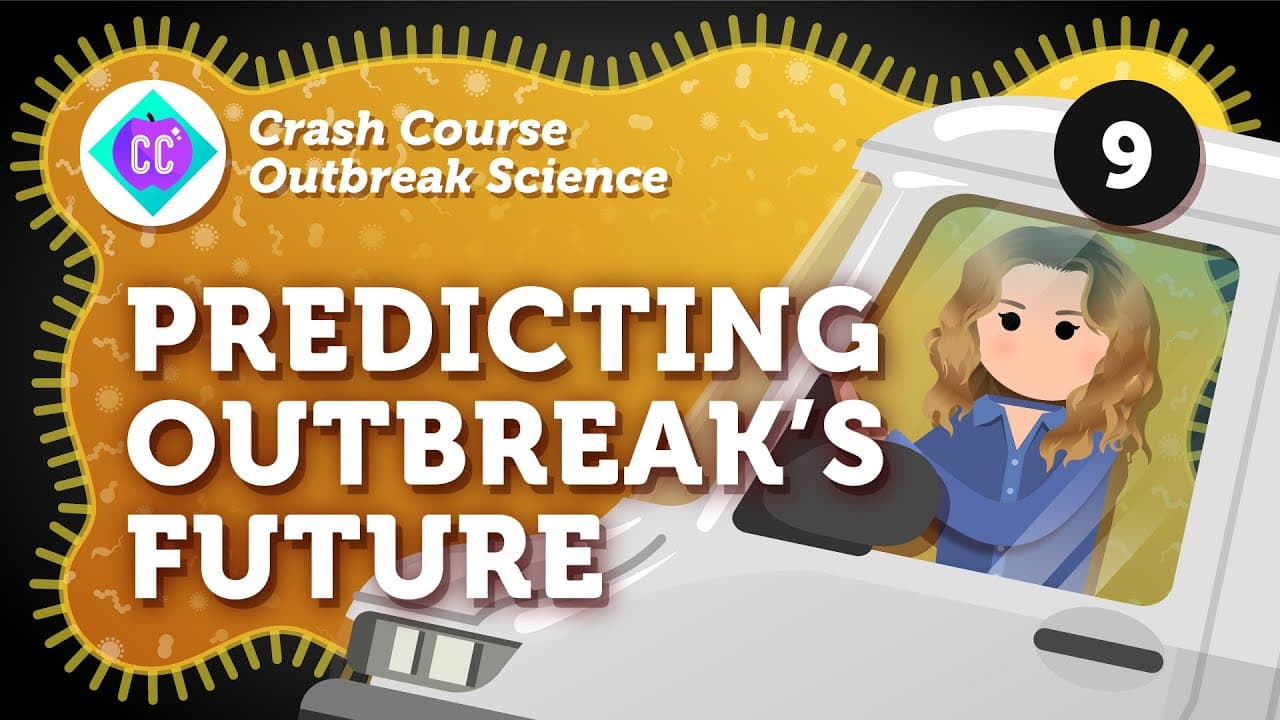
Can We Predict An Outbreak's Future? - Modeling: Crash Course Outbreak Science #9
TL;DR
Models are used to simulate outbreaks and predict their impact on population health, helping us make informed decisions and save lives.
Transcript
When outbreaks happen, we have to consider some important questions: How fast could the disease spread? How many people could get sick? What would work best to stop the outbreak? We can’t run experiments on real people to answer questions like these. But we can simulate outbreaks to see how different scenarios would play out during an outbreak. ... Read More
Key Insights
- 🛟 Models are valuable tools in understanding and predicting the spread of outbreaks, helping us save lives through informed decision-making.
- 🎅 The S-I-R model is commonly used to study outbreaks, dividing the population into susceptible, infected, and removed groups and analyzing their interactions.
- ❓ Models can be adjusted and refined by incorporating various parameters and interventions, improving their accuracy and usefulness.
- ⌛ Parameters in models, such as the reproductive number (R), can change over time, affecting the course and severity of an outbreak.
- 🌍 The accuracy of model predictions is limited by the availability and accuracy of real-world data, as well as uncertainties associated with parameter estimation.
- 👻 Models provide estimates rather than exact predictions, allowing decision-makers to understand potential outcomes and evaluate the effectiveness of interventions.
- ❓ Continual improvement and refinement of models enhance their ability to accurately predict and respond to outbreaks.
Install to Summarize YouTube Videos and Get Transcripts
Explore YouTube Video Summarizer or Get YouTube Transcript Extractor
Questions & Answers
Q: What is a scientific model, and how does it help us understand and predict outbreaks?
A scientific model is a description of the relationship between different variables in the world. By simulating outbreaks using models, we can predict the spread of diseases, the number of people who will get sick, and the effectiveness of various interventions.
Q: What is the S-I-R model, and how does it work?
The S-I-R model divides the population into three groups: susceptible, infected, and removed. It describes how these groups interact and how the proportions of people in each group change over time during an outbreak.
Q: How can the S-I-R model help us estimate the impact of an outbreak?
The S-I-R model allows us to calculate the total number of people who become infected during an outbreak, predict when the outbreak might peak, and determine the duration of the outbreak. It helps us understand the strain on healthcare systems and make informed decisions.
Q: What are some limitations of using models to predict outbreaks?
Models rely on parameters that are calculated from real-world data and may be uncertain. This uncertainty affects the accuracy of the model's predictions. Additionally, models are simplifications of complex real-world dynamics and may not capture all the nuances of an outbreak.
Summary & Key Takeaways
-
Scientific models are descriptions of how different variables are related to each other, helping us understand and predict real-world phenomena.
-
The S-I-R model is commonly used to study outbreaks, dividing the population into susceptible, infected, and removed groups and examining their interactions over time.
-
By adjusting parameters and incorporating interventions, models can provide estimates on the duration and severity of an outbreak and guide decision-making.
Read in Other Languages (beta)
Share This Summary 📚
Summarize YouTube Videos and Get Video Transcripts with 1-Click
Try YouTube Summary with ChatGPT & Claude or YouTube Transcript Generator
Explore More Summaries from CrashCourse 📚




Summarize YouTube Videos and Get Video Transcripts with 1-Click
Try YouTube Summary with ChatGPT & Claude or YouTube Transcript Generator