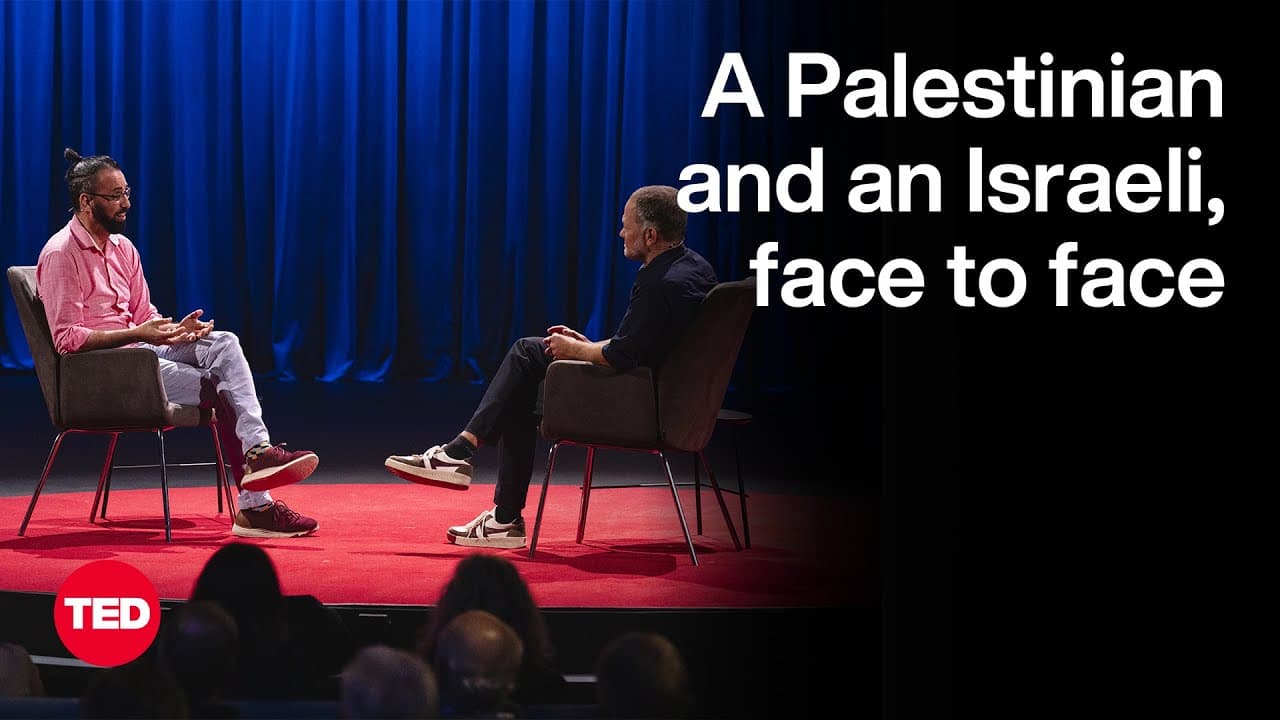
A Palestinian and an Israeli, Face to Face | Aziz Abu Sarah and Maoz Inon | TED
TL;DR
Aziz Abu Sarah and Maoz Inon argue that peace begins with choosing reconciliation over revenge, even after devastating personal loss. Inon made that choice after losing his parents on October 7, while Abu Sarah rejected vengeance eight years after his 19-year-old brother Tayseer was killed. Their stories show how understanding narratives, building partnerships, and acting on hope can create a shared future. Read on for their practical five-step approach.
Transcript
Maoz Inon: You know, Aziz, only four days ago, last Thursday, we buried the remains of my parents. My mom was burned so badly, she could not be identified. I lost them on October 7. I lost so many of my childhood friends, their parents, their children. Many were kidnapped to Gaza. I was drowning in an ocean of sorrow and pain. I was broken into pie... Read More
Key Insights
- ✌️ Loss can be a catalyst for choosing peace rather than revenge.
- 🏛️ Understanding and partnerships are essential in building a shared future.
- 💀 Anger can be channeled into positive actions and bridging divides.
- 🥡 Hope is created through collaborative efforts, envisioning a better future, and taking effective action.
- ✌️ Divisions should be based on those who believe in peace and justice, and those who do not yet.
- 🍝 Forgiving the past and present does not mean forgiving for the future.
- 💦 Tragedy can inspire individuals to work towards reconciliation and lasting peace.
Install to Summarize YouTube Videos and Get Transcripts
Explore YouTube Video Summarizer or Get YouTube Transcript Extractor
Questions & Answers
Q: Why did Maoz Inon choose peace instead of revenge after October 7?
After losing his parents and many childhood friends on October 7, Inon dreamed that humanity’s tears healed wounded bodies and washed blood from the ground, revealing a path to peace. He understood that he must choose reconciliation rather than revenge and later described that choice as his parents’ legacy.
Q: How did Aziz Abu Sarah move from vengeance toward reconciliation?
Abu Sarah was 10 when Israeli soldiers killed his 19-year-old brother, Tayseer, and he initially became angry, bitter, and intent on vengeance. Eight years later, studying Hebrew with Jewish immigrants helped him realize that they could be allies and partners and that his response remained his own choice.
Q: What did Maoz Inon say publicly after his parents were killed?
Inon said he was crying not only for his parents but also for people in Gaza who were losing their lives. He did not want his loss to justify revenge or war.
Q: How did Inon’s parents influence his commitment to peace?
Inon’s farmer father repeatedly promised to sow again after seasons ruined by drought, flooding, or insects because the next year could be better. His mother gave him a mandala stating that dreams can be achieved when people are brave enough to pursue them, lessons he connected to hope and action after their deaths.
Q: What five steps does Maoz Inon use to turn dreams into reality?
His five steps are dreaming, creating a partnership and coalition with as many stakeholders as possible, finding shared value and common ground, writing a detailed road map, and executing it. He said he followed this process while pursuing projects over the previous 20 years.
Q: What projects did Maoz Inon help create?
Inon opened Fauzi Azar, described as the first guest house in the old city of Nazareth. He also co-founded the Jesus Trail, Abraham Hostel and tours, along with other projects.
Q: Why is learning the other side’s narrative important to Inon?
Through partnerships with Palestinians, Israelis, Jordanians, and Egyptians, Inon learned that knowing the other side’s narrative is the first step toward a shared society and future. His approach connects mutual understanding with finding common ground and building coalitions.
Q: How did Abdelrahim respond after losing 50 relatives?
Abu Sarah said his friend Abdelrahim lost 50 members of his family, including children shown in a photograph. Despite this loss and his parents being unable to get food or leave northern Gaza, Abdelrahim remained committed to peace and refused to let his story lead to hate.
Summary & Key Takeaways
-
Maoz Inon shares the heartbreaking loss of his parents and friends in the conflict, leading him to choose a path of peace and reconciliation instead of revenge.
-
Aziz Abu Sarah recounts his own journey towards peace, realizing that understanding and cooperation can lead to a shared future.
-
Despite the immense tragedy and ongoing conflict, both Inon and Abu Sarah emphasize the importance of forgiveness, understanding, and the belief in a better future.
Read in Other Languages (beta)
Share This Summary 📚
Summarize YouTube Videos and Get Video Transcripts with 1-Click
Try YouTube Summary with ChatGPT & Claude or YouTube Transcript Generator
Explore More Summaries from TED 📚



Summarize YouTube Videos and Get Video Transcripts with 1-Click
Try YouTube Summary with ChatGPT & Claude or YouTube Transcript Generator