Transistor Amplifiers - Class A, AB, B, & C Circuits
TL;DR
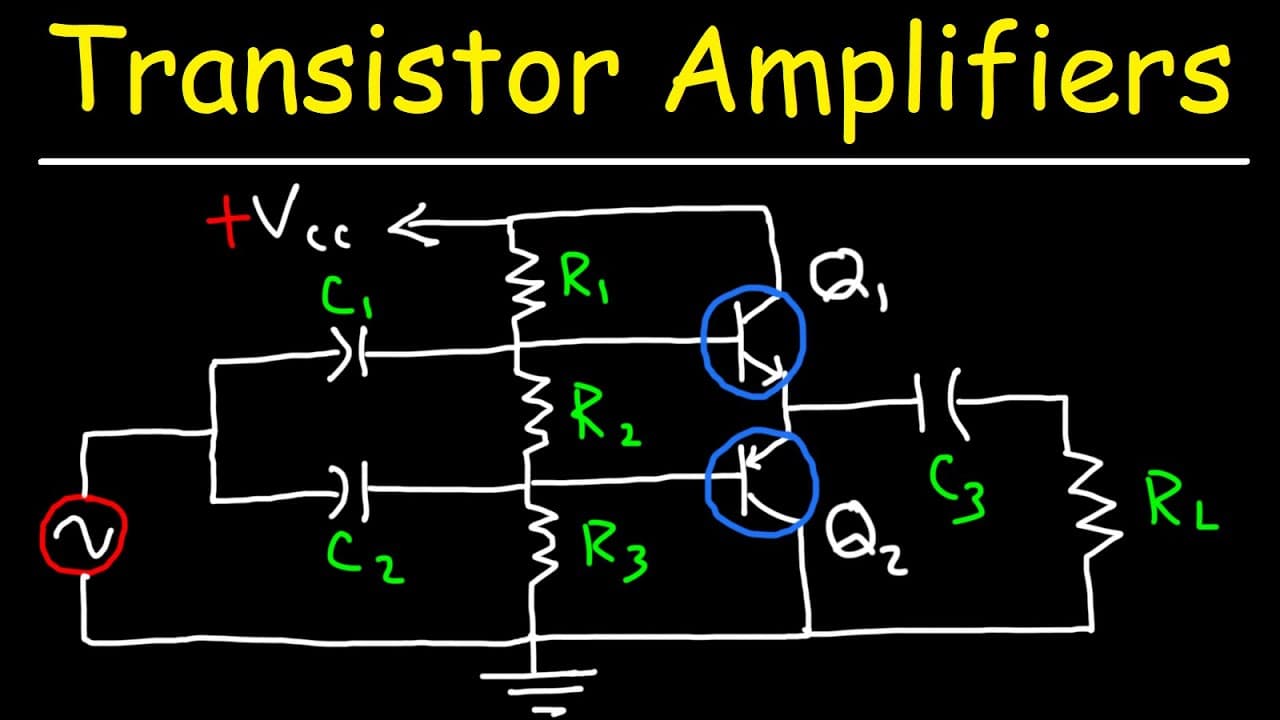
This video discusses different types of transistor amplifiers, including class A, class AB, class B, and class C, and the differences in their efficiency and distortion.
Transcript
in this video we're going to talk about the different types of transistor amplifiers such as the class a amplifier the class a b amplifier the class b amplifier and the class c amplifier there's also the class d amplifier but we're not going to touch that one in this video so let's draw the circuit for the class a amplifier we're going to start wit... Read More
Key Insights
- 😘 Class A amplifiers have low efficiency but minimal distortion, making them suitable for small signal amplification.
- ✋ Class B amplifiers have higher efficiency but suffer from crossover distortion, where the output waveform is distorted.
- 🏛️ Class AB amplifiers overcome crossover distortion by using diodes to bias the transistors and reduce distortion.
- 😣 Class C amplifiers have high efficiency but severe distortion due to their tuned circuit design and limited conduction.
- 🏛️ Replacing the collector resistor with a transformer can increase the efficiency of a class A amplifier.
- ❓ The resonant frequency of a tuned amplifier circuit is determined by the values of the inductor and capacitor.
- 🏛️ Class A and class AB amplifiers are commonly used for audio amplification, while class C amplifiers find applications in RF (Radio Frequency) circuits.
Install to Summarize YouTube Videos and Get Transcripts
Explore YouTube Video Summarizer or Get YouTube Transcript Extractor
Questions & Answers
Q: What is the key difference between a class A and class B amplifier?
The key difference is that a class A amplifier conducts for the entire input cycle, while a class B amplifier conducts for only half of the input cycle. This results in higher efficiency for the class B amplifier but with the tradeoff of crossover distortion.
Q: How can the efficiency of a class A amplifier be increased?
One way to increase the efficiency of a class A amplifier is by replacing the collector resistor with a transformer. The transformer can absorb and release stored energy using its magnetic fields, increasing the overall efficiency of the circuit.
Q: What is the advantage of using a class AB amplifier over a class B amplifier?
The class AB amplifier reduces crossover distortion, which is present in class B amplifiers, by replacing a resistor with two silicon diodes. This improves the overall performance of the amplifier.
Q: Why does the class C amplifier have high distortion?
The class C amplifier conducts for less than 180 degrees of the input cycle, resulting in severe distortion. This is due to its tuned circuit design and the non-linear characteristics of the transistor.
Summary & Key Takeaways
-
The class A amplifier, also known as the common emitter amplifier, has low efficiency but little to no distortion. It is used as a small signal amplifier rather than a power amplifier.
-
The class B amplifier uses complementary transistors and conducts for only one half of the input cycle. It has higher efficiency but suffers from crossover distortion.
-
The class AB amplifier is an improvement of the class B amplifier that uses diodes to reduce crossover distortion.
-
The class C amplifier is a tuned amplifier using a single transistor and exhibits high efficiency but severe distortion.
Read in Other Languages (beta)
Share This Summary 📚
Summarize YouTube Videos and Get Video Transcripts with 1-Click
Try YouTube Summary with ChatGPT & Claude or YouTube Transcript Generator
Explore More Summaries from The Organic Chemistry Tutor 📚


Summarize YouTube Videos and Get Video Transcripts with 1-Click
Try YouTube Summary with ChatGPT & Claude or YouTube Transcript Generator