How to Calculate the Moment of Inertia for a Lamina
TL;DR
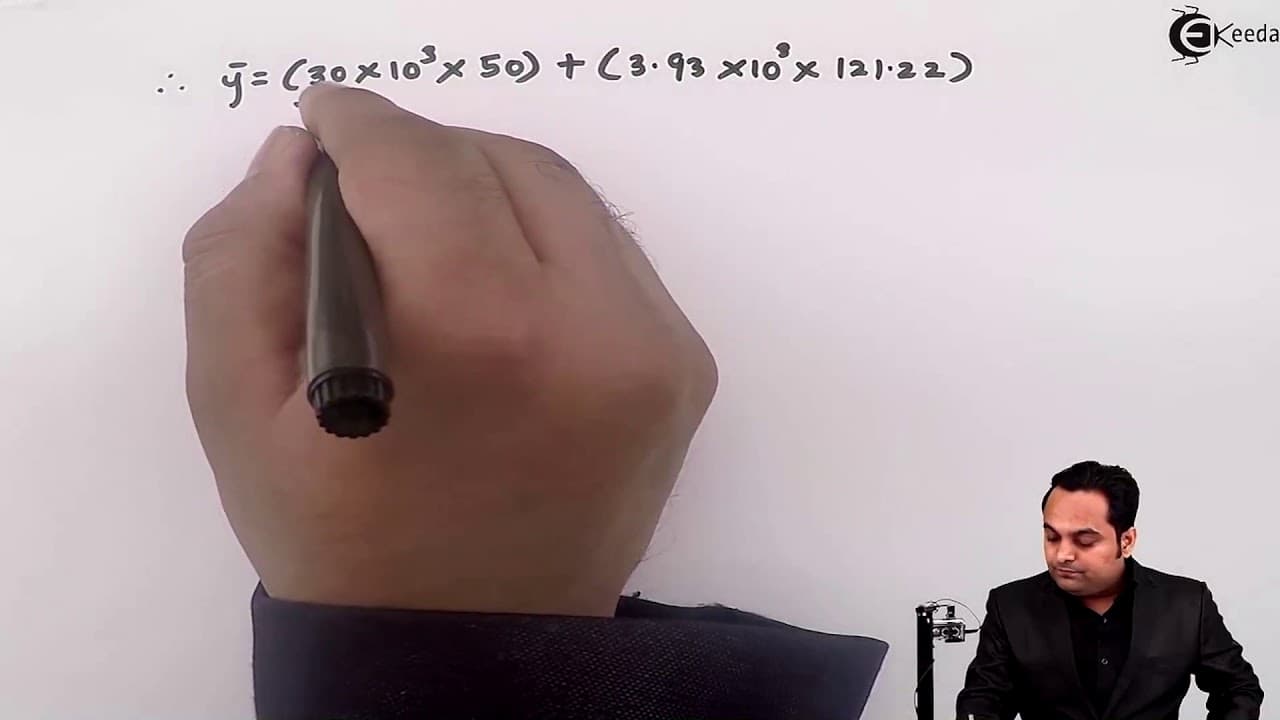
To calculate the moment of inertia for a uniform lamina composed of a rectangle and a semicircle, find the centroid using its area coordinates and then apply the parallel axis theorem. The final moments of inertia about the x-axis and y-axis are 43.31 × 10^6 mm^4 and 262.20 × 10^6 mm^4, respectively.
Transcript
hello friends here in this video we will see a problem on calculation of moment of inertia for a given lamina here we have a question find ixx and iyy of the uniform lamina as shown in figure the diagram is given the diameter of the semicircle is 100 mm so we have to find i xx and iyy for this lamina i'll write it in the data your ixx is the moment... Read More
Key Insights
- 🍹 The moment of inertia for a composite section can be calculated by summing the moments of inertia of its individual components using the parallel axis theorem.
- 📌 The location of the centroid is crucial for calculating the moments of inertia.
- ❓ The parallel axis theorem is used to account for the distance between the axes of the composite section and the individual components.
- ❣️ The moment of inertia about the x-axis and y-axis can be calculated separately for a composite section.
- 💠 The formulas for the moment of inertia vary depending on the shape and orientation of the component.
Install to Summarize YouTube Videos and Get Transcripts
Explore YouTube Video Summarizer or Get YouTube Transcript Extractor
Questions & Answers
Q: How is the centroid determined for the composite section?
The centroid is found by calculating the weighted average of the individual centroids of the rectangle and the semicircle, using their respective areas as weights.
Q: What is the formula for the moment of inertia of a rectangle about its own axis?
The moment of inertia (ixx or iyy) of a rectangle about its own axis is given by (bd^3)/12, where b is the width and d is the depth.
Q: Why is the parallel axis theorem used in this calculation?
The parallel axis theorem is used because there is a distance between the axes of the individual components (rectangle and semicircle) and the axes of the composite section. This theorem allows for the calculation of the moment of inertia about a different axis using the moment of inertia about a known axis.
Q: How is the moment of inertia of a semicircle calculated?
The moment of inertia (ixx or iyy) of a semicircle about its own axis is given by (π/128) * (d^4), where d is the diameter of the semicircle.
Summary & Key Takeaways
-
The video demonstrates how to find the moments of inertia (ixx and iyy) for a composite section made up of a rectangle and a semicircle.
-
The first step is to find the centroid, which involves calculating the x and y coordinates of the centroid using the centroid formulas.
-
With the centroid determined, the moments of inertia about the x-axis and y-axis can be calculated using the parallel axis theorem.
Read in Other Languages (beta)
Share This Summary 📚
Summarize YouTube Videos and Get Video Transcripts with 1-Click
Try YouTube Summary with ChatGPT & Claude or YouTube Transcript Generator
Explore More Summaries from Ekeeda 📚


Summarize YouTube Videos and Get Video Transcripts with 1-Click
Try YouTube Summary with ChatGPT & Claude or YouTube Transcript Generator