Tragedy of the commons | Consumer and producer surplus | Microeconomics | Khan Academy
TL;DR
When a resource is collectively owned, individuals have a rational incentive to overuse or deplete it, resulting in the tragedy of the commons. This can be avoided through implementing a permitting process or transforming the resource into private land.
Transcript
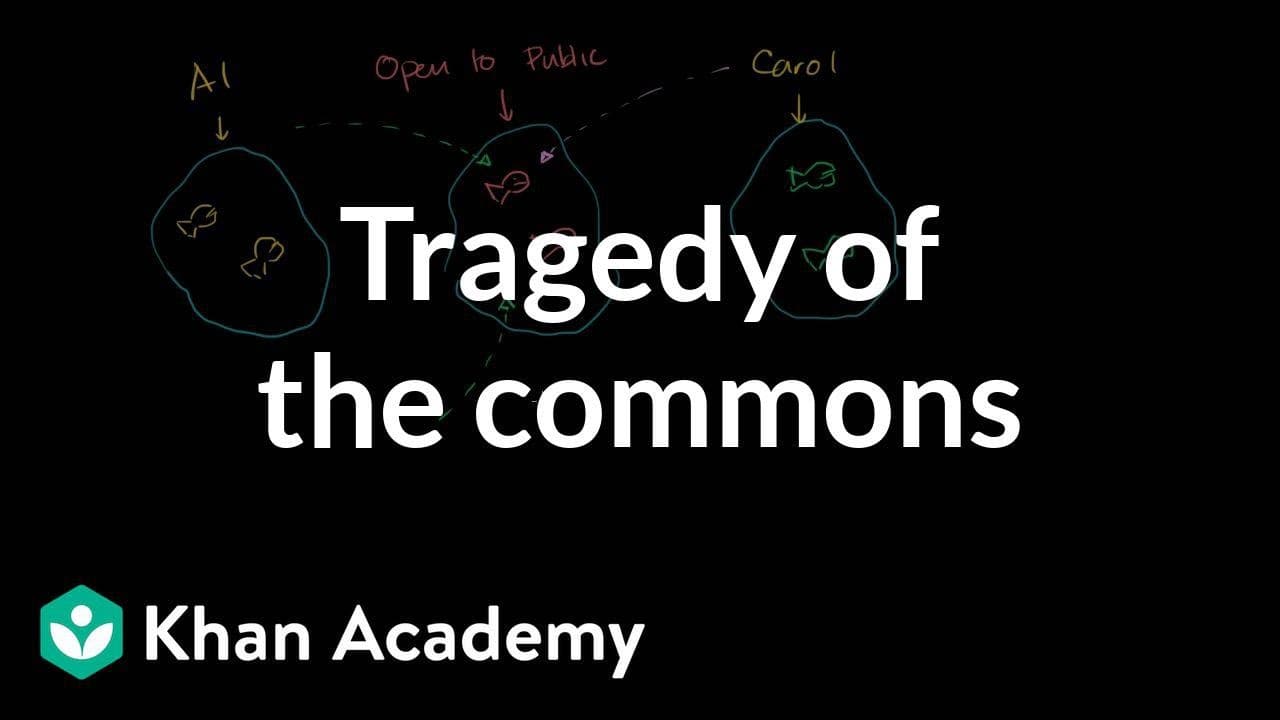
let's say that we have three small ponds so this is pond a this is pond B and this is pond C over here and let's say that this first pond right over here it's a privately owned pond it's owned by it's owned by Al and this pond over here is owned by Carol is owned by Carol but this middle pond pond B I guess we called it to start off with this is co... Read More
Key Insights
- 🥺 The tragedy of the commons arises when shared resources have no ownership or protection, leading to overexploitation.
- 🍉 Rational self-interest drives individuals to exploit the resource for personal gain in the short term, even if it harms the long-term sustainability.
- 😒 Converting the resource into private land or implementing permits can incentivize responsible use and prevent overexploitation.
- 💦 Common examples of the tragedy of the commons include fishing in public waters, grazing on common land, and overuse of camping areas.
Install to Summarize YouTube Videos and Get Transcripts
Explore YouTube Video Summarizer or Get YouTube Transcript Extractor
Questions & Answers
Q: What is the tragedy of the commons?
The tragedy of the commons refers to the overuse or depletion of a shared resource due to rational self-interest. When a resource is collectively owned, individuals have no incentive to hold back from exploiting it, resulting in its destruction.
Q: How does the tragedy of the commons affect fishers in the example?
In the example, Al and Carol fish responsibly in their privately owned ponds, but the public pond is open to everyone. Al recognizes the risk of overfishing in the public pond, but he has no incentive to hold back because others may exploit it. This leads to the depletion of fish in the public pond.
Q: What is the solution to the tragedy of the commons?
One solution is to transform the common resource into private land. This can be done by selling the land to private owners who can then regulate access. Alternatively, a permitting process can be implemented, where individuals need permits to use the resource, limiting the amount of exploitation.
Q: How does a permitting process help prevent the tragedy of the commons?
By requiring permits, a governing body can control and monitor the use of the resource. Permits can be priced in a way that balances the benefits individuals obtain with the need for sustainability. This ensures responsible use and prevents overexploitation.
Summary & Key Takeaways
-
There are three ponds: one privately owned, one owned by Carol, and one public. Al and Carol are both fishers who rely on their ponds for a living. They both fish responsibly to avoid depleting their own ponds, but in the public pond, anyone can fish without considering depletion.
-
The tragedy of the commons occurs when shared resources are abused because there is no ownership or protection. People exploit the resource for personal benefit in the short term, leading to its destruction in the long term.
-
The solution to the tragedy of the commons is to convert the resource into private land or implement a permitting process. This ensures responsible use and prevents overexploitation.
Read in Other Languages (beta)
Share This Summary 📚
Summarize YouTube Videos and Get Video Transcripts with 1-Click
Try YouTube Summary with ChatGPT & Claude or YouTube Transcript Generator
Explore More Summaries from Khan Academy 📚



Summarize YouTube Videos and Get Video Transcripts with 1-Click
Try YouTube Summary with ChatGPT & Claude or YouTube Transcript Generator