How Does Encryption Shape Global Data Privacy?
TL;DR
Customer-controlled encryption keys can limit a cloud provider or device manufacturer to surrendering only encrypted data, forcing authorities to seek access from the customer directly. The Apple and Microsoft disputes show how government demands for device assistance and data stored abroad can reshape privacy expectations, legal exposure, cloud risk, and global business models.
Transcript
Hello, my name is Jeffrey Blatt. I'm a technology and cybersecurity lawyer now based in Asia, but I professionally grew up in the Silicon Valley representing many leading tech companies. Today in this quick look, we're going to explore some of the issues regarding the current debate around encryption, the FBI versus Apple case, and the global impli... Read More
Key Insights
- Encryption-key ownership is a central control point because it determines whether a provider can decrypt customer information for authorities. If customers exclusively hold the keys, a provider can generally surrender only the encrypted material it possesses, requiring the government to pursue the customer directly.
- Data breaches are board-level business risks because compromises can threaten operational continuity, damage reputation, prompt customer lawsuits, and lead to regulatory fines or actions. The risks apply across cloud models, including software, infrastructure, and database services, as well as corporate and personal information systems.
- The third-party doctrine reduces constitutional privacy expectations in the United States for information voluntarily supplied to another party. Its influence extends internationally because major cloud providers are often United States companies or maintain enough presence there to face demands under United States legal processes.
- The Microsoft dispute concerned whether a United States search warrant could compel access to customer email stored in Dublin. The government's position sought compliance from providers under United States jurisdiction regardless of storage location, potentially bypassing local legal procedures and conflicting with the law where data resides.
- The proposed Rule forty-one amendment would permit remote access to computers located anywhere in the world under a single search warrant. It was described as supporting investigations involving Tor or anonymizers through network investigative techniques such as hacking, deception, or man-in-the-middle methods.
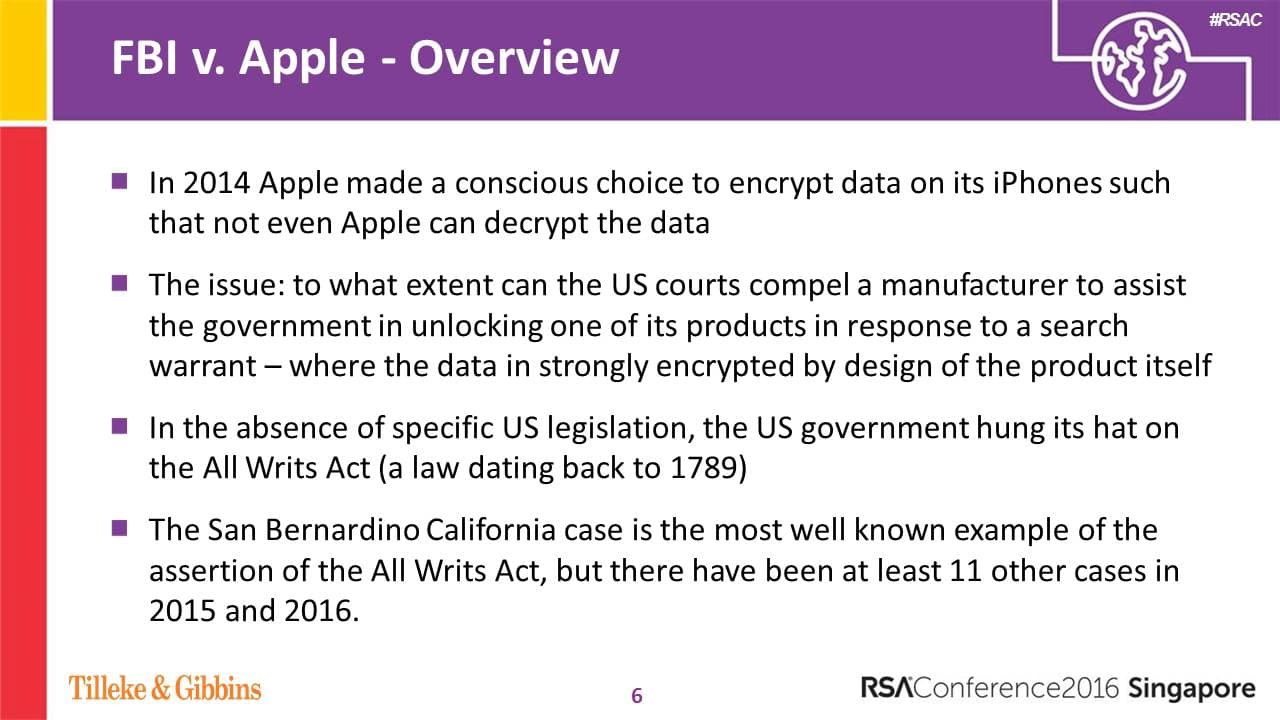
- Apple designed its iPhones so that even Apple could not decrypt protected device data. The legal controversy asked whether the All Writs Act could be used, without specific legislation addressing the issue, to compel Apple to develop code that would help the government compromise its own product.
- Cloud backups and device contents can have different access models because Apple controlled the keys for encrypted iCloud data but could not decrypt the protected information remaining on the iPhone. Authorities had also obtained call records, SMS information, location data, and other metadata elsewhere.
- Customer-controlled encryption is the recommended business strategy presented because it makes authorities seek customer data from customers rather than providers. Strong cloud and device encryption, with keys held only by customers or trusted third parties, can reduce providers' direct capacity to disclose readable information.
Install to Summarize YouTube Videos and Get Transcripts
Explore YouTube Video Summarizer or Get YouTube Transcript Extractor
Questions & Answers
Q: How does encryption-key ownership affect government access to cloud data?
Encryption-key ownership determines whether a cloud provider can turn stored information into readable form. When the provider controls the decoding keys, it can decrypt customer data and respond to lawful demands. When the customer alone controls those keys, the provider can generally supply only encrypted material, so the government must approach the customer directly to obtain readable information.
Q: Why are data breaches considered a board-level business risk?
Data breaches can create direct losses while also threatening business continuity and corporate reputation. A serious compromise of a cloud service, infrastructure platform, or database may disrupt operations and undermine customer trust. The affected company and its directors or officers may also face customer lawsuits, regulatory fines, and other government actions arising from inadequate protection of information.
Q: What is the third-party doctrine's effect on cloud privacy?
The third-party doctrine holds that, under United States constitutional law, a person has no reasonable expectation of privacy in information voluntarily provided to another party. Although it is a United States doctrine, it can influence users worldwide because many major cloud and service providers are United States companies or have a sufficient presence there to fall within United States jurisdiction.
Q: Why did the United States versus Microsoft dispute matter globally?
The Microsoft dispute addressed a search warrant seeking customer emails stored in Dublin, Ireland. The United States government sought to establish that a cloud provider within its jurisdiction must comply regardless of where the data is stored or what local law applies there. Such a position could give domestic search warrants worldwide practical reach and alter cloud customers' risk assessments.
Q: What would the proposed Rule forty-one amendment allow?
The proposed Rule forty-one amendment would allow the FBI, under a single United States search warrant, to access computers remotely anywhere in the world. One warrant could cover many computers and authorize network investigative techniques described as hacking, deception, or man-in-the-middle activity. The proposal was particularly directed toward investigations involving Tor or anonymizers that conceal a true IP address.
Q: What was the central legal question in the FBI versus Apple case?
The central question was whether a court could compel Apple to create code that would help the government unlock or compromise an encrypted iPhone. No specific United States legislation addressed that demand, so the government relied on the All Writs Act, which permits courts to issue necessary writs to carry out legal process such as a search warrant.
Q: What information had authorities obtained before seeking access to the iPhone?
Before seeking Apple's assistance with the protected iPhone, authorities had obtained information previously backed up to iCloud and application data connected with downloads from the Apple store. The telecommunications provider had also supplied call records, SMS information, tower location data, and other metadata. The remaining target was information stored only on the device and not transmitted or backed up elsewhere.
Q: How can companies reduce exposure to demands for readable customer data?
Companies can build strong encryption into cloud services and devices while placing decoding keys only in the hands of customers or trusted third parties. Under this model, providers cannot decrypt the information themselves and can surrender only encrypted data they possess. Authorities seeking readable content would therefore need to approach the customer rather than relying on the provider's technical access.
Summary & Key Takeaways
-
Encryption architecture determines who can respond meaningfully to government demands for customer data. When providers or manufacturers control decoding keys, they can decrypt information and comply with legal process. When customers alone control the keys, providers generally possess only encrypted data and authorities must approach customers directly for access.
-
The Apple dispute concerned whether a court could compel a manufacturer to create code that would help authorities bypass protections on its own product. Apple had already supplied available iCloud information because it controlled those encryption keys, while the remaining sought-after material existed only on the protected device.
-
The Microsoft dispute examined whether a search warrant issued in the United States could reach customer email stored in Dublin. Together with proposed changes to criminal procedure, the dispute illustrated how domestic legal authority could affect data and computers worldwide, potentially conflicting with laws where information is physically stored.
Read in Other Languages (beta)
Share This Summary 📚
Summarize YouTube Videos and Get Video Transcripts with 1-Click
Try YouTube Summary with ChatGPT & Claude or YouTube Transcript Generator
Explore More Summaries from RSAC Cybersecurity 📚




Summarize YouTube Videos and Get Video Transcripts with 1-Click
Try YouTube Summary with ChatGPT & Claude or YouTube Transcript Generator