Reasoning through inequality expressions | Linear inequalities | Algebra I | Khan Academy
TL;DR
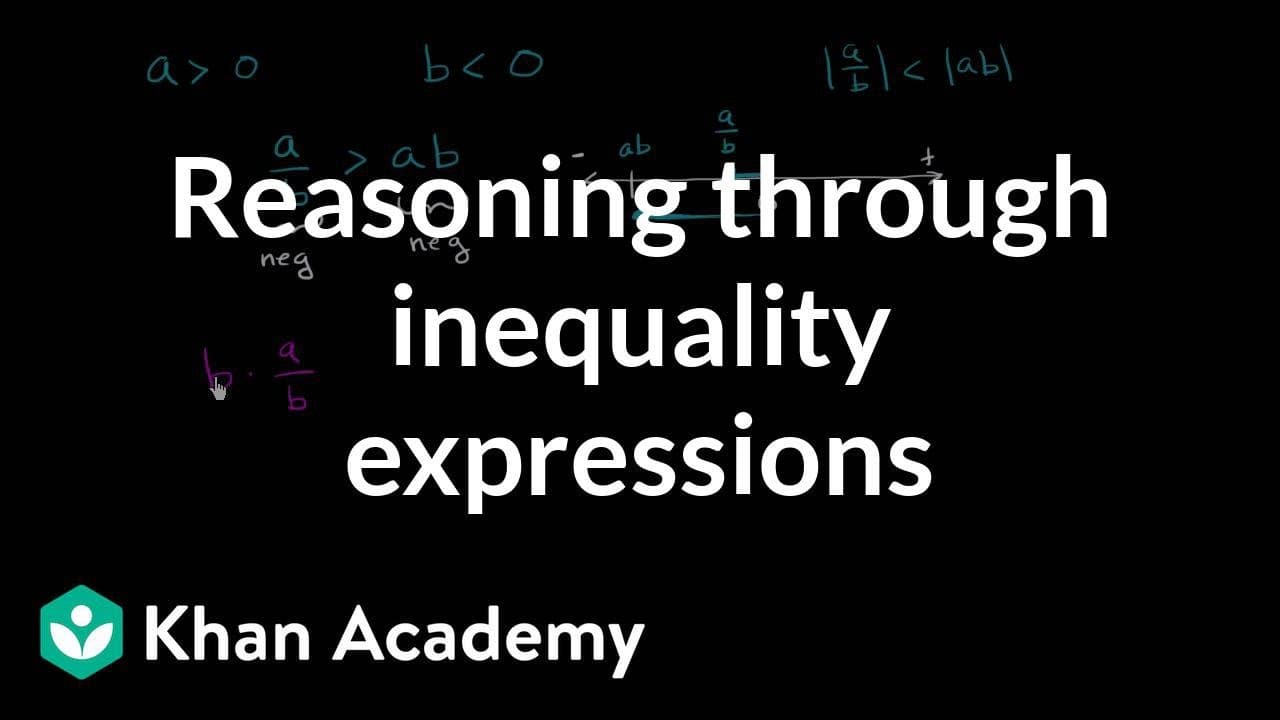
Given positive integer a, negative integer b, and a/b > ab, the key conclusion is that b must be less than -1. Both expressions are negative, but a/b is less negative and has a smaller absolute value than ab. Multiplying the inequality by negative b reverses its direction, leading to 1 < b² and |b| > 1. Read on to see why each inequality step works.
Transcript
You go for a job interview. And the first thing that your interviewer says is, look, you have great work experience. You seem like a nice young person. But what I really care about is your logical reasoning capabilities. So what she says is, just sit down. I'm going to ask you a question about some math expressions. And you say, sure, shoot away. G... Read More
Key Insights
- 😑 The relationship between positive and negative integers in math expressions can provide valuable clues about the values of variables.
- 😑 Manipulating inequalities algebraically allows for a deeper understanding of the relationships between different mathematical expressions.
- 💁 Constraints and given information can help narrow down the possible values of variables in math problems.
Install to Summarize YouTube Videos and Get Transcripts
Explore YouTube Video Summarizer or Get YouTube Transcript Extractor
Questions & Answers
Q: What can be concluded from a > 0, b < 0, and a/b > ab?
The conditions imply that b must be less than -1. They also show that a/b and ab are both negative, with a/b being the greater, less negative value.
Q: Why are a/b and ab both negative?
The integer a is positive, while b is negative. Dividing or multiplying a positive quantity by a negative quantity produces a negative result, so both a/b and ab are negative.
Q: What does a/b > ab mean on a number line?
Both quantities lie to the left of 0 because they are negative. Since a/b is greater, it lies to the right of ab and is therefore less negative.
Q: How do the absolute values of a/b and ab compare?
The absolute value of a/b is less than the absolute value of ab. On the number line, a/b is closer to 0, so its distance from 0 is smaller.
Q: Why does multiplying a/b > ab by b reverse the inequality?
The inequality reverses because b is less than 0. After multiplication, the result is a < ab².
Q: How does a < ab² simplify to 1 < b²?
Both sides can be divided by a because a is greater than 0. Dividing by a positive quantity does not reverse the inequality, leaving 1 < b².
Q: What does 1 < b² reveal about b?
It means that the absolute value of b is greater than 1. Equivalently, b must be less than -1 or greater than 1.
Q: Why must b be less than -1 rather than greater than 1?
The original conditions state that b is less than 0, so the possibility b > 1 is excluded. Combining b < 0 with |b| > 1 leaves only b < -1.
Summary & Key Takeaways
-
In a job interview, a candidate is asked to analyze the relationship between two integers, a and b, based on the inequality a/b > a times b.
-
By considering the signs of a and b, it is deduced that a/b is less negative than a times b.
-
Manipulating the inequality further reveals that the absolute value of b must be greater than 1 and b must be less than 0.
Read in Other Languages (beta)
Share This Summary 📚
Summarize YouTube Videos and Get Video Transcripts with 1-Click
Try YouTube Summary with ChatGPT & Claude or YouTube Transcript Generator
Explore More Summaries from Khan Academy 📚



Summarize YouTube Videos and Get Video Transcripts with 1-Click
Try YouTube Summary with ChatGPT & Claude or YouTube Transcript Generator