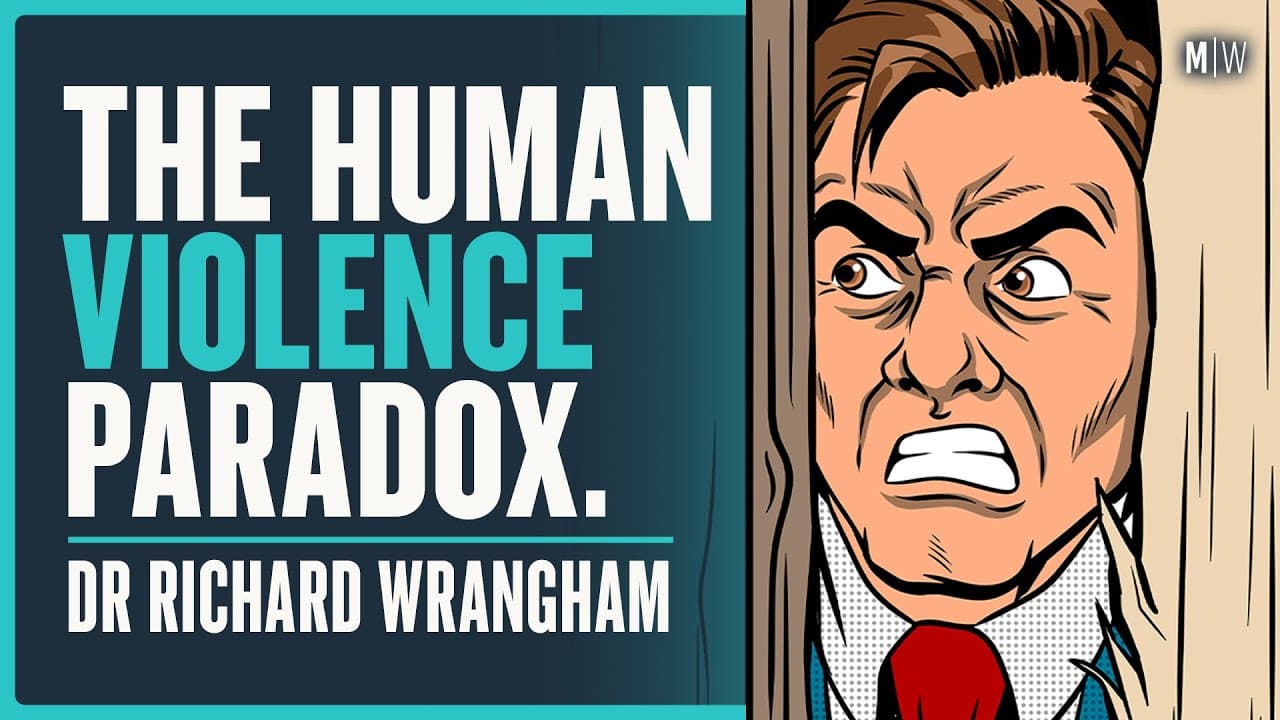
How Did Human Aggression Evolve?, Dr Richard Wrangham
TL;DR
Human aggression evolved alongside an equally biological capacity for tolerance, friendliness, and cooperation. Dr Richard Wrangham traces this paradox through nearly two million years of the genus Homo, comparisons with great apes, language-enabled coalitions, and human self-domestication. He also connects facial breadth with aggression and contrasts the views of Rousseau and Thomas Hobbes, offering several reasons to read on.
Transcript
if you look at males it turns out that in a number of animals males who have a relatively broad face are more aggressive there was a Canadian team that looked at hockey teams and looked at the number of minutes that individual players spent in The Penalty Box for being too aggressive there was a positive relationship between breadth of the face and... Read More
Key Insights
- ❓ Humans have biological predispositions toward both aggression and cooperation.
- ❓ Aggression and tolerance coexist in human nature, creating a paradox in our behavior.
- 💠 Language and coalitional abilities shaped human aggression and morality.
- 🤳 Self-domestication resulted in physical and behavioral changes in humans and bonobos.
- 🕵️♂️ Societal systems, such as patriarchy, reflect the interests of dominant male groups.
Install to Summarize YouTube Videos and Get Transcripts
Explore YouTube Video Summarizer or Get YouTube Transcript Extractor
Questions & Answers
Q: Are humans inherently aggressive or tolerant?
Humans are biologically predisposed toward both aggression and tolerance. Dr Richard Wrangham argues that society neither simply tames an aggressive species nor turns a peaceful species violent; both sides are part of human biology.
Q: Why does Dr Richard Wrangham call human aggression a paradox?
Humans cause more deaths among members of their own species than is typical of other animals. Yet humans can also be remarkably friendly, tolerant, and averse to aggression, so both contrasting tendencies must be explained together.
Q: What does facial breadth suggest about aggression?
In a number of animals, males with relatively broad faces are more aggressive. A Canadian study of hockey teams found a positive relationship between players’ facial breadth and the number of minutes they spent in the penalty box for being too aggressive.
Q: How has self-domestication influenced human evolution?
Human self-domestication involved coordinated efforts to remove highly aggressive individuals. It was associated with reduced facial breadth, shorter faces, and behavioral changes related to reactive aggression.
Q: What role did language play in human aggression and morality?
Language allowed people to coordinate and form coalitions against aggressive members of their own group. It also supported moral principles about right and wrong, shaped in part by what benefited dominant male groups.
Q: How did Rousseau and Thomas Hobbes differ on human aggression?
Rousseau was associated with the view that humans are inherently unaggressive but are made aggressive by society. Hobbes viewed humans as inherently competitive, cruel, and violent, requiring an ultimate authority, the Leviathan, to keep them under control; Wrangham says both captured part of the truth.
Q: How do great apes help explain human aggression?
Great apes display elements of both aggressive and tolerant behavior. Comparing species shows how evolution can generate different levels and kinds of aggression rather than revealing one behavioral quality inherited from one particular ape.
Q: How far back does the evolutionary story of human aggression extend?
Wrangham looks back across the nearly two million years in which humans have belonged to the genus Homo. He describes the earliest members as roughly human-sized and human-shaped but smaller, more robust, and marked by large brow ridges and broad faces.
Summary & Key Takeaways
-
Aggression in humans is a result of both biological predispositions and societal influences.
-
Humans have displayed both aggressive and cooperative tendencies throughout history, leading to a paradoxical nature.
-
The development of language and the ability to form coalitions greatly influenced human aggression and morality.
-
Self-domestication in humans and bonobos resulted in changes to the physical and psychological traits of males.
-
Patriarchy and moral systems have been shaped by the interests of dominant male groups.
-
The surplus of resources and changing gender roles in modern society pose new challenges for male identity and aggression.
Read in Other Languages (beta)
Share This Summary 📚
Summarize YouTube Videos and Get Video Transcripts with 1-Click
Try YouTube Summary with ChatGPT & Claude or YouTube Transcript Generator
Explore More Summaries from Chris Williamson 📚






Summarize YouTube Videos and Get Video Transcripts with 1-Click
Try YouTube Summary with ChatGPT & Claude or YouTube Transcript Generator