How Is NVIDIA Building the Next Era of AI?
TL;DR
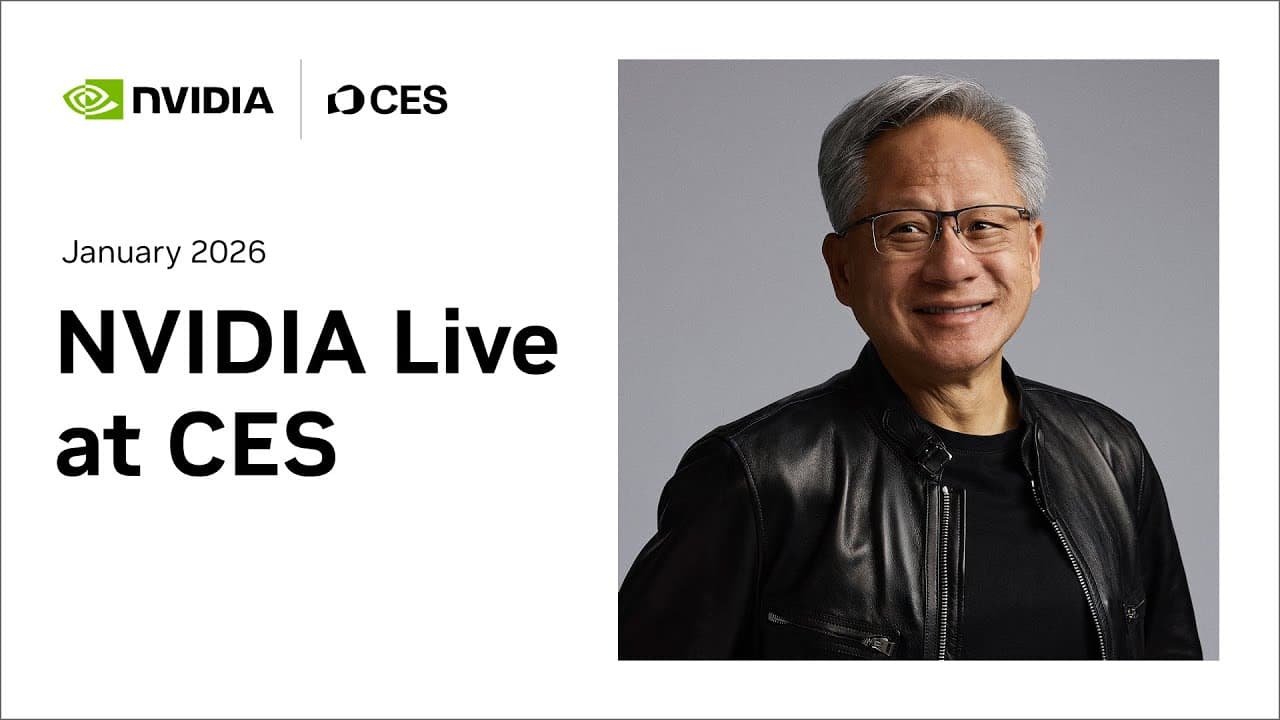
AI is becoming a computing platform on which developers build applications, while software development shifts from programming code for CPUs to training models for GPUs. NVIDIA is supporting this transition with accelerated computing, open models, AI-agent tools, physical AI systems, autonomous-driving technology, robotics platforms, and libraries that cover the full model lifecycle.
Transcript
Heat. Heat. N. Ready, go. Thank you. Heat. Heat. [music] >> [music] [music] >> Heat. Heat. [music] Heat. Heat. Heat. Heat. [music] [music] Heat. [music] [music] Heat. Heat. Heat. [music] [music] [music] Welcome to the stage Nvidia founder and CEO Jensen Wong. Hello, Las Vegas. Happy New Year. Welcome to CES. Well, we have about 15 kilos worth of ma... Read More
Key Insights
- AI is becoming a foundational computing platform because developers can build applications on top of intelligent models, rather than treating each AI only as a standalone application. This shift changes both the target platform for software and the process used to create it.
- Software development is moving from programming to training, while execution is moving from CPUs to GPUs. Applications can now understand context and generate each pixel or token from scratch, instead of relying exclusively on prerecorded and precompiled behavior.
- AI scaling includes pretraining, reinforcement-learning-based post-training, and test-time reasoning. Each phase requires substantial computing resources, while test-time scaling lets a model think during use rather than relying solely on what it learned before deployment.
- Agentic systems are models that can reason, retrieve information, conduct research, use tools, plan future actions, and simulate outcomes. NVIDIA uses Cursor as an example of an agentic system that changed how software programming is performed inside the company.
- Open models are helping AI spread across startups, established companies, researchers, students, industries, and countries. DeepSeek R1 is identified as the first open reasoning model, while new open models are described as emerging every six months and becoming increasingly capable.
- NVIDIA is building frontier models openly across multiple domains, including proteins, cellular representation, weather, language reasoning, world understanding, humanoid robotics, and autonomous driving. The company also releases training data so users can examine model origins and develop derivatives.
- NVIDIA's NeMo-related libraries manage the AI lifecycle from data processing and generation through model creation, training, evaluation, guardrails, and deployment. Specialized libraries mentioned include PhysicsNeMo, Clara, and BioNeMo, with the broader platform made available as open source.
- Physical AI combines models that interact with the physical world with AI systems that understand physical laws. NVIDIA connects this approach to Cosmos, Groot, Alpamayo, DRIVE AV, robotics simulation, autonomous vehicles, industrial design, system emulation, and Siemens CUDA-X integration.
Install to Summarize YouTube Videos and Get Transcripts
Explore YouTube Video Summarizer or Get YouTube Transcript Extractor
Questions & Answers
Q: How is AI changing the way software is built?
AI is changing software development by shifting the central activity from explicitly programming instructions to training models. The resulting applications run on GPUs, interpret their current context, and generate pixels or tokens during each interaction. Developers can also build applications on top of AI systems, making intelligence part of the underlying computing platform rather than only a standalone application.
Q: What are the two computing platform shifts described by Jensen Huang?
The first shift is toward AI as the platform targeted by new applications, similar to earlier transitions involving PCs, the internet, cloud computing, and mobile computing. The second shift changes how software is created and executed: models are trained instead of conventionally programmed, workloads run on GPUs instead of CPUs, and outputs are generated dynamically from context.
Q: How does test-time scaling improve an AI model?
Test-time scaling gives an AI model computing time to reason while it is answering or performing a task. It complements pretraining, which develops broad learning, and reinforcement-learning-based post-training, which develops skills. The approach is described as thinking in real time, and it adds another compute-intensive phase through which language models can continue improving their results.
Q: What can agentic AI systems do?
Agentic AI systems can reason, look up information, conduct research, use tools, plan future actions, and simulate possible outcomes. These abilities allow them to address important multi-step problems rather than simply generate a response from an initial prompt. Cursor is cited as an agentic system that revolutionized software programming practices within NVIDIA.
Q: Why are open AI models important to NVIDIA's strategy?
Open models allow startups, large companies, researchers, students, industries, and countries to participate in AI development. NVIDIA supports this ecosystem by releasing models, training data, derivative-building tools, and lifecycle libraries. Open training data also helps users understand how a model was created, which the keynote presents as necessary for establishing trust in its origins.
Q: Which open AI model projects does NVIDIA highlight?
NVIDIA highlights La Protina for synthesizing and generating proteins, OpenFold 3 for protein structures, Evo 2 for understanding and generating multiple proteins, Earth-2 work for physical laws and weather, Nemotron 3 for efficient reasoning, Cosmos for understanding how the world works, Groot for humanoid robotics, and Alpamayo for self-driving vehicles.
Q: What does NVIDIA mean by physical AI and AI physics?
Physical AI refers to artificial intelligence that interacts with the physical world and understands relevant natural behavior. AI physics refers to systems that understand the laws of physics encoded in the world. NVIDIA connects these areas through world foundation models, humanoid robotics, autonomous driving, robotics learning simulation, industrial AI, design acceleration, simulation, and system-scale emulation.
Q: How is NVIDIA supporting autonomous driving and robotics?
NVIDIA presents Alpamayo as part of its self-driving work and demonstrates Level 2++ autonomous driving in San Francisco with NVIDIA DRIVE AV. It also states that its full-stack autonomous-vehicle technology ships on the 2025 Mercedes-Benz CLA. For robotics, NVIDIA highlights Cosmos, Groot, a robotics learning simulator, and systems designed to move robotics into real-world environments.
Summary & Key Takeaways
-
Jensen Huang describes two simultaneous platform shifts: applications are being built on AI, and software itself is moving from explicitly programmed instructions to trained models. Accelerated computing and GPUs support applications that interpret context and generate pixels or tokens from scratch, prompting modernization across the computer industry.
-
AI development has expanded from pretraining into reinforcement learning, test-time reasoning, and agentic systems that can research, use tools, plan, and simulate outcomes. NVIDIA is also developing open models for biology, weather, robotics, documents, speech, retrieval, world understanding, and autonomous driving, supported by its DGX supercomputers.
-
Physical AI connects artificial intelligence with the laws and environments of the physical world. NVIDIA presents a full-stack strategy spanning Cosmos world models, Groot humanoid robotics, Alpamayo autonomous driving, DRIVE AV, simulation, industrial AI, and partnerships or integrations involving Mercedes-Benz, Cadence, Synopsys, and Siemens.
Read in Other Languages (beta)
Share This Summary 📚
Summarize YouTube Videos and Get Video Transcripts with 1-Click
Try YouTube Summary with ChatGPT & Claude or YouTube Transcript Generator
Explore More Summaries from NVIDIA 📚

Summarize YouTube Videos and Get Video Transcripts with 1-Click
Try YouTube Summary with ChatGPT & Claude or YouTube Transcript Generator