Products
Features
YouTube Video Summarizer
Summarize YouTube videos
Web & PDF Highlighter
Highlight web pages & PDFs
Chat with PDF
Ask any PDF questions with AI
Ask AI Clone
Chat with your highlights & memories
Audio Transcriber
Transcribe audio files to text
Glasp Reader
Read and highlight articles
Kindle Highlight Export
Export your Kindle highlights
Idea Hatch
Hatch ideas from your highlights
Integrations
Obsidian Plugin
Notion Integration
Pocket Integration
Instapaper Integration
Medium Integration
Readwise Integration
Snipd Integration
Hypothesis Integration
Apps & Extensions
Chrome Extension
Safari Extension
Edge Add-ons
Firefox Add-ons
iOS App
Android App
Discover
Discover
Ideas
Discover new ideas and insights
Articles
Curated articles and insights
Books
Book recommendations by great minds
Posts
Essays and notes from readers
Quotes
Inspiring quotes collection
Videos
Curated videos and summaries
Explore Glasp
Glasp Newsletter
Weekly insights and updates
Glasp Talk
Interview series with great minds
Glasp Blog
Latest news and articles
Glasp Use Cases
Learn how others use Glasp
Build & Support
Glasp API
Access Glasp's API for developers
MCP Connector
Connect Glasp to Claude & ChatGPT
Community
Glasp Reddit Community
Students
Student discount and benefits
FAQs
Frequently Asked Questions
AboutPricing
DashboardLog inSign up

The Metric System - Basic Introduction
August 25, 2022
by
The Organic Chemistry Tutor
YouTube video player
The Metric System - Basic Introduction

TL;DR

An analysis of the metric system and unit conversions, including prefixes, multipliers, conversion factors, and step-by-step examples.

Transcript

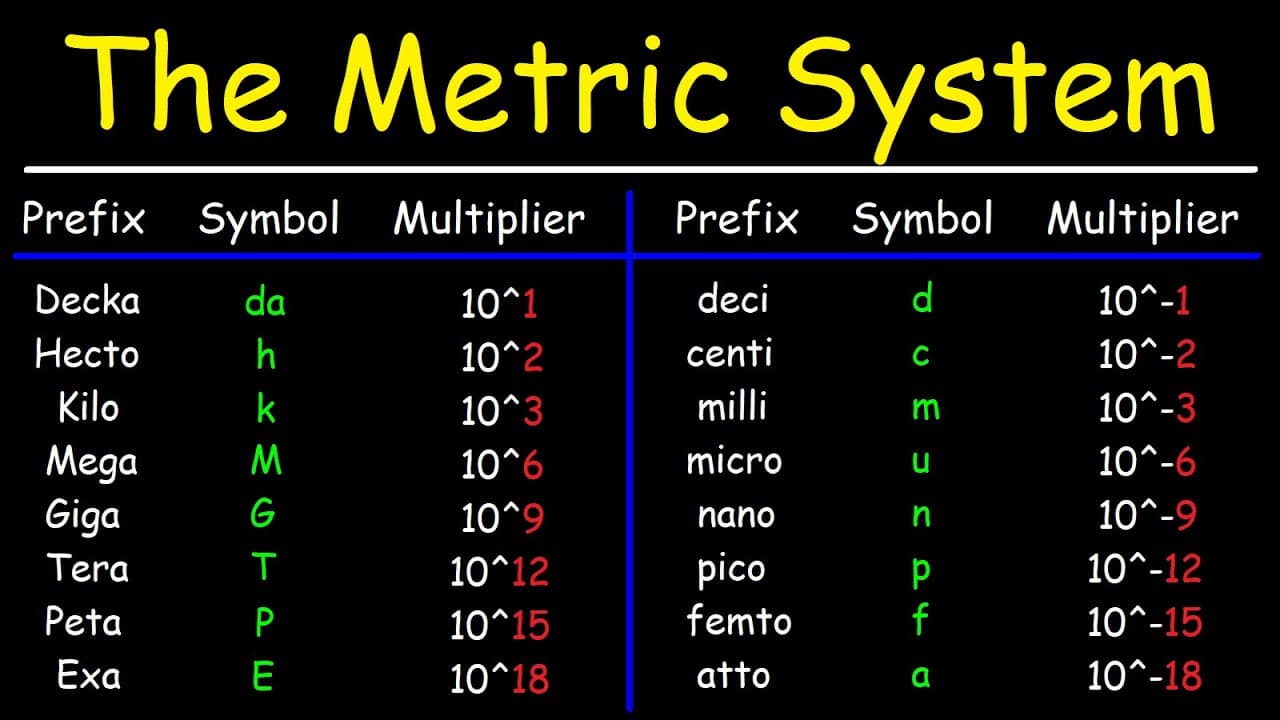
now we're going to talk about the prefix of the metric system the symbols that correspond to it and the multiplier so first we're going to start with deca the symbol for deca is d a the multiplier is 10 to the 1 or just 10. hecto has a symbol lowercase h the multiplier is 10 squared or 100 kilo kilo is lower case k and it's 10 to the third or a tho... Read More

Key Insights

  • 😒 The metric system uses prefixes and multipliers to represent different magnitudes of measurement.
  • 🧑‍🏭 Conversion factors are written by attaching a 1 to the prefix and the multiplier to the base unit.
  • 🇦🇪 To convert between units, unwanted units are canceled out using the appropriate conversion factors.
  • 📣 The common prefixes in the metric system are kilo, mega, giga, tera, and pico, representing different magnitudes of measurement.
  • 🇦🇪 Unit conversions can be done step-by-step by converting to intermediate units and then to the desired unit.
  • 🐕‍🦺 The exponent of a unit can be changed by moving it from the top to the bottom or vice versa in the conversion fraction.
  • 😑 Scientific notation is commonly used in expressing measurements in the metric system.

Install to Summarize YouTube Videos and Get Transcripts

Explore YouTube Video Summarizer or Get YouTube Transcript Extractor

Questions & Answers

Q: What is the multiplier and symbol for deca in the metric system?

The multiplier for deca is 10 to the 1, or simply 10, and its symbol is "da" in the metric system.

Q: How would you convert 478 meters to kilometers using the metric system?

To convert meters to kilometers, we use the conversion factor 1 kilometer = 1000 meters. Thus, 478 meters is equal to 0.478 kilometers.

Q: What is the prefix and multiplier for micro in the metric system?

The prefix for micro is represented by the symbol lowercase "μ", and its multiplier is 10 to the -6.

Q: How would you convert 0.236 liters to milliliters using the metric system?

0.236 liters is equal to 236 milliliters using the conversion factor 1 liter = 1000 milliliters.

Q: What are the common prefixes used in the metric system?

The most common prefixes used in the metric system are kilo, mega, giga, tera, and pico, representing various magnitudes of measurement.

Summary & Key Takeaways

  • The metric system uses prefixes to represent different magnitudes, with deca (10), hecto (100), kilo (1,000), mega (1,000,000), and giga (1,000,000,000) being commonly used.

  • Conversion factors are written by attaching a 1 to the prefix and the multiplier to the base unit, such as meters or liters.

  • Conversion between units is done by canceling out the unwanted unit and using the appropriate conversion factors.


Read in Other Languages (beta)

English

Share This Summary 📚

Summarize YouTube Videos and Get Video Transcripts with 1-Click

Download browser extensions on:

Try YouTube Summary with ChatGPT & Claude or YouTube Transcript Generator

Explore More Summaries from The Organic Chemistry Tutor 📚

How to Calculate Work and Power in Rotational Motion thumbnail
How to Calculate Work and Power in Rotational Motion
The Organic Chemistry Tutor
Integration By Parts Formula Derivation thumbnail
Integration By Parts Formula Derivation
The Organic Chemistry Tutor
How To Find The Amount of Excess Reactant That Is Left Over - Chemistry thumbnail
How To Find The Amount of Excess Reactant That Is Left Over - Chemistry
The Organic Chemistry Tutor
Related Rates - The Shadow Problem thumbnail
Related Rates - The Shadow Problem
The Organic Chemistry Tutor
How to Solve Simple Quadratic Equations Step by Step thumbnail
How to Solve Simple Quadratic Equations Step by Step
The Organic Chemistry Tutor
Simple interest and Compound Interest - SAT Math Part 35 thumbnail
Simple interest and Compound Interest - SAT Math Part 35
The Organic Chemistry Tutor

Summarize YouTube Videos and Get Video Transcripts with 1-Click

Download browser extensions on:

Try YouTube Summary with ChatGPT & Claude or YouTube Transcript Generator

Apps & Extensions

  • Chrome Extension
  • Safari Extension
  • Edge Add-ons
  • Firefox Add-ons
  • iOS App
  • Android App

Key Features

  • YouTube Video Summarizer
  • Web & PDF Summarizer
  • Web & PDF Highlighter
  • Chat with PDF
  • Ask AI Clone
  • Audio Transcriber
  • Glasp Reader
  • Kindle Highlight Export
  • Idea Hatch

Integrations

  • Obsidian Plugin
  • Notion Integration
  • Pocket Integration
  • Instapaper Integration
  • Medium Integration
  • Readwise Integration
  • Snipd Integration
  • Hypothesis Integration

More Features

  • APIs
  • MCP Connector
  • Blog & Post
  • Embed Links
  • Image Highlight
  • Personality Test
  • Quote Shots

Company

  • About us
  • Blog
  • Community
  • FAQs
  • Job Board
  • Newsletter
  • Pricing
Terms

•

Privacy

•

Guidelines

© 2026 Glasp Inc. All rights reserved.