How Do You Find a Common Denominator for 3/5 and 7/2? | Math | 4th Grade | Khan Academy
TL;DR
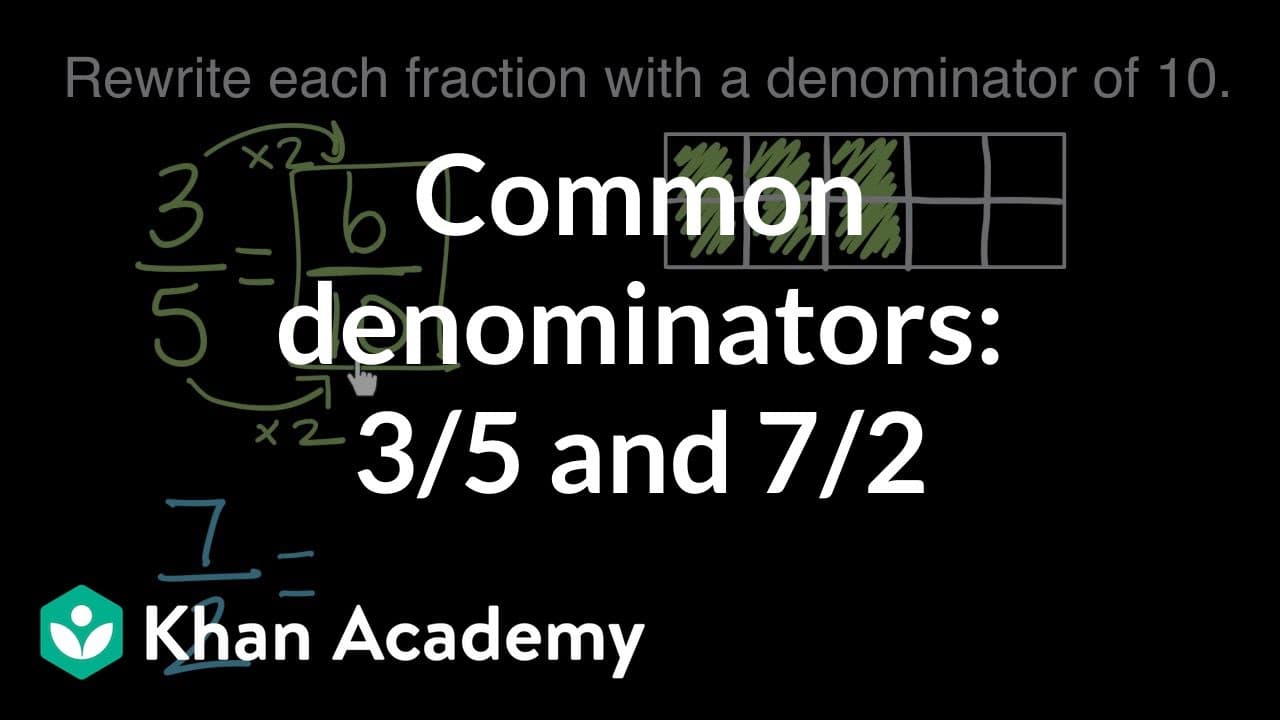
Rewrite 3/5 and 7/2 with the common denominator 10 as 6/10 and 35/10. For 3/5, multiply the numerator and denominator by 2; for 7/2, multiply both by 5. These steps preserve the amount each fraction represents while expressing both in tenths. Read on to see how the visual model explains why both parts must change together.
Transcript
- Rewrite each fraction with a denominator of 10. So we have two fractions, three fifths and seven halves and we wanna take their denominators of five and two and change them to be a common denominator of 10. Lets start with three fifths and we can look at this visually. Here we can use this rectangle to represent a whole, one whole. To show three ... Read More
Key Insights
- 🆘 Visual representation helps with understanding fractions and conversion.
- ⏫ Doubling the denominator also doubles the numerator when converting fractions.
- 👻 Multiplying or dividing the numerator and denominator by the same number allows for equivalent fractions.
- ❓ Converting fractions to a common denominator simplifies comparison and mathematical operations.
- ✖️ The process of converting fractions involves dividing or multiplying both the numerator and denominator.
- 👻 Fraction conversion allows for consistent denominators, facilitating addition, subtraction, and comparison.
- 🦻 Understanding the relationship between different fractions and their visual representations aids in conversion.
Install to Summarize YouTube Videos and Get Transcripts
Explore YouTube Video Summarizer or Get YouTube Transcript Extractor
Questions & Answers
Q: How do you rewrite 3/5 and 7/2 with a common denominator of 10?
Rewrite 3/5 as 6/10 by multiplying both 3 and 5 by 2. Rewrite 7/2 as 35/10 by multiplying both 7 and 2 by 5.
Q: Why is 10 a common denominator for 3/5 and 7/2?
The denominator 5 becomes 10 when multiplied by 2, and the denominator 2 becomes 10 when multiplied by 5. Therefore, both fractions can be expressed in tenths.
Q: How do you convert 3/5 to tenths?
Multiply the denominator 5 by 2 to get 10, and multiply the numerator 3 by the same number. This gives 3/5 = 6/10.
Q: How does a visual model show that 3/5 equals 6/10?
Divide a rectangle representing one whole into five equal pieces and shade three. Split every fifth in half, producing 10 equal pieces with six shaded, so the shaded amount stays the same.
Q: What happens to the numerator when the denominator of 3/5 is doubled?
The numerator also doubles, changing from 3 to 6. Each of the three shaded fifths is split into two pieces, creating six shaded tenths.
Q: How do you convert 7/2 to tenths?
Multiply the denominator 2 by 5 to get 10. Multiply the numerator 7 by the same number, giving 7/2 = 35/10.
Q: Why must the numerator and denominator be multiplied by the same number?
When every original piece is split into the same number of smaller pieces, the shaded pieces are split as well. Multiplying the numerator and denominator by the same number therefore changes how the fraction is written without changing the amount represented.
Q: What are the final equivalent fractions with denominator 10?
The final equivalent fractions are 6/10 and 35/10. Thus, 3/5 = 6/10 and 7/2 = 35/10.
Summary & Key Takeaways
-
To convert fractions, such as 3/5 and 7/2, to a common denominator of 10, visualize each fraction and divide the whole into equal parts.
-
Change the denominator by splitting each part in half or doubling the amount of pieces to achieve tenths.
-
The numerator will also change accordingly when the denominator is multiplied or divided.
Read in Other Languages (beta)
Share This Summary 📚
Summarize YouTube Videos and Get Video Transcripts with 1-Click
Try YouTube Summary with ChatGPT & Claude or YouTube Transcript Generator
Explore More Summaries from Khan Academy 📚



Summarize YouTube Videos and Get Video Transcripts with 1-Click
Try YouTube Summary with ChatGPT & Claude or YouTube Transcript Generator