Lecture 1 | Quantum Entanglements, Part 1 (Stanford)

TL;DR
Quantum entanglement challenges our intuitive understanding of physics, as it deals with phenomena beyond our evolutionary experience. Our brains are not wired to understand concepts like the uncertainty principle, making quantum mechanics seem strange. This lecture explores the logic and information theory of quantum mechanics, rather than conventional topics like wave-particle duality.
Transcript
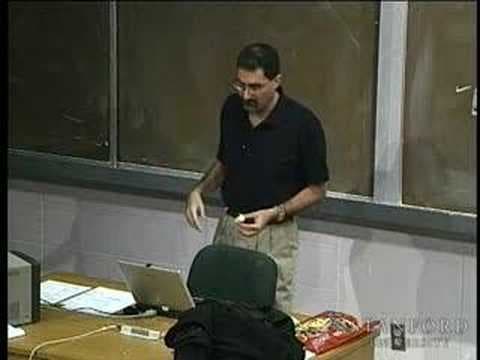
this program is brought to you by Stanford University please visit us at stanford.edu I almost always begin with the same sermon about especially when teaching about quantum mechanics or relativity the sermon is always the same it's the fact that we as animals have inherited through the process of evolution certain intuitive ways of thinking about ... Read More
Key Insights
- Quantum mechanics is unintuitive because it involves phenomena outside human evolutionary experience.
- Our intuitive understanding of physics is based on inherited biological instincts, not suited for quantum phenomena.
- Quantum entanglement demonstrates the peculiar logic and information theory in quantum mechanics.
- Classical physics is deterministic and reversible, unlike the probabilistic nature of quantum mechanics.
- Quantum bits differ from classical bits; they can exist in superpositions of states, unlike classical binary states.
- Matrix algebra is crucial for understanding quantum mechanics, as it describes state transformations.
- The concept of unitarity in quantum mechanics ensures that information is conserved over time.
- Quantum mechanics requires a new intuition and mathematical framework, different from classical physics.
Install to Summarize YouTube Videos and Get Transcripts
Explore YouTube Video Summarizer or Get YouTube Transcript Extractor
Questions & Answers
Q: What is the key difference between classical and quantum bits?
Classical bits exist in one of two states, typically represented as 0 or 1, and are deterministic. Quantum bits, or qubits, can exist in superpositions of states, meaning they can be both 0 and 1 simultaneously until measured. This fundamental difference allows for the unique properties of quantum computing, such as parallelism and entanglement, which are not possible with classical bits.
Q: Why is quantum mechanics considered unintuitive?
Quantum mechanics is considered unintuitive because it involves phenomena that are outside the range of human evolutionary experience. Our brains are wired to understand classical physics through biological instincts, like predicting the trajectory of a thrown rock. However, quantum phenomena, such as entanglement and the uncertainty principle, do not align with these instincts, requiring new mathematical frameworks and intuitions.
Q: How does matrix algebra apply to quantum mechanics?
Matrix algebra is used in quantum mechanics to describe the transformations and evolutions of quantum states. Quantum states are represented as vectors, and matrices act on these vectors to update them over time. This mathematical framework is essential for understanding quantum phenomena, as it allows for the precise calculation of probabilities and the behavior of qubits in superposition and entanglement.
Q: What role does unitarity play in quantum mechanics?
Unitarity in quantum mechanics ensures that information is conserved over time. It means that the evolution of quantum states is reversible, allowing for the reconstruction of past states from future states and vice versa. This principle is crucial for maintaining the integrity of quantum information and distinguishes quantum mechanics from classical systems, which may lose information in irreversible processes.
Q: How do physicists develop intuition for quantum mechanics?
Physicists develop intuition for quantum mechanics by rewiring their thinking to accommodate abstract mathematical concepts and phenomena beyond classical intuition. This involves learning to visualize and work with superpositions, entanglements, and other quantum states through mathematical frameworks, such as matrix algebra and probability theory, rather than relying on instinctive, classical understandings.
Q: What is the significance of the uncertainty principle in quantum mechanics?
The uncertainty principle is a fundamental concept in quantum mechanics that states there is a limit to how precisely certain pairs of physical properties, like position and momentum, can be known simultaneously. This principle highlights the probabilistic nature of quantum mechanics and challenges classical notions of determinism and predictability, emphasizing the inherent limitations in measuring and predicting quantum states.
Q: Why is quantum mechanics more complex than classical physics?
Quantum mechanics is more complex than classical physics because it involves probabilistic events, superpositions, and entanglements, which do not have classical analogs. The mathematical framework of quantum mechanics, including matrix algebra and complex probability amplitudes, is more abstract and requires a departure from classical deterministic principles, making it a more intricate and less intuitive field.
Q: How does quantum entanglement challenge classical physics?
Quantum entanglement challenges classical physics by demonstrating that particles can be instantaneously correlated over long distances, a phenomenon that defies classical explanations of locality and causality. This peculiar behavior suggests that information can be shared between entangled particles in ways that classical physics cannot account for, leading to new insights and technologies, such as quantum computing and cryptography.
Summary
In this video, the speaker discusses the intuitive ways of thinking about the physical world that humans have inherited through evolution. He explains how our intuitions about physics are based on our biological origins and how these intuitions are limited to the range of parameters we have experienced in the ordinary world. He also introduces the concept of classical bits and how classical physics can be represented in terms of bits.
Questions & Answers
Q: How do our intuitive ways of thinking about the physical world come from our biological origins?
Our intuitive ways of thinking about the physical world are a result of the process of evolution. As animals, we have inherited certain intuitive ways of thinking about the physical world that have helped us survive and navigate our environment. For example, the way a lion stops dead when the relative velocity between the lion and its prey changes sign is an example of our intuitive understanding of velocity and direction.
Q: Why do our intuitions about physics only apply to parameters within the range of our experience?
Our intuitions about physics are based on the parameters and situations we have experienced in our everyday lives. For example, we have never experienced velocities approaching the speed of light, so our intuitions about adding velocities are incorrect in the realm of relativity. In order to understand and work with parameters that are outside the range of our experience, such as in modern physics, we have had to develop new mathematical concepts and ways of thinking.
Q: What is the difference between classical bits and quantum bits?
Classical bits, or c-bits, are used in classical physics to represent information in the form of a binary digit - either a 0 or a 1. They are used to represent discrete information, such as yes or no answers or up or down states. On the other hand, quantum bits, or qubits, are used in quantum mechanics to represent information in a superposition of states. They can exist in multiple states simultaneously, allowing for more complex and versatile information processing.
Q: How can classical physics be represented in terms of bits?
Classical physics can be represented in terms of classical bits, which are used to represent discrete information. For example, the temperature in a room can be represented by a series of bits, where each bit represents a specific temperature value. By breaking up physical systems into smaller cells and assigning bit values to each cell, we can represent the information of the system using bits.
Q: What does it mean for a physical system to be reversible?
Reversibility in the context of physics means that a physical process can unfold in both the forward and backward directions of time. In classical physics, the laws of motion are reversible, meaning that if you know the current state of a system, you can uniquely determine its past and future states. This is known as the uniqueness of the future and past points. However, in certain cases, such as irreversible processes, information may be lost, making it impossible to determine the past state from the future state.
Q: Is time symmetry the same as time reversibility?
While time symmetry and time reversibility are related concepts, they are not exactly the same. Time symmetry refers to the invariance of physical laws under time translations, meaning that the laws of physics should remain unchanged when time is reversed. On the other hand, time reversibility specifically refers to the ability to reverse the direction of time in a physical process without changing its outcome. Time reversibility is a property of reversible systems, where knowing the present state of the system uniquely determines its past and future states.
Q: Why is it that some physical systems suppress quantum mechanics and appear classical?
The reason why some physical systems appear classical and suppress quantum mechanics is still not fully understood. However, it is believed to be due to a phenomenon known as decoherence, where interactions with the environment cause the delicate quantum superpositions to "collapse" into classical states. This collapse leads to the emergence of classical behavior and the loss of quantum effects. The study of decoherence and the transition from quantum to classical behavior is an active area of research in quantum mechanics.
Q: Can irreversible processes occur in classical physics?
In classical physics, irreversible processes can occur, but they are generally not considered fundamental or fundamental laws of physics. Irreversible processes are typically macroscopic phenomena that arise due to complexity, dissipative effects, or interactions with the environment. At the most fundamental level, the laws of classical physics are reversible and do not allow for the loss of information. Irreversibility emerges when considering systems at larger scales or when incorporating additional factors like friction, heat transfer, or energy dissipation.
Q: Can reversible laws of motion occur in classical mechanics?
Yes, reversible laws of motion can occur in classical mechanics. Reversibility in classical mechanics refers to the fact that starting from a given state, the laws of motion allow for the determination of both the past and future states of a system. Reversible laws of motion ensure that information is not lost or destroyed during the evolution of the system. However, it is worth noting that in practice, certain factors such as energy dissipation, friction, or irreversibilities introduced by the macroscopic properties of the system may limit the practical reversibility of a process.
Q: What is the difference between quantum mechanics and classical mechanics?
Quantum mechanics and classical mechanics are two different frameworks for understanding and describing the behavior of physical systems. Classical mechanics, also known as Newtonian mechanics, is the branch of physics that deals with the motion and interaction of macroscopic objects, such as planets, billiard balls, or everyday objects. It is based on principles like Newton's laws of motion and the conservation of energy and momentum. On the other hand, quantum mechanics is the branch of physics that deals with the behavior of matter and energy at the atomic and subatomic scales. It introduces the concept of wave-particle duality, probabilistic behavior, and superposition, which are not present in classical mechanics.
Summary & Key Takeaways
-
Quantum entanglement reveals the non-intuitive nature of quantum mechanics, challenging our inherited ways of understanding physics. Unlike classical physics, which is deterministic and reversible, quantum mechanics involves probabilistic events and phenomena outside human experience. This lecture focuses on the logic and information theory aspects of quantum mechanics, rather than traditional equations and wave-particle duality.
-
Our intuitive grasp of physics is biologically inherited, based on experiences like throwing rocks or observing natural motions. Quantum mechanics, however, involves phenomena that evolution did not equip us to visualize, such as the uncertainty principle. To understand quantum mechanics, physicists must rewire their intuitions and adopt abstract mathematical frameworks.
-
Matrix algebra plays a crucial role in quantum mechanics, as it allows for the representation and transformation of quantum states. Quantum bits, or qubits, differ from classical bits in that they can exist in superpositions, presenting a more complex logical framework. The concept of unitarity ensures information conservation, distinguishing quantum mechanics from classical deterministic systems.
Read in Other Languages (beta)
Share This Summary 📚
Summarize YouTube Videos and Get Video Transcripts with 1-Click
Try YouTube Summary with ChatGPT & Claude or YouTube Transcript Generator
Explore More Summaries from Stanford 📚


Summarize YouTube Videos and Get Video Transcripts with 1-Click
Try YouTube Summary with ChatGPT & Claude or YouTube Transcript Generator