Introduction to conic sections | Conic sections | Algebra II | Khan Academy
TL;DR
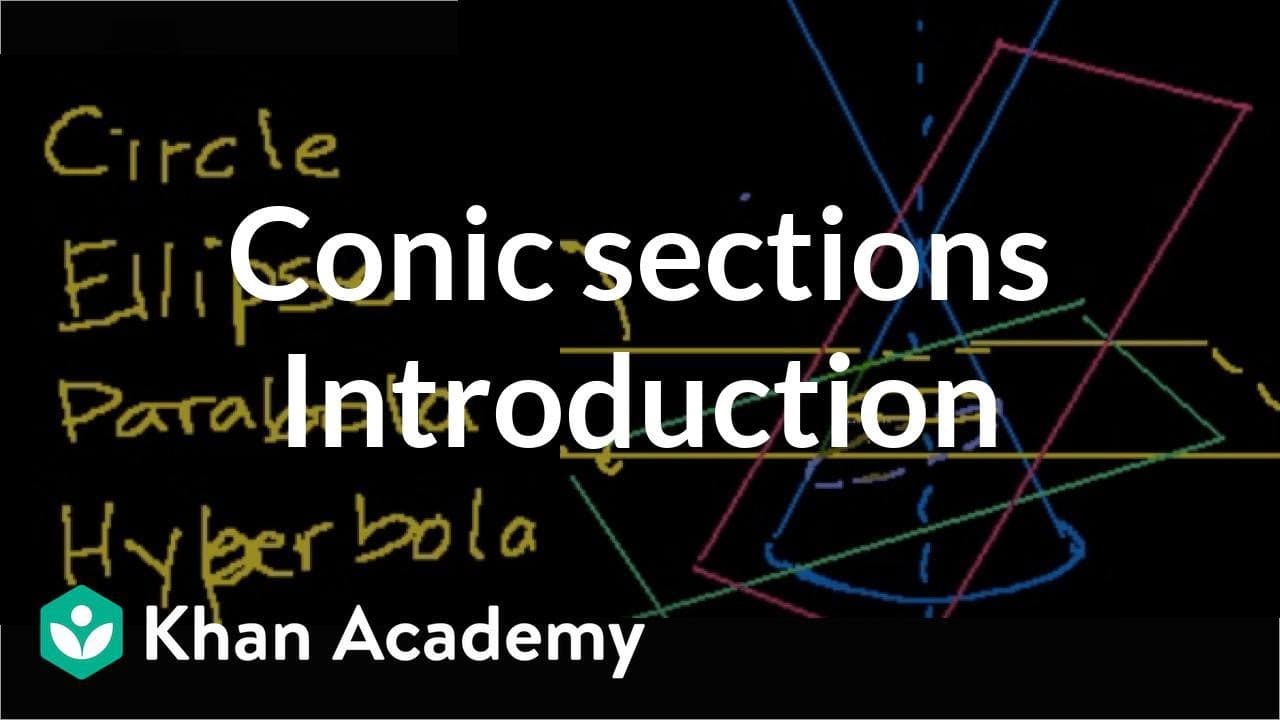
Conic sections refer to the intersection of a plane and a cone, resulting in shapes like circles, ellipses, parabolas, and hyperbolas.
Transcript
Let's see if we can learn a thing or two about conic sections. So first of all, what are they and why are they called conic sections? Actually, you probably recognize a few of them already, and I'll write them out. They're the circle, the ellipse, the parabola, and the hyperbola. That's a p. Hyperbola. And you know what these are already. When I fi... Read More
Key Insights
- 💁 Conic sections are named because they are formed by the intersection of a plane and a cone.
- ⭕ Circles are a special type of ellipse that are not stretched in any direction.
- 😄 Parabolas have a U-shape and can be described by various equations.
- 😚 Hyperbolas have two curves and approach asymptotes as they get closer to them.
- ❓ Conic sections have distinct characteristics that can be represented mathematically and graphically.
- ✈️ The tilt and orientation of the intersecting plane determine the shape of the conic section.
- ⭕ There is a relationship between circles and ellipses, as well as between parabolas and hyperbolas.
Install to Summarize YouTube Videos and Get Transcripts
Explore YouTube Video Summarizer or Get YouTube Transcript Extractor
Questions & Answers
Q: How are conic sections named?
Conic sections are named because they are formed by the intersection of a plane and a cone, resulting in shapes like circles, ellipses, parabolas, and hyperbolas.
Q: What is the relationship between circles and ellipses?
Circles are a special case of ellipses, where they are perfectly symmetrical and not stretched more in one dimension than the other.
Q: How can parabolas be represented by equations?
Parabolas can be represented by equations such as y = x^2 or x = y^2, and they can be shifted or rotated.
Q: What are the characteristics of hyperbolas?
Hyperbolas have two curves that resemble open U-shapes and can be oriented in various directions. They approach asymptotes as they get closer to them.
Summary & Key Takeaways
-
Conic sections are shapes formed by the intersecting of a plane and a cone, and they include circles, ellipses, parabolas, and hyperbolas.
-
Circles are equidistant points from a center, while ellipses are squished circles and can be tilted.
-
Parabolas have a U-shape and can be represented by equations like y = x^2 or x = y^2.
-
Hyperbolas have two curves that resemble open U-shapes and can be represented in various orientations.
Read in Other Languages (beta)
Share This Summary 📚
Summarize YouTube Videos and Get Video Transcripts with 1-Click
Try YouTube Summary with ChatGPT & Claude or YouTube Transcript Generator
Explore More Summaries from Khan Academy 📚



Summarize YouTube Videos and Get Video Transcripts with 1-Click
Try YouTube Summary with ChatGPT & Claude or YouTube Transcript Generator