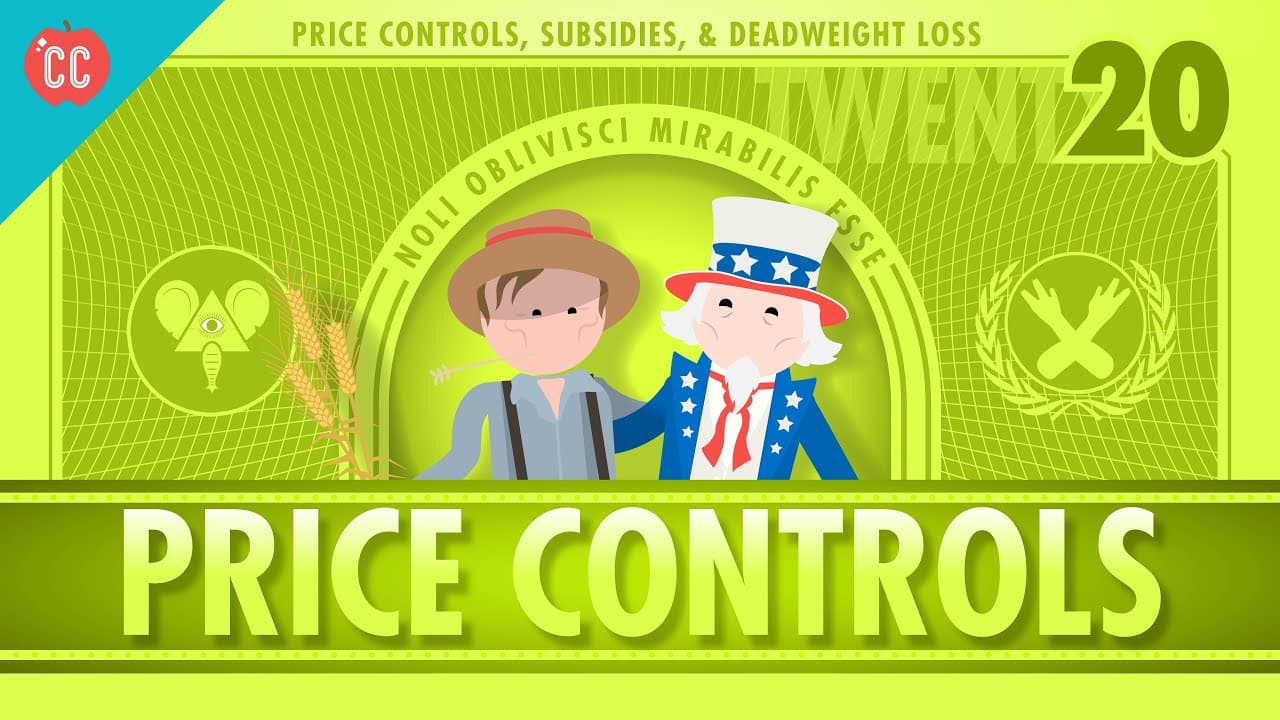
Price Controls, Subsidies, and the Risks of Good Intentions: Crash Course Economics #20
TL;DR
Price controls usually create shortages or surpluses and deadweight loss, while subsidies can encourage production but may also distort markets. Crash Course Economics #20 explains how a $1 gas price ceiling below a $3 equilibrium reduces supply and how a $7 corn price floor above a $4 equilibrium creates surplus. Read on to understand when well-intended government intervention can make markets less efficient.
Transcript
Adriene: Welcome to Crash Course Economics. My name is Adriene Hill Jacob: And I’m Jacob Clifford, and today we’re going to talk about good intentions, and how they can go wrong. Price controls can derail markets. And subsidies can distort them. Adriene: And “deadweight” isn’t just a good description of your ex. [Theme Music] Jacob: Let’s say Craig... Read More
Key Insights
- Price controls, such as ceilings and floors, often lead to market inefficiencies and shortages or surpluses.
- Price ceilings can result in shortages, as seen in Venezuela, where low prices discourage production.
- Rent control is a form of price ceiling that reduces housing availability and quality, despite its intention to increase affordability.
- Price floors, like those on agricultural products, can lead to surpluses and inefficiencies, as consumers avoid higher-priced goods.
- Subsidies can encourage production and lower consumer prices, but they may also discourage innovation and create market distortions.
- Agricultural subsidies in the US have historically provided significant financial support to farmers, sometimes regardless of market conditions.
- Economists generally oppose subsidies due to their market-distorting effects, but some support them for R&D in renewable energy.
- Government intervention is necessary when markets fail, but it must be carefully considered to avoid unintended consequences.
Install to Summarize YouTube Videos and Get Transcripts
Explore YouTube Video Summarizer or Get YouTube Transcript Extractor
Questions & Answers
Q: What are price controls, and why can they be counterproductive?
Price controls are government rules that set maximum or minimum prices in a market. When they prevent prices from reaching equilibrium, they can reduce the quantity traded and create shortages, surpluses, deadweight loss, and inefficiency.
Q: What is the difference between a price ceiling and a price floor?
A price ceiling sets the maximum price permitted for a good or service, while a price floor sets the minimum price. A binding ceiling below equilibrium tends to create a shortage, whereas a floor above equilibrium tends to create a surplus.
Q: How does a price ceiling cause a shortage?
A lower price encourages consumers to demand more while giving producers less incentive to supply the product. In the gasoline example, a $1 ceiling below the $3 equilibrium price reduces the quantity bought and sold and creates a shortage.
Q: When does a price ceiling affect a market?
A price ceiling affects a market only when it is below the equilibrium price. The lower the ceiling, the greater the resulting deadweight loss and inefficiency described in the lesson.
Q: What effects did price controls have in Venezuela?
Venezuela imposed price controls on products including basic foods, medicine, and toilet paper during high inflation. Because controlled prices were low relative to production costs, some farmers and factories reduced or halted production, contributing to long lines, shortages, and empty shelves.
Q: How does rent control affect housing availability and quality?
Rent control caps monthly rent for some apartments and can help long-term tenants remain in their homes as real estate prices rise. However, lower rents discourage renovation and new construction, reducing housing supply and landlords’ incentives to maintain buildings or respond to tenants.
Q: Why does a price floor create a surplus?
A price floor above equilibrium encourages producers to supply more while prompting consumers to buy less or choose substitutes. In the corn example, a $7 floor above the $4 equilibrium price increases supply, reduces demand, and produces a surplus and deadweight loss.
Q: What are subsidies, and what risks do they create?
A subsidy is a government payment to individuals or businesses, often intended to offset costs and advance a public goal. Subsidies can encourage production and lower consumer prices, but they may also discourage innovation and distort markets, so their use must be considered carefully.
Summary & Key Takeaways
-
Price controls, such as ceilings and floors, often lead to market inefficiencies, shortages, or surpluses. While intended to help consumers or producers, they usually result in deadweight loss and reduced market efficiency.
-
Subsidies can sometimes work by encouraging production and lowering consumer prices. However, they may also discourage innovation and create market distortions, leading economists to generally oppose them.
-
Government intervention is necessary when markets fail, but it must be carefully considered to avoid unintended consequences. Subsidies may be justified in specific cases, such as renewable energy R&D, to address underproduction.
Read in Other Languages (beta)
Share This Summary 📚
Summarize YouTube Videos and Get Video Transcripts with 1-Click
Try YouTube Summary with ChatGPT & Claude or YouTube Transcript Generator
Explore More Summaries from CrashCourse 📚




Summarize YouTube Videos and Get Video Transcripts with 1-Click
Try YouTube Summary with ChatGPT & Claude or YouTube Transcript Generator