Amines & its Classifications - Compounds Containing Nitrogen - Chemistry Class 12
TL;DR
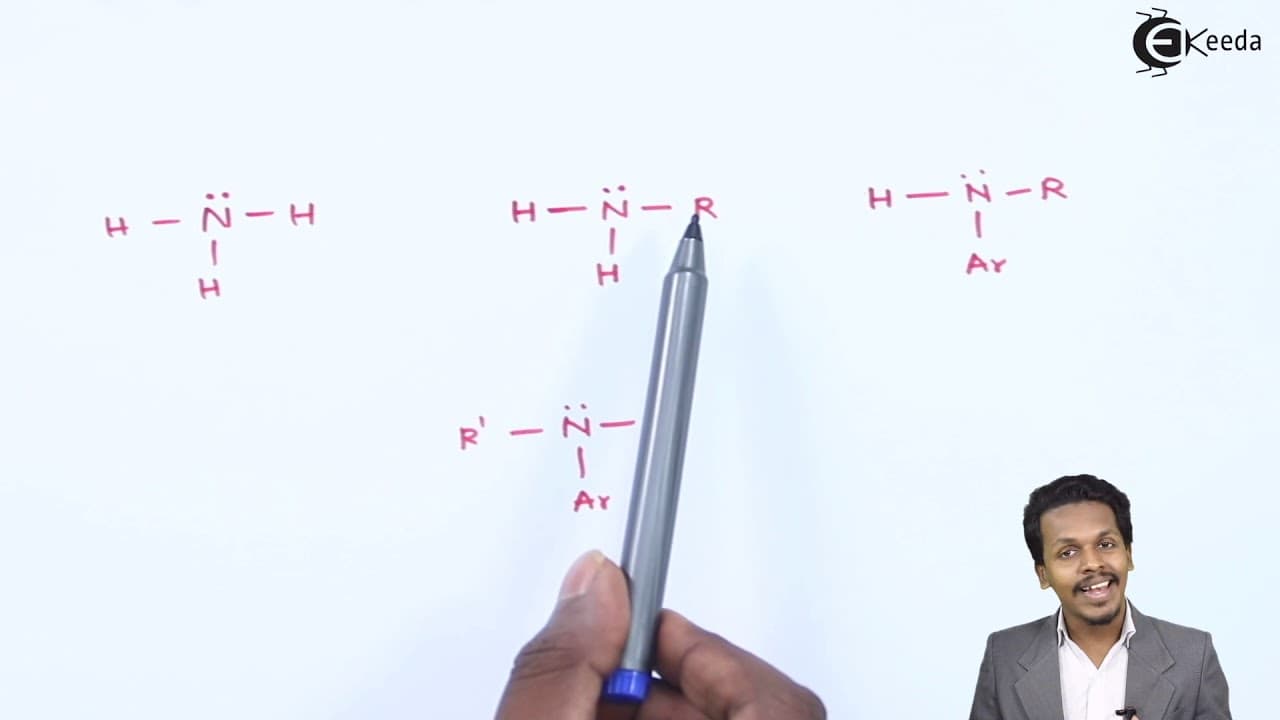
Amines are classified as primary, secondary, tertiary, or quaternary according to how many hydrogen atoms in ammonia or an ammonium salt are replaced by alkyl or aryl groups. One, two, and three replacements produce primary, secondary, and tertiary amines, while four replacements produce a quaternary amine. Secondary and tertiary amines may also be simple or mixed, so read on for the distinctions and examples.
Transcript
click the bell icon to get latest videos from equator references the previous lectures we have discussed about the Nitro alkane and that is nothing but the compounds that contain nitrogen and now we are going to talk about the mixture that is our minds so now let us understand what our minds every what is the classification of our minds can this to... Read More
Key Insights
- ❓ Amines are organic derivatives of ammonia, and amides are a subset of amines.
- 🫀 Amines can be classified as primary, secondary, tertiary, or quaternary based on the number of hydrogen atoms replaced.
- 🫀 Secondary amines can be further classified as simple or mixed, depending on the similarity of the alkyl groups attached to the nitrogen atom.
Install to Summarize YouTube Videos and Get Transcripts
Explore YouTube Video Summarizer or Get YouTube Transcript Extractor
Questions & Answers
Q: How are amines classified?
Amines are classified as primary, secondary, tertiary, or quaternary based on the number of hydrogen atoms replaced by alkyl or aryl groups. The four classes correspond to one, two, three, or four replacements, respectively.
Q: What is an amine?
An amine is described as an organic derivative of ammonia. It forms when one, two, or all three hydrogen atoms attached to nitrogen are replaced by an equal number of alkyl or aryl groups.
Q: What is a primary amine?
A primary amine forms when one hydrogen atom of ammonia is replaced by an alkyl or aryl group. Two hydrogen atoms remain attached to the nitrogen.
Q: What is a secondary amine?
A secondary amine forms when two hydrogen atoms of ammonia are replaced by alkyl or aryl groups. Both attached groups may be alkyl, both may be aryl, or one may be alkyl and the other aryl.
Q: What is a tertiary amine?
A tertiary amine forms when all three hydrogen atoms of ammonia are replaced by alkyl or aryl groups. The nitrogen is therefore attached to three replacement groups.
Q: What is a quaternary amine?
The lesson describes a quaternary amine, also called a four-degree amine, using an ammonium salt. It forms when all four hydrogen atoms of the ammonium salt are replaced by alkyl or aryl groups.
Q: What is the difference between simple and mixed secondary amines?
A simple secondary amine has two identical alkyl groups attached to nitrogen, while a mixed secondary amine has two different alkyl groups. Two methyl groups give the simple secondary amine named dimethylamine, whereas methyl and ethyl groups illustrate a mixed secondary amine.
Q: Can tertiary amines also be classified as simple or mixed?
Yes, the lesson says tertiary amines can also be divided into simple and mixed tertiary amines. The distinction depends on whether the groups attached to nitrogen are the same or different.
Summary & Key Takeaways
-
Amides are organic derivatives of ammonia in which one or more hydrogen atoms attached to nitrogen are replaced by alkyl or aryl groups.
-
Amines can be classified as primary, secondary, tertiary, or quaternary, depending on the number of hydrogen atoms replaced by alkyl or aryl groups.
-
Secondary amines can further be classified as simple secondary amines or mixed secondary amines, depending on the similarity or difference of alkyl groups attached to the nitrogen atom.
Read in Other Languages (beta)
Share This Summary 📚
Summarize YouTube Videos and Get Video Transcripts with 1-Click
Try YouTube Summary with ChatGPT & Claude or YouTube Transcript Generator
Explore More Summaries from Ekeeda 📚



Summarize YouTube Videos and Get Video Transcripts with 1-Click
Try YouTube Summary with ChatGPT & Claude or YouTube Transcript Generator