Jennifer Aaker: Power of Humor
TL;DR
Humor can improve creativity, health, and relationships by helping people relax, releasing endorphins, and making shared experiences more satisfying. In one creativity study, only 20% of participants who watched a neutral video solved the candle challenge, compared with three quarters of those who watched a funny video. Read on for the experiments, results, and implications for leaders.
Transcript
[MUSIC] Disneyland is a paradox because let's be honest it can be miserable. With long lines, expensive tickets and kids having meltdowns. When our family went there a few years ago my son Cooper later recalled the experience in our annual holiday card by recounting episodes of heat stroke and vomiting. Followed by a long, silent car ride home. Yet... Read More
Key Insights
- Humor reshapes difficult memories: The Disneyland story shows how laughter can coexist with heat stroke, vomiting, expensive tickets, long lines, meltdowns, and a silent trip home. Humor does not erase the difficult experience as it happens. It helps the negative moments fade afterward, making it possible for a family to sincerely want to return despite recalling what went wrong.
- Endorphins explain emotional endurance: Laughter releases endorphins that allow people to endure and even triumph over negative emotions and pain. This mechanism is offered as an answer to why stressful moments from family vacations become less prominent while happier ones remain memorable. The effect gives humor a role in both immediate tolerance and later recollection.
- Creativity depends on mental flexibility: The candle challenge required participants to stop seeing the tack box only as a container. They had to recognize that the box itself could hold the candle and keep wax from dripping onto the table. Humor helped participants notice this previously missed connection, illustrating how relaxed thinking can support a creative reframing of familiar objects.
- The performance gap was substantial: Only 20% of participants who watched the neutral video solved the creativity challenge, compared with three quarters of those who watched the funny video. The comparison ties humor to a specific difference in problem-solving performance. Aaker emphasizes that the better result did not mean the funny-video group had suddenly become more intelligent.
- Emotional safety supports discovery: The funny video allowed participants to relax and feel emotionally safer before attempting the candle problem. Humor loosened their minds, which helped them identify connections they had overlooked. The study therefore presents creative performance as partly dependent on a person's emotional state, not solely on knowledge or raw intellectual ability.
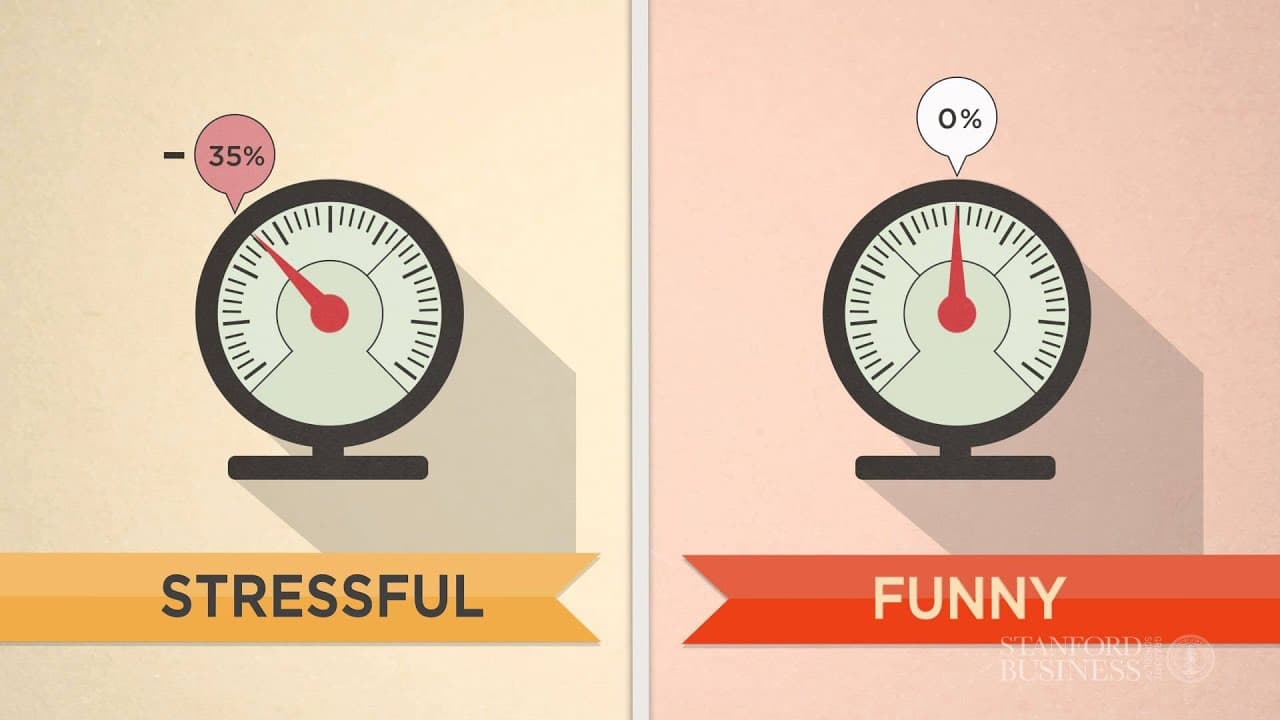
- Stress and comedy produced opposites: The blood-flow study compared responses to a stressful segment from Saving Private Ryan and a humorous clip from Kingpin. Blood flow decreased by 35% after the stressful scene but increased by 22% after the comedy. These opposing measurements make the health discussion concrete rather than relying only on participants saying that they felt better.
- The study separated its viewings: Participants watched two 15-minute movie segments 48 hours apart, with blood flow measured before the study and after each session. The stressful segment came first, followed two days later by the humorous one. This setup enabled Michael Miller and his colleagues to compare measured responses associated with sharply different kinds of viewing experiences.
- Shared laughter exceeds positive recall: Couples who reminisced about laughing together reported greater relationship satisfaction than couples who recalled shared memories that simply made them feel good about the relationship. Both tasks involved positive material, but laughter produced the stronger result. The distinction suggests that remembering mutual humor has a particular relational value beyond recalling positivity in general.
- Relationship effects involve participation: The couples did not merely watch comedy separately. They revisited moments in which they had laughed together, making shared experience central to the finding. Their higher satisfaction was measured after this act of reminiscence. The study connects relationship strength to jointly experienced laughter and the later recovery of that shared memory.
- Pain tolerance offers another measure: Robin Dunbar and his colleagues used a tightening blood pressure cuff to test how much discomfort participants could withstand. After participants watched either funny clips or a documentary, pain tolerance increased by 10% among the funny viewers. The result supports the proposed connection among humor, endorphin release, and increased capacity to tolerate pain.
- Humor has several linked benefits: The talk does not present creativity, health, pain tolerance, and relationship satisfaction as unrelated topics. Laughter's ability to create relaxation, emotional safety, and endorphin release connects the results. Across the cited studies, humor changes how people think, how their bodies respond, how much discomfort they tolerate, and how satisfied couples feel.
- Leadership requires permission for humor: Aaker does not recommend playing a favorite comedy clip whenever a meeting becomes tense. Her practical conclusion is narrower: leaders should allow humor to flourish whenever possible. This follows from evidence that humor can support creativity, health, and stronger relationships, all of which can positively affect the business world and make teams more appreciative.
Install to Summarize YouTube Videos and Get Transcripts
Explore YouTube Video Summarizer or Get YouTube Transcript Extractor
Questions & Answers
Q: How does Jennifer Aaker explain the power of humor?
Jennifer Aaker explains that humor can increase creativity, improve health, and strengthen relationships. Laughter releases endorphins, helping people endure negative emotions and pain while allowing difficult moments to fade in memory. Funny material can also promote relaxation and emotional safety, which helps people recognize connections they previously missed. Studies in the talk connect humor with higher creativity-task success, increased blood flow, greater pain tolerance, and higher relationship satisfaction. These effects explain why humor can matter in both personal life and the business world.
Q: What is the Disney Paradox, and how does laughter explain it?
The Disney Paradox is the tendency to remember a family amusement-park trip fondly despite its stressful or miserable moments. Aaker describes long lines, expensive tickets, meltdowns, heat stroke, vomiting, and a long, silent car ride home, followed by her son Cooper sincerely saying the family could not wait to return. Laughter helps explain this response because it releases endorphins that support endurance of negative emotions and pain. The ability to find humor in bad situations helps negative moments fade, leaving happy memories more prominent.
Q: How does humor improve creativity?
Humor improves creativity by helping people relax and feel emotionally safer. In Alice Eisen's study, participants watched either a neutral or funny video and then attempted a candle challenge using a candle, a box of tacks, and matches. Only 20% of the neutral group solved it, compared with three quarters of the funny group. The funny clip did not make participants smarter, but it loosened their thinking. That mental shift helped them see that the tack box itself could hold the candle.
Q: What did the blood-flow study find about funny and stressful movies?
Michael Miller and his colleagues showed participants two 15-minute movie segments 48 hours apart. Participants first watched a stressful scene from Saving Private Ryan, then watched a humorous clip from Kingpin two days later. Blood flow was measured before the study and after each viewing session. It decreased by 35% after the stressful clip and increased by 22% after the funny one. Aaker connects this striking contrast to the objective of achieving a better immune system.
Q: Why can shared laughter strengthen a relationship?
Shared laughter can strengthen a relationship because recalling it produced greater satisfaction than recalling other positive memories. Doris Pazini and her colleagues asked some couples to remember times when they laughed together. Other couples remembered shared experiences that made them feel good about their relationship. When satisfaction was measured afterward, the laughter group reported higher satisfaction. The comparison suggests that mutual laughter contributes something distinctive to a couple's sense of connection.
Q: How did researchers test whether laughter increases pain tolerance?
Robin Dunbar and his colleagues measured pain thresholds using a tightening blood pressure cuff wrapped around each participant's arm. The cuff was tightened until the participant said the discomfort had become intolerable. Participants then watched either funny video clips or a documentary. Pain tolerance increased by 10% among those who watched the funny material. The result supports Aaker's explanation that laughter releases endorphins, which can increase tolerance for pain.
Q: Does humor make people smarter?
The creativity study does not show that humor makes people smarter. Instead, the funny video helped participants relax and feel emotionally safer before solving the candle problem. This loosened their minds and made it easier to notice a useful connection they had previously missed. The difference matters because the improvement came from a changed mental state, not a claimed increase in intelligence. Humor supported more flexible use of what participants already had in front of them.
Q: How should leaders use humor at work?
Leaders should allow humor to flourish whenever they can. Aaker does not say they should play clips from a favorite comedy simply to break up every tense meeting. The recommendation is based on the broader findings that humor can support creativity, healthier responses, pain tolerance, and stronger relationships. Those benefits can have a positive effect in the business world. By making room for humor, leaders can create an environment their teams appreciate.
Summary
This video explores the concept of the Disney Paradox, where despite the potentially miserable experiences at amusement parks like Disneyland, people still look back on them fondly. The answer lies in the power of laughter, which not only helps us endure negative emotions but also has various positive effects. Laughter increases creativity, improves health, and strengthens relationships. It allows people to relax, opens up their minds, and helps them see connections they may have missed before. Additionally, laughter releases endorphins, which increase pain tolerance. Humor should be encouraged in both personal and professional settings, as it can have a positive impact on individuals and teams.
Questions & Answers
Q: Why do we tend to recall the happy moments rather than the sad or stressful ones from family vacations or similar experiences?
Laughter is one explanation behind this phenomenon. It releases endorphins that enable us to endure negative emotions and pain. Laughter has the power to make negative moments fade, allowing us to focus on the positive aspects of the experience.
Q: How does humor influence creativity?
Psychologist Alice Eisen conducted a study where participants had to solve a creativity challenge after watching a video. Those who watched a funny video were significantly more successful at solving the problem compared to those who watched a neutral video. Humor allowed them to relax, feel emotionally safer, and think more creatively by making new connections.
Q: What impact does humor have on health?
In a study, participants were shown a stressful movie clip followed by a humorous one. The participants' blood flow was measured before and after each viewing session, indicating the effects on their health. Blood flow decreased by 35% after the stressful clip, but increased by 22% after the funny clip. This suggests that humor has a positive effect on blood flow and overall health.
Q: How does laughter contribute to stronger relationships?
Couples in a study were asked to reminisce about times when they laughed together, while others were asked to recall positive memories about their relationship. The couples who reminisced about laughter showed higher relationship satisfaction compared to those who focused on positive memories. Laughing together creates a stronger bond and increases relationship satisfaction.
Q: Why is humor so powerful?
Laughter releases endorphins, which increase pain tolerance. In a study, participants' pain thresholds were tested by applying pressure until they couldn't tolerate it anymore. Afterwards, they watched either a funny video or a documentary. The participants who watched the funny video exhibited a 10% increase in pain tolerance. This demonstrates the power of humor in increasing pain tolerance and overall well-being.
Q: How can humor be beneficial in the business world?
Humor can have a positive impact in the business world as well. It can enhance creativity, improve health, and strengthen relationships among team members. Encouraging humor and allowing it to flourish within teams can lead to increased satisfaction, better teamwork, and improved outcomes.
Q: Should leaders incorporate humor into professional settings?
Yes, leaders should allow humor to flourish whenever possible. Teams will appreciate it and benefit from the positive effects of humor. However, it's important to remember that appropriate humor should be used in professional settings, rather than simply showing clips from favorite comedies in tense meetings.
Takeaways
Laughter has a profound impact on our lives. It helps us endure negative emotions, increases creativity, improves health by enhancing blood flow and pain tolerance, and strengthens relationships by fostering satisfaction and closeness. The power of humor should not be underestimated, and leaders should create spaces where humor can thrive, benefiting both individuals and teams.
Summary & Key Takeaways
-
Explaining the Disney Paradox: Disneyland can involve long lines, expensive tickets, children having meltdowns, and even miserable family experiences. Jennifer Aaker describes how her son Cooper recalled heat stroke, vomiting, and a long, silent drive home, yet still wrote that the family could not wait to return. Laughter offers one explanation for this contradiction. By releasing endorphins, it helps people endure negative emotions and pain, allows difficult moments to fade, and leaves happier memories more prominent.
-
Opening minds through humor: Psychologist Alice Eisen and her colleagues asked participants to watch either a neutral or funny video before attempting a candle challenge involving a candle, a box of tacks, and matches. Only 20% of the neutral-video group found the solution, while three quarters of the funny-video group succeeded. The funny clip did not make participants smarter. It helped them relax, feel emotionally safer, loosen their thinking, and recognize that the tack box could hold the candle.
-
Measuring effects on blood flow: Michael Miller and his colleagues showed participants two 15-minute movie segments, presented 48 hours apart. The first came from the stressful war movie Saving Private Ryan, while the second was from the comedy Kingpin. Measurements taken before the study and after each viewing showed sharply different responses. Blood flow decreased by 35% after the stressful segment and increased by 22% after the funny segment, a contrast connected in the talk to the objective of a better immune system.
-
Strengthening satisfaction between couples: Doris Pazini and her colleagues recruited couples and assigned them different memories to revisit. Some couples reminisced about occasions when they had laughed together, while others recalled shared memories that made them feel good about their relationship. Researchers then measured relationship satisfaction. Couples who remembered laughing together reported greater satisfaction than those who revisited positive relationship memories. The result suggests that shared laughter contributes something distinctive to closeness, beyond merely remembering an experience as positive.
-
Connecting endorphins to leadership: Robin Dunbar and his colleagues tested pain thresholds by tightening a blood pressure cuff around each participant's arm until the person could no longer tolerate it. Participants then watched either funny clips or a documentary. Pain tolerance rose by 10% among the funny viewers, supporting the explanation that laughter releases endorphins. Aaker closes by applying the findings to business: leaders need not interrupt tense meetings with comedy clips, but they should allow humor to flourish because teams will appreciate it.
Read in Other Languages (beta)
Share This Summary 📚
Summarize YouTube Videos and Get Video Transcripts with 1-Click
Try YouTube Summary with ChatGPT & Claude or YouTube Transcript Generator
Explore More Summaries from Stanford Graduate School of Business 📚






Summarize YouTube Videos and Get Video Transcripts with 1-Click
Try YouTube Summary with ChatGPT & Claude or YouTube Transcript Generator