How to Calculate Maximum Torque on a Current Loop
TL;DR
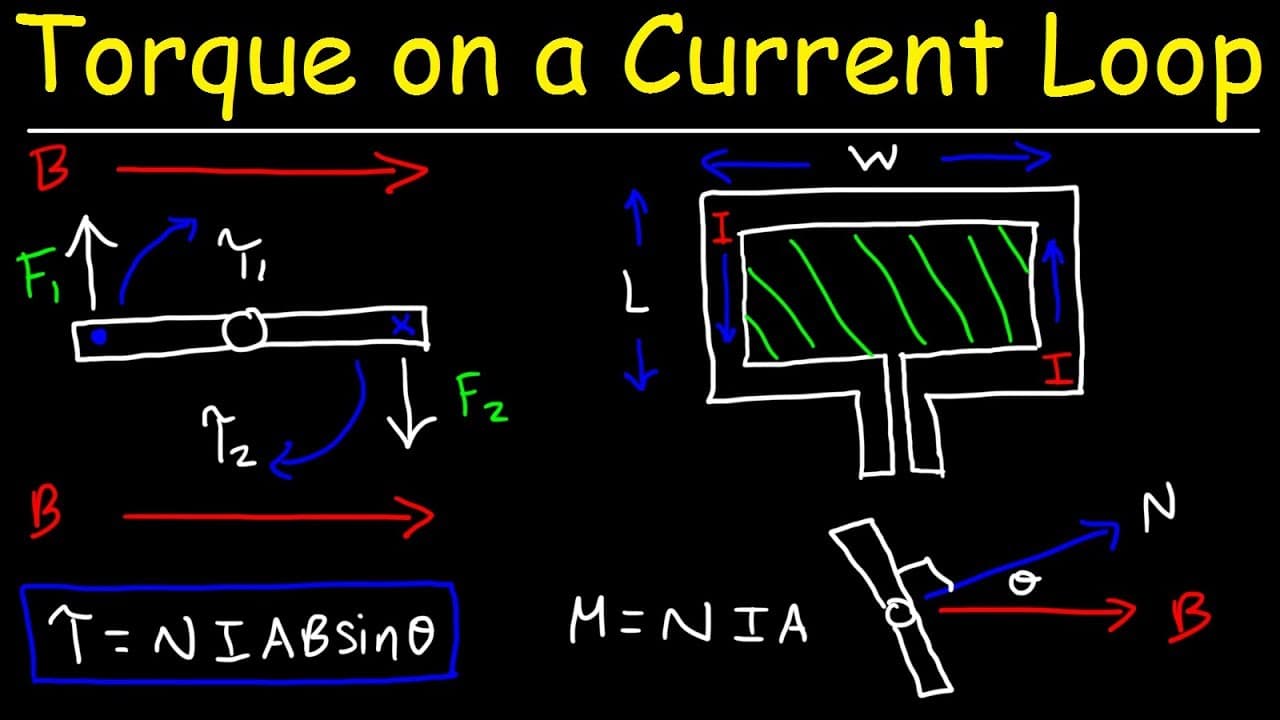
To calculate the maximum torque on a current loop, use the equation τ = n * i * A * B * sin(θ). In this case, with 20 loops, a current of 3 amps, an area of 0.01 square meters, and a magnetic field strength of 8 tesla, the maximum torque is 4.8 Newton-meters when the normal line is perpendicular to the magnetic field.
Transcript
a current of 3 amps flows through a square coil that's 10 centimeters by 10 centimeters and it has 20 loops of wires calculate the maximum torque that can be produced under these conditions at the instant the face of the coil is perpendicular to a magnetic field of a tesla so let's say this is the side view of the coil and let's say we have a magne... Read More
Key Insights
- 🔁 The net torque acting on a coil with multiple loops can be calculated by summing the individual torques produced by each loop.
- 🔁 The magnetic dipole moment of a coil can be calculated using the formula n𝑖𝐴, where n is the number of loops, i is the current, and A is the area of the coil.
- ✈️ The magnetic dipole moment is a vector and is always perpendicular to the plane of the coil.
- 🫱 The direction of the force on a coil depends on the direction of the current and the magnetic field, as determined by the right-hand rule.
- 🫥 The maximum torque of a coil occurs when the normal line of the coil is perpendicular to the magnetic field, resulting in an angle θ of 90 degrees.
- 🫥 The maximum torque can be calculated using the equation n𝑖𝐴𝐵sinθ, where n is the number of loops, i is the current, A is the area of the coil, B is the strength of the magnetic field, and θ is the angle between the normal line and the magnetic field.
- 🏑 The strength of the magnetic field, current, and number of loops all contribute to the overall torque produced by the coil.
Install to Summarize YouTube Videos and Get Transcripts
Explore YouTube Video Summarizer or Get YouTube Transcript Extractor
Questions & Answers
Q: How can the maximum torque of a square coil with multiple loops be calculated?
The maximum torque can be calculated using the equation n𝑖𝐴𝐵sinθ, where n is the number of loops, i is the current, A is the area of the coil, B is the strength of the magnetic field, and θ is the angle between the normal line of the coil and the magnetic field.
Q: What factors affect the maximum torque of a coil?
The number of loops, the current, the area of the coil, the strength of the magnetic field, and the angle between the normal line of the coil and the magnetic field all affect the maximum torque.
Q: How does the direction of the current affect the direction of the force on the coil?
The direction of the force on the coil depends on the direction of the current. Using the right-hand rule, if the current is going out of the page, the force is north. If the direction of the current is reversed, the direction of the force will also be reversed.
Q: When does the maximum torque occur?
The maximum torque occurs when the magnetic field is perpendicular to the normal line of the coil. In this position, the angle θ is 90 degrees, and sinθ is equal to 1, maximizing the torque.
Summary & Key Takeaways
-
A current of 3 amps flows through a 10cm by 10cm square coil with 20 loops of wires.
-
The maximum torque that can be produced when the face of the coil is perpendicular to a magnetic field of 1 Tesla can be calculated using the equation n𝑖𝐴𝐵sinθ.
-
The torque is a result of the magnetic force acting on the moving charges in the wire.
Read in Other Languages (beta)
Share This Summary 📚
Summarize YouTube Videos and Get Video Transcripts with 1-Click
Try YouTube Summary with ChatGPT & Claude or YouTube Transcript Generator
Explore More Summaries from The Organic Chemistry Tutor 📚


Summarize YouTube Videos and Get Video Transcripts with 1-Click
Try YouTube Summary with ChatGPT & Claude or YouTube Transcript Generator