Analyzing mistakes when finding extrema (example 1) | AP Calculus AB | Khan Academy
TL;DR
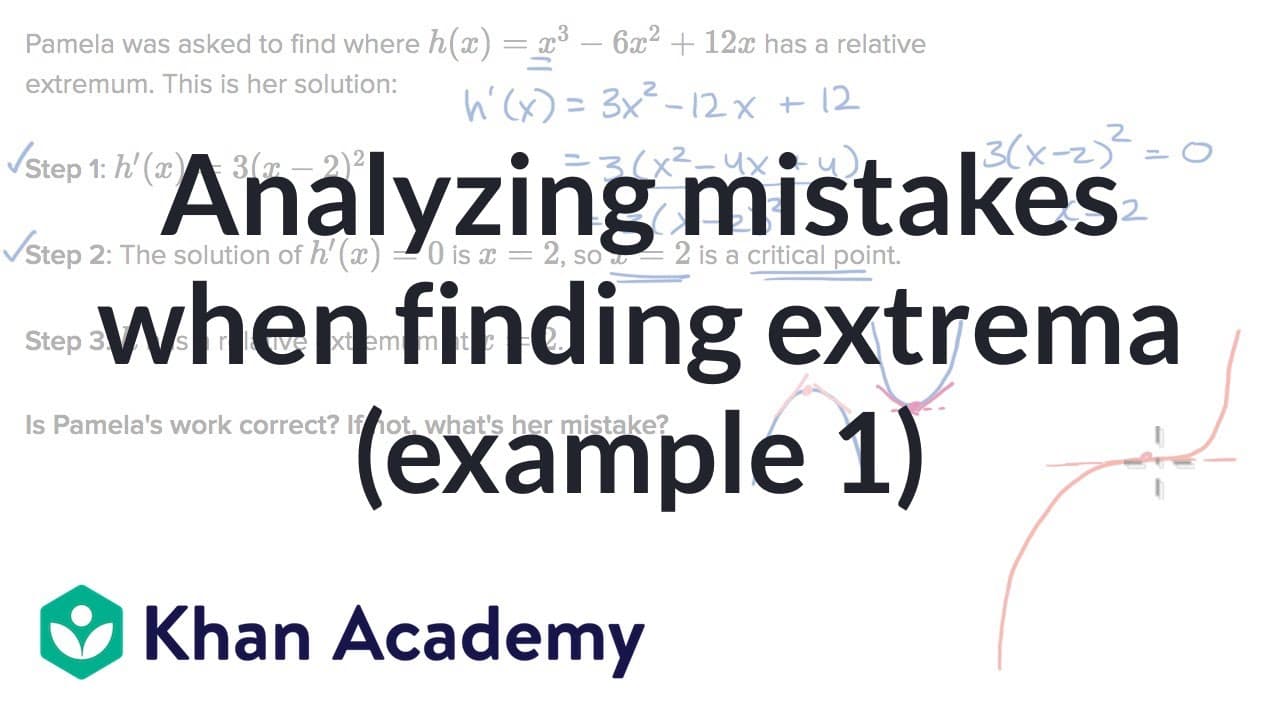
Pamela mistakenly concludes that a function has a relative extremum at x = 2 based solely on the fact that the derivative is zero at that point.
Transcript
- [Instructor] Pamela was asked to find where h of x equals x to the third minus six x squared plus 12 x has a relative extremum. This is her solution. So step one, it looks like she tried to take the derivative. Step two, she tries to find the solution, find where the derivative is equal to zero and she found that it happens at x equals two so she... Read More
Key Insights
- 😥 Taking the derivative of a function to find critical points is a crucial step in identifying potential relative extrema.
- 😥 Zero derivatives at a point indicate a critical point but not necessarily a relative extremum.
- 😥 Testing the function's derivative on either side of the critical point is necessary to determine if there is a change in slope and, thus, a relative extremum.
- 🥺 Making conclusions about relative extrema based solely on zero derivatives can lead to incorrect results.
Install to Summarize YouTube Videos and Get Transcripts
Explore YouTube Video Summarizer or Get YouTube Transcript Extractor
Questions & Answers
Q: What is Pamela's mistake in her analysis of finding the relative extremum?
Pamela's mistake is in step three, where she concludes that the function has a relative extremum at x = 2 based solely on the fact that the derivative is zero at that point.
Q: Why is it necessary to test the derivative on either side of the critical point?
Testing the derivative on either side of the critical point is necessary to determine if the function has a positive or negative slope before and after the critical point, which is crucial in identifying a relative extremum.
Q: Can a function have a zero derivative at a point without having a relative extremum?
Yes, there can be cases where the derivative is zero at a point, but the function does not have a relative extremum. This occurs when the slope changes from positive to negative or vice versa before and after the critical point.
Q: What is the correct way to identify a relative extremum?
To identify a relative extremum, one must test the function's derivative on either side of the critical point. If the slope changes from positive to negative (minimum) or negative to positive (maximum), then the function has a relative extremum at that point.
Summary & Key Takeaways
-
Pamela correctly takes the derivative of the function and finds that h'(x) = 3(x-2)^2.
-
She correctly identifies that h'(x) = 0 when x = 2, which is a critical point.
-
However, she mistakenly concludes that h has a relative extremum at x = 2 without further analysis.
-
To determine if there is a relative extremum, it is necessary to test the derivative on either side of the critical point.
Read in Other Languages (beta)
Share This Summary 📚
Summarize YouTube Videos and Get Video Transcripts with 1-Click
Try YouTube Summary with ChatGPT & Claude or YouTube Transcript Generator
Explore More Summaries from Khan Academy 📚



Summarize YouTube Videos and Get Video Transcripts with 1-Click
Try YouTube Summary with ChatGPT & Claude or YouTube Transcript Generator