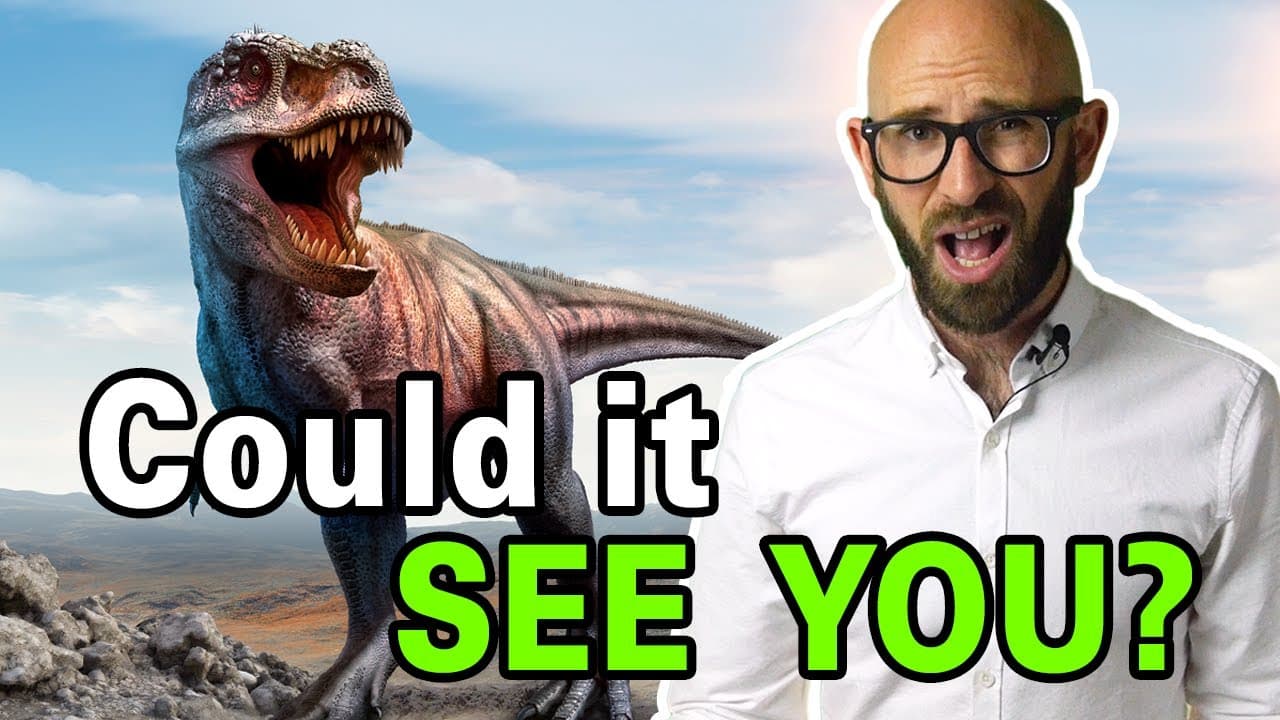
Could a T-Rex Really Not See You If You Don't Move?
TL;DR
The idea that a T-Rex couldn't see you if you remained still is false; they had excellent eyesight, potentially 13 times better than humans. Research indicates their vision was optimized for clarity and depth perception, allowing them to detect both moving and stationary objects effectively.
Transcript
In the immensely popular movie Jurassic Park, there’s the famous scene where the giant T-Rex is attacking a jeep during a thunder storm. As it attacks, Dr. Alan Grant, a self-respecting paleontologist, yells, “Don’t move! He can’t see you, if you don’t move.” Here’s the thing - that's wrong. (If that comes as a blow, you're definitely not going to ... Read More
Key Insights
- 🦖 Contrary to the movie, the T-Rex had excellent vision, possibly better than modern-day hawks and eagles.
- 🦖 Kent Stevens' research using digital technology and dinosaur models provided insights into the T-Rex's visual field, depth perception, and binocular range.
- 🦖 The T-Rex's head and eyes were structurally optimized for great vision, and their olfactory bulbs and nerves indicated a strong sense of smell.
- 🐦 Velociraptors were smaller and more bird-like than depicted in the movie, and they were likely solitary creatures, not pack hunters.
Install to Summarize YouTube Videos and Get Transcripts
Explore YouTube Video Summarizer or Get YouTube Transcript Extractor
Questions & Answers
Q: Was the statement made by Dr. Grant in the movie Jurassic Park about the T-Rex's vision actually referring to a frog's vision?
It's unlikely that the statement referred to a frog's vision because frogs can still see prey that doesn't move, and Dr. Grant's quote suggests that they used West African frogs that change sex, possibly the African reed frog.
Q: How good were the T-Rex's eyes really?
Based on Kent Stevens' research, the T-Rex may have had visual clarity up to 13 times better than a modern human, and their vision allowed them to see objects up to six kilometers away.
Q: Were Velociraptors as depicted in the movie Jurassic Park actually accurate?
No, Velociraptors were smaller than portrayed in the movie, about the size of a domesticated turkey. They had similarities to birds, such as hollow bones, feathers, nest-building behavior, and were likely solitary creatures.
Q: Why was the name "Velociraptor" used in the movie instead of "Deinonychus"?
Michael Crichton, the author of Jurassic Park, used the name "Velociraptor" because it was deemed more dramatic, even though the creatures in the movie were based on the larger Deinonychus.
Summary & Key Takeaways
-
The T-Rex had great vision and its binocular range was wider than even hawks, possibly better than modern-day hawks and eagles.
-
Research conducted by Kent Stevens using digital technology and dinosaur models confirmed the T-Rex's visual field, depth perception, and binocular range.
-
T-Rex's snout, cheek bones, and eyeballs were structurally primed for excellent vision, and their olfactory bulbs and nerves indicate a great sense of smell.
Read in Other Languages (beta)
Share This Summary 📚
Summarize YouTube Videos and Get Video Transcripts with 1-Click
Try YouTube Summary with ChatGPT & Claude or YouTube Transcript Generator
Explore More Summaries from Today I Found Out 📚


Summarize YouTube Videos and Get Video Transcripts with 1-Click
Try YouTube Summary with ChatGPT & Claude or YouTube Transcript Generator