How to Build a Cyber Threat Attribution Chain
TL;DR
Cyber threat attribution requires combining technical and human evidence to assign a malicious action to an actor, agent, or group. A credible attribution chain examines ownership, location, behavior, timing, attack stages, artifacts, affiliations, and intelligence from multiple sources while guarding against assumptions that turn limited evidence into unsupported claims about identity or intent.
Transcript
Hi, everybody. Thanks for coming out, uh I appreciate it. Thunderous applause. Thank you. Um, today we're gonna be discussing attribution chain analysis and what's required to establish, uh, chain analysis as it relates to attribution. Uh, my name is Will Gradwohl. I'm the senior manager of RSA First Watch for the Threat Research and Intelligence t... Read More
Key Insights
- Cyber threat attribution is the assignment of ownership of a threat, act, or action to a threat actor, agent, or group. It is a demanding analytical problem because credible ownership claims require evidence that connects technical events, human behavior, identity, location, and motivation.
- The internet is a difficult attribution environment because users can connect for different purposes without their identities or intentions being known with definitive certainty. Its enormous volume of data also makes comprehensive, simultaneous analysis of every relevant actor and event effectively impossible.
- Plausible deniability is strengthened by the internet's accessibility and usefulness as a hiding place. Broadband and mass communications support legitimate knowledge seeking, but the same accessibility allows malicious users to employ internet infrastructure as a means to accomplish harmful objectives.
- Cyberattacks threaten psychological certainty as well as assets, personnel, systems, and ecosystems. When confidence in security controls and risk assessments is weakened, analysts can lose perspective, making disciplined focus especially important during attribution and threat-actor profiling.
- Technical attribution includes machine ownership, asset ownership, and geographic location. These dimensions can help connect activity to infrastructure or places, but the broader attribution problem also requires human analysis of threat actors, agents, individuals, groups, and their aggregate identities.
- Human attribution addresses identity and behavior beyond technical infrastructure. Explanatory attribution asks why an actor attacks a target, while interpersonal attribution considers why events with multiple possible causes occur together and who may be responsible for them.
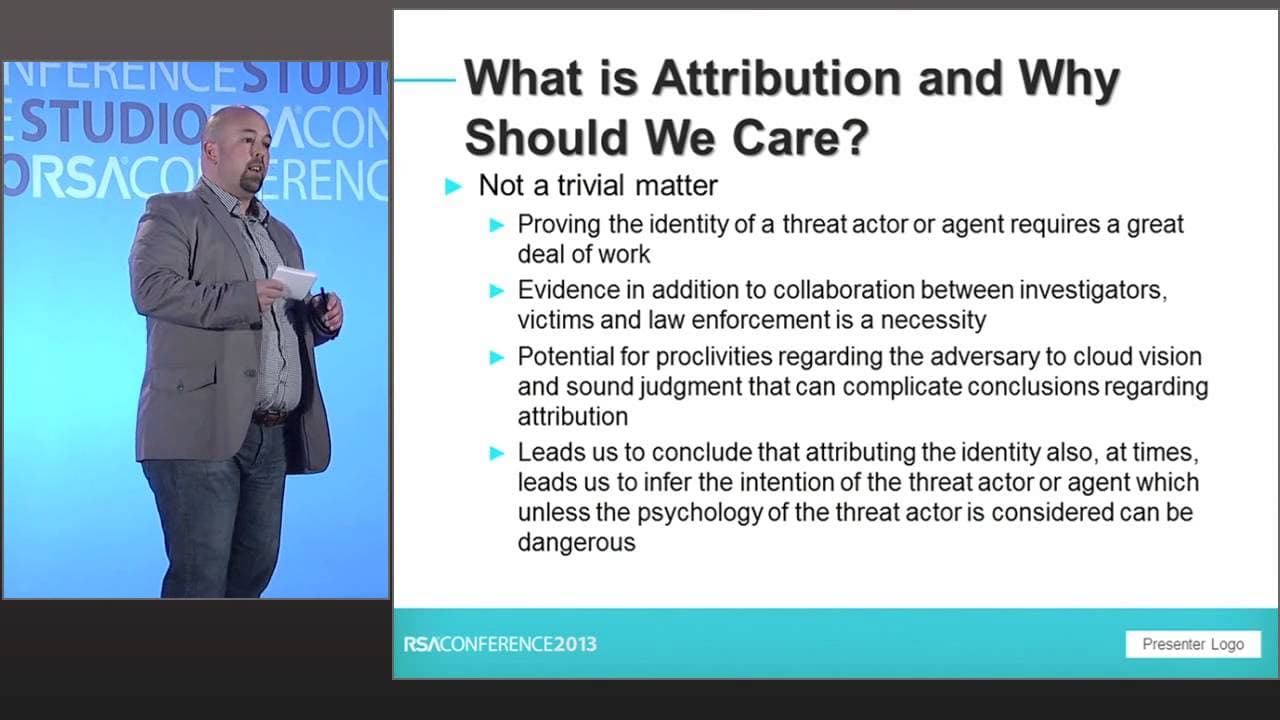
- Attributing identity can create an unsupported inference of intention. Analysts who rely on a small subset of data may mistake incomplete observations for a composite picture, especially when they lack sufficient understanding of an adversary's motives, behavior, and tactics, techniques, and procedures.
- A complete attribution inquiry considers who, what, where, when, how, attack frequency, campaign stages, indicators of compromise, evidence, artifacts, profiles, and affiliations. Collaboration across researchers, investigators, defenders, law enforcement, and governments is also necessary because no single perspective provides the entire picture.
Install to Summarize YouTube Videos and Get Transcripts
Explore YouTube Video Summarizer or Get YouTube Transcript Extractor
Questions & Answers
Q: What is cyber threat attribution?
Cyber threat attribution is the assignment of ownership of a threat, act, or action to a threat actor, agent, or group. It seeks to establish who or what is responsible by examining technical infrastructure, human identity, behavior, location, timing, evidence, and affiliations. The process is challenging and requires more than identifying a single machine, artifact, or apparent geographic origin.
Q: Why is cyber threat attribution so difficult?
Cyber threat attribution is difficult because the internet is described as a stateless environment in which identity, purpose, methods, and intent cannot always be known with definitive certainty. The volume of available data prevents complete analysis at one moment, broad access enables malicious participation, and the environment provides a strong hiding place that supports plausible deniability.
Q: Does identifying a cyber threat actor matter for defense?
Identifying the actor can matter alongside understanding the immediate threat. Focusing only on who conducted an attack may distract from what is happening, but focusing only on the attack can omit useful knowledge about the adversary. Understanding both the activity and the actor can help defenders interpret motives, tactics, techniques, procedures, campaigns, and possible affiliations.
Q: What are the main types of cyber threat attribution?
The two high-level types are technical attribution and human attribution. Technical attribution includes machine or asset ownership and location-based analysis from a geographic intelligence perspective. Human attribution addresses threat actors, agents, individuals, groups, and aggregate identity. A broader attribution chain connects these categories rather than assuming that one technical observation proves a human identity.
Q: What evidence should an attribution analysis examine?
An attribution analysis should consider who acted, what occurred, where and when it happened, how it was performed, and how frequently related activity appears. It can also examine attack stages, indicators of compromise, campaign patterns, evidence, artifacts, threat-actor profiles, and affiliations. These elements help form a connected assessment rather than a conclusion based on isolated data.
Q: How can assumptions distort cyber attribution?
Assumptions can distort attribution when analysts infer intention immediately after assigning an apparent identity. A small subset of evidence does not necessarily provide a composite picture of an adversary's actions or motives. Analysts must therefore maintain focus, recognize their own proclivities, and avoid treating partial technical or behavioral observations as definitive proof of responsibility or purpose.
Q: How does uncertainty affect cyber threat analysis?
Cyberattacks can undermine certainty itself by weakening confidence in assets, personnel, systems, ecosystems, threat posture, risk posture, and protective controls. This psychological effect can cloud perspective and clarity during attribution. Recognizing uncertainty as part of the attack environment helps analysts remain deliberate and avoid rushing toward conclusions when evidence is incomplete or ambiguous.
Q: Who needs to collaborate on a credible attribution chain?
Credible attribution can require collaboration among analysts, investigators, defenders, researchers, local and municipal law enforcement, federal law enforcement, governments, and other relevant parties across geographic boundaries. The process demands substantial time, work, energy, and evidence. Cooperation is important because technical, geographic, behavioral, investigative, and governmental perspectives each contribute different parts of the attribution picture.
Summary & Key Takeaways
-
Cyberattacks can originate from criminal groups, agenda-driven hacktivists, cyber mercenaries, or state-sponsored actors. Their effects can reach brands, enterprises, livelihoods, economies, and confidence in security controls. Because attacks undermine certainty as well as technical assets, analysts must preserve clarity and avoid allowing fear or assumptions to distort attribution judgments.
-
Attribution assigns ownership of a threat, act, or action to an actor, agent, or group. Establishing that assignment is difficult because the internet supports broad access, enormous data volumes, uncertain identities, and plausible deniability. Reliable analysis therefore requires extensive evidence, sustained effort, and cooperation among researchers, investigators, defenders, law enforcement, and governments.
-
A useful attribution methodology combines technological and human perspectives. Analysts can examine machine or asset ownership, geographic location, individual or group identity, attack frequency, campaign stages, indicators of compromise, artifacts, behavioral patterns, and affiliations. These linked observations can improve understanding of adversaries and support defensive planning without treating attribution as simple or definitive.
Read in Other Languages (beta)
Share This Summary 📚
Summarize YouTube Videos and Get Video Transcripts with 1-Click
Try YouTube Summary with ChatGPT & Claude or YouTube Transcript Generator
Explore More Summaries from RSAC Cybersecurity 📚






Summarize YouTube Videos and Get Video Transcripts with 1-Click
Try YouTube Summary with ChatGPT & Claude or YouTube Transcript Generator