How to Use the Second Derivative Test Effectively
TL;DR
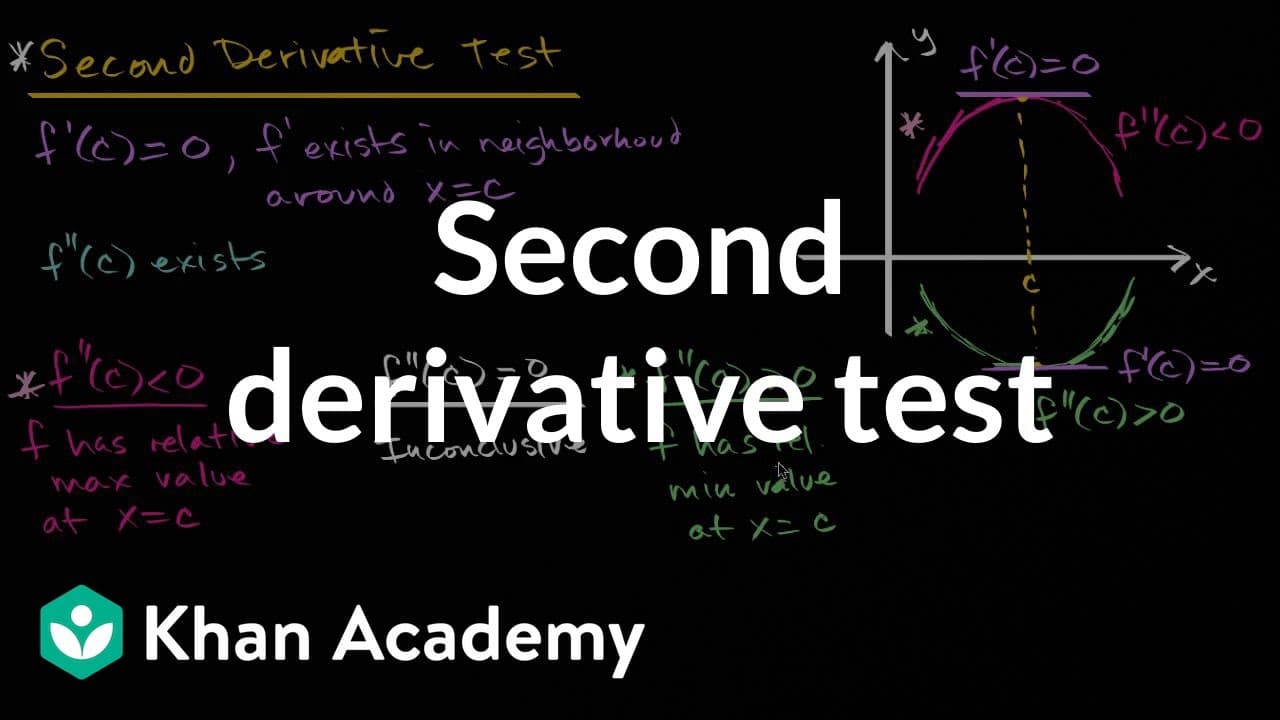
The second derivative test tells you whether a critical point is a relative maximum or minimum: at a point x=c where the first derivative f'(c)=0, check the second derivative. If f''(c) is less than zero the function is concave down and you have a relative maximum; if f''(c) is greater than zero it is concave up and you have a relative minimum; if f''(c)=0 the test is inconclusive. Read on for the concavity intuition and a worked example.
Transcript
- [Voiceover] So what I want to do in this video is familiarize ourselves with the second derivative test and before I even get into the nitty-gritty of it, I really just want to get an intuitive feel for what the second derivative test is telling us. So let me just draw some axes here. So let's say that's my y-axis, let's say this is my x-axis and... Read More
Key Insights
- 😒 The second derivative test uses calculus tools to analyze the shape of the graph and determine if a point is a maximum or minimum.
- 💁 The concavity of a function reveals information about the slope and curvature of the graph.
- 😥 A positive second derivative indicates an upward-opening bowl and a relative minimum point.
- 😥 A negative second derivative indicates a downward-opening bowl and a relative maximum point.
- 🏆 The second derivative test is applicable to twice differentiable functions and relies on the assumption that the first and second derivatives exist.
- 😥 If the second derivative is zero, no conclusion can be drawn about the nature of the point.
Install to Summarize YouTube Videos and Get Transcripts
Explore YouTube Video Summarizer or Get YouTube Transcript Extractor
Questions & Answers
Q: How do you do the second derivative test?
Start with a critical point x=c where the first derivative is zero, f'(c)=0, so the slope of the tangent line is flat there. Then evaluate the second derivative at that point. If f''(c) is less than zero you have a relative maximum, if f''(c) is greater than zero you have a relative minimum, and if f''(c)=0 the result is inconclusive. The function is assumed to be twice differentiable in a neighborhood around c.
Q: What does the second derivative test help determine?
It determines whether a critical point is a relative maximum or a relative minimum by analyzing the function's concavity. It applies to a twice differentiable function at a point where the first derivative equals zero. If the second derivative is negative you have a maximum, and if it is positive you have a minimum.
Q: What does a second derivative less than zero indicate?
A second derivative less than zero means the function is concave downward, like a downward opening bowl, in the neighborhood around the point. Combined with a first derivative of zero, this indicates a relative maximum point. The slope is decreasing as it passes through zero, going from positive to negative.
Q: What does a second derivative greater than zero indicate?
A positive second derivative means the function is concave upward, an upward opening bowl, and the slope is constantly increasing. At a critical point where the first derivative is zero, this indicates a relative minimum point. That point sits at the bottom of the bowl.
Q: What happens when the second derivative is zero?
When the second derivative equals zero, the second derivative test is inconclusive. You cannot make any strong statement about whether the point is a maximum, a minimum, or neither. The test simply does not tell you the nature of the point in that case.
Q: Can you walk through an example of the second derivative test?
Suppose H is twice differentiable with h(8)=5, H'(8)=0, and the second derivative at x=8 less than zero. Because the first derivative is zero and the second derivative is negative, the point (8, 5) is a relative maximum. If the second derivative had been zero it would be inconclusive, and if it had been greater than zero the point would be a relative minimum.
Q: What conditions must a function meet to use the second derivative test?
The function must be twice differentiable, meaning its first and second derivatives exist over the interval. You apply the test at a point x=c where the first derivative is zero, and you assume the derivative exists in a neighborhood around c. For most functions that are differentiable at c, this holds in a neighborhood around c as well.
Q: How do concavity and slope identify a relative maximum versus a minimum?
At both a relative maximum and minimum the slope of the tangent line is zero. The difference is concavity: a relative maximum is concave downward with the slope decreasing through zero, while a relative minimum is concave upward with the slope increasing through zero. The second derivative captures this, being negative for the maximum and positive for the minimum.
Summary & Key Takeaways
-
The second derivative test analyzes the concavity and slope of a function to determine if a point is a relative maximum or minimum.
-
A relative maximum point is characterized by a slope of zero and concavity decreasing towards the point, while a relative minimum point has a slope of zero and concavity increasing towards the point.
-
If the second derivative is less than zero, it indicates a relative maximum point, and if it is greater than zero, it indicates a relative minimum point.
Read in Other Languages (beta)
Share This Summary 📚
Summarize YouTube Videos and Get Video Transcripts with 1-Click
Try YouTube Summary with ChatGPT & Claude or YouTube Transcript Generator
Explore More Summaries from Khan Academy 📚



Summarize YouTube Videos and Get Video Transcripts with 1-Click
Try YouTube Summary with ChatGPT & Claude or YouTube Transcript Generator