What Are Uniporters, Symporters, and Antiporters in Cells?
TL;DR
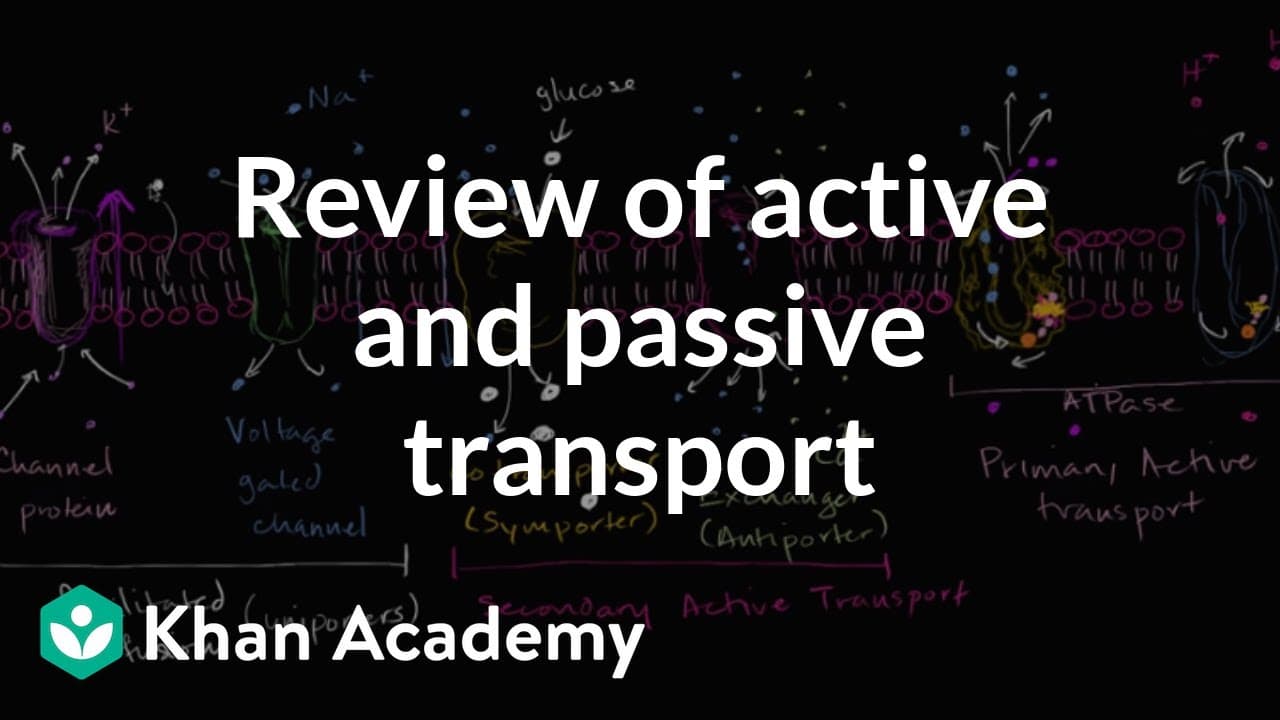
Uniporters, symporters, and antiporters are types of transport proteins that move molecules across cellular membranes. Uniporters transport a single molecule in one direction, symporters move two molecules in the same direction, and antiporters exchange two molecules in opposite directions. These mechanisms are crucial for maintaining cellular function and homeostasis.
Transcript
- [Voiceover] So let's talk about all of the different ways that molecules can be transported across a cellular membrane. So perhaps the most basic, the most passive of the passive transports would be straight up diffusion. And if you have a small enough molecule, let's say this is molecular oxygen. It's small, it doesn't have any charge, it has no... Read More
Key Insights
- 👻 Diffusion is the simplest form of passive transport, allowing small, nonpolar molecules to move down their concentration gradient.
- 🌥️ Facilitated diffusion involves channels or gated tunnels to help molecules with charge or larger sizes move down their concentration gradient.
- 😒 Primary active transport, like the sodium-potassium pump, directly uses ATP to transport molecules against their concentration gradient.
- 😑 Secondary active transport utilizes energy from an established gradient to transport other molecules, such as the sodium-glucose symporter or sodium-calcium ion exchanger.
- ❓ Symporters transport two substances in the same direction, while antiporters transport substances in opposite directions.
- ☢️ Different types of active transport are essential in maintaining cellular processes and establishing concentration gradients.
- 🖐️ Cellular membranes play a crucial role in regulating the movement of molecules and maintaining cellular homeostasis.
Install to Summarize YouTube Videos and Get Transcripts
Explore YouTube Video Summarizer or Get YouTube Transcript Extractor
Questions & Answers
Q: What is the difference between diffusion and facilitated diffusion?
Diffusion is the passive movement of small, nonpolar molecules down their concentration gradient, while facilitated diffusion allows molecules with charge or larger sizes to flow down their concentration gradient through channels or gated tunnels.
Q: What is primary active transport?
Primary active transport is the direct use of ATP to transport molecules against their concentration gradient. An example is the sodium-potassium pump, which uses ATP to pump sodium out of the cell and potassium into the cell.
Q: How does secondary active transport work?
Secondary active transport uses the energy from an established concentration gradient to transport other molecules. Symporters, like the sodium-glucose symporter, leverage the flow of sodium down its concentration gradient to transport glucose against its concentration gradient.
Q: What is the difference between symporters and antiporters?
Symporters transport two substances in the same direction, with one substance flowing down its gradient and providing energy for the other substance to be transported against its gradient. Antiporters transport substances in opposite directions, with one substance flowing down its gradient while another substance is transported against its gradient.
Summary & Key Takeaways
-
Molecules can be transported across cellular membranes through diffusion, which occurs when small, nonpolar molecules move down their concentration gradient.
-
Facilitated diffusion allows molecules with charge or larger sizes to flow down their concentration gradient through channels or gated tunnels.
-
Active transport requires energy and can be primary, where ATP is directly used to transport molecules against their gradient, or secondary, where the energy from an established gradient helps transport other molecules.
Read in Other Languages (beta)
Share This Summary 📚
Summarize YouTube Videos and Get Video Transcripts with 1-Click
Try YouTube Summary with ChatGPT & Claude or YouTube Transcript Generator
Explore More Summaries from Khan Academy 📚



Summarize YouTube Videos and Get Video Transcripts with 1-Click
Try YouTube Summary with ChatGPT & Claude or YouTube Transcript Generator