How Can Businesses Detect Manipulated Images?
TL;DR
Businesses should treat manipulated images, videos, and digital documents as a fraud risk because inexpensive editing tools can create convincing fakes that frontline staff may not detect. Possible defenses include training staff, strengthening verification processes, and registering media with checksums or a blockchain so organizations can identify originals and detect later tampering.
Transcript
Hello, and thank you for tuning in to my quick look presentation of the presentation at RSA twenty nineteen Asia Pacific and Japan called Fakes Aren't Funny. I'm Dr. Tom Keenan. I'm a professor at the University of Calgary in both the School of Architecture, Landscape and Planning, and also the Department of Computer Science. And I have a lifelong ... Read More
Key Insights
- Image manipulation is widely accessible because tools such as Photoshop, InDesign, GIMP, Pixlr, and Inkscape are available to ordinary users, sometimes free or inexpensive. Once an image has passed through a computer, even an experienced newspaper photo editor may be unable to identify alterations visually.
- Visual content is increasingly important on social platforms, where image-oriented services such as Instagram and Pinterest center communication on pictures. The presentation states that tweets containing images are thirty-four percent more likely to attract attention and be retweeted, increasing the possible reach of manipulated content.
- Political image manipulation is capable of changing the apparent meaning of authentic material. Examples include editing Emma Gonzalez to appear to tear up the United States Constitution and altering footage of Nancy Pelosi to make her seem to slur her words.
- Video manipulation can make recognizable people appear to say or do things that did not occur. The examples include Jordan Peele manipulating Barack Obama's image and altered footage intended to make CNN reporter Jim Acosta appear to hit another person.
- Digital documents create business risks because moving away from paper can leave organizations relying on images displayed on screens. Small businesses still use paper documents and checks, while frontline personnel may not receive adequate training to recognize fabricated or altered evidence.
- Insurance fraud can be supported by manipulated photographs submitted as evidence of property damage. A person claiming to have a flooded basement can send an altered picture, making image authenticity an important consideration when insurers evaluate claims remotely.
- Fake promotional materials can combine financial fraud with identity theft. Lowe's faced bogus fifty-dollar coupons presented in stores, while the website distributing those coupons was also described as a phishing site designed to steal identities.
- Blockchain registration is proposed as a way to track the origin and modification of images or videos. If competing versions are registered, the version recorded first could be treated as the original, although responsibility for operating such a system remains unresolved.
Install to Summarize YouTube Videos and Get Transcripts
Explore YouTube Video Summarizer or Get YouTube Transcript Extractor
Questions & Answers
Q: Why should businesses address image manipulation now?
Businesses should address image manipulation because widely available, inexpensive software allows people to alter photographs, videos, checks, invoices, coupons, and other documents in ways that can be difficult to detect. These fakes can support insurance fraud, phishing, identity theft, and unauthorized payments. Frontline staff may honor manipulated materials because they are not trained to identify them.
Q: How can manipulated images create insurance fraud?
Manipulated images can make an insurance claim appear supported by convincing visual evidence. The presentation gives the example of someone claiming to have a flooded basement, photographing the supposed damage, and sending the image to an insurer. Because image fakery has been used to assist insurance fraud, insurers cannot automatically assume that a submitted photograph accurately represents the claimed event.
Q: What makes modern image fakes difficult to detect?
Modern fakes are difficult to detect because computer-based editing removes many of the physical clues associated with older manipulation methods. A New York Times photo editor reportedly said that razor blade marks could once reveal where negatives had been joined, but after an image passes through a computer, visual detection may no longer be possible. Numerous accessible editing tools compound the problem.
Q: How does manipulated media affect politics?
Manipulated media can change how viewers interpret a political figure's words or conduct. The examples include footage edited to make Nancy Pelosi appear to slur her words, an image altered to show Emma Gonzalez tearing up the United States Constitution, and footage modified to make Jim Acosta appear to hit someone. Each alteration creates a misleading impression from visual material.
Q: How can deepfake-style videos misrepresent public figures?
Video manipulation can modify a person's mouth, apparent speech, or movements so that the person seems to say or do something that never happened. The presentation cites a demonstration in which Jordan Peele manipulates Barack Obama's image to produce statements Obama did not make. Such techniques make apparent video evidence less trustworthy when its source and history cannot be verified.
Q: How could blockchain help verify images and videos?
A blockchain could register an image or video and create a record for comparing later versions. In the proposed approach, when two competing videos exist, the version registered first would be treated as the original. The system could therefore help identify subsequent alteration or tampering. An unresolved question is whether a government, YouTube, or another organization should operate it.
Q: What business losses can fake documents cause?
Fake documents can cause losses when employees accept fabricated invoices, coupons, checks, or other visual records as authentic. The presentation describes a Canadian university losing hundreds of thousands of dollars because fake invoices were honored. It also cites bogus fifty-dollar Lowe's coupons, which reached stores through a website that was additionally used as a phishing mechanism for identity theft.
Q: How can businesses reduce risks from image manipulation?
Businesses can reduce risk by treating digital images and documents as potentially alterable, training frontline staff to recognize suspicious submissions, and adding verification controls before honoring claims, coupons, invoices, or other records. Technical measures such as checksums or blockchain registration may help establish provenance and expose tampering. Organizations should prioritize controls where manipulation could produce substantial financial losses.
Summary & Key Takeaways
-
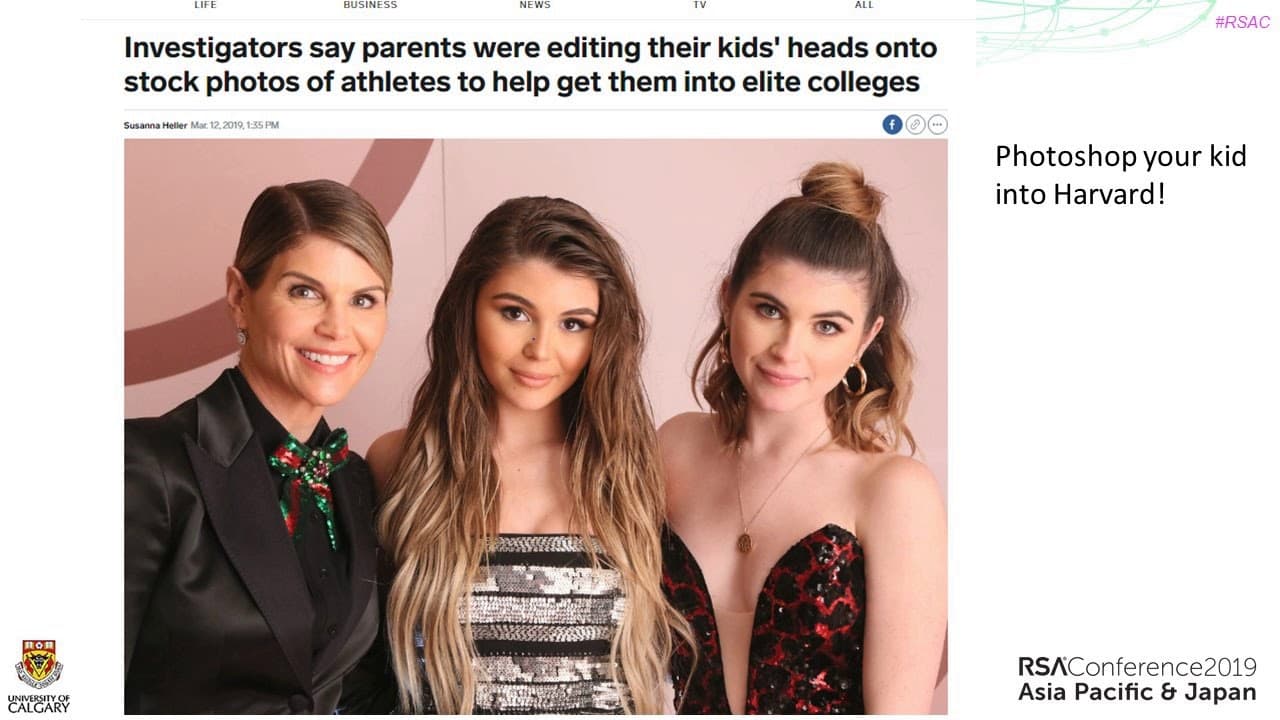
Image manipulation has become accessible because many editing tools are free or inexpensive, while computer processing makes alterations difficult to recognize visually. Examples include composite photographs, altered political videos, fabricated athletic images, and manipulated speech. The growing importance of visual content on social media increases the reach and potential influence of these fakes.
-
Businesses face practical risks when images replace physical evidence or support transactions. Manipulated photographs can assist fraudulent insurance claims, fake coupons can damage retailers and direct victims to phishing sites, and fabricated invoices can cause substantial financial losses. Frontline employees may be especially vulnerable because they often lack training in detecting altered materials.
-
Organizations can respond through both technical and procedural safeguards. A proposed checksum or blockchain system could register images and videos, establish which version appeared first, and reveal subsequent tampering. However, an organization such as a government or platform would need to operate the system, while businesses must decide which risks justify stronger controls.
Read in Other Languages (beta)
Share This Summary 📚
Summarize YouTube Videos and Get Video Transcripts with 1-Click
Try YouTube Summary with ChatGPT & Claude or YouTube Transcript Generator
Explore More Summaries from RSAC Cybersecurity 📚

Summarize YouTube Videos and Get Video Transcripts with 1-Click
Try YouTube Summary with ChatGPT & Claude or YouTube Transcript Generator